2017 was a bad year. I’d dress it up as something else if I could, but it’s kind of an any-way-you-slice-it situation. I’m talking personal life here, not games. But considering what a challenging, absolute beatdown of year it was for me, writing this list and playing these games was a nice break from reality.
Games-wise, this year was pretty great. I’ll detail that below. To any that take the time to read some of it, you have my sincere thanks.
Quick obligatory notes:
– This is a ranked Top 10 list with 3 honorable mentions (unranked).
– Each game features a link to one of my favorite pieces of music from its soundtrack. Feel free to listen as you read.
– I’m never able to get to all the games I’d like to by the end of the year. There are always ones that slip through the cracks. I typically like to list up front the games that I had the most interest in that I admittedly didn’t have time to get to. This year, my pile of shame is as follows:
Persona 5
Middle-earth: Shadow of War
The Evil Within 2
Splatoon 2
Cuphead
Now that that’s taken care of, on to the list…
Honorable Mentions:
Uncharted: The Lost Legacy – Naughty Dog

Hey, sue me. It turns out, I really like Naughty Dog games. Yes, this is the fifth entry in the Uncharted series, but hear me out here.
I admire The Lost Legacy for concentrating Naughty Dog’s strengths into a tighter, more focused experience. The Lost Legacy is 8 hours in length compared to Uncharted 4’s whopping 20. It focuses on a singular area of the world – namely the Western Ghats of India – and keeps its cast small and personal in scope, focusing on the backstories of Chloe Frazer and Nadine Ross.
India is a gorgeous and, in retrospect, obvious locale to set an Uncharted game. The wide palette of vivid colors, lush geography, and Hindu architecture come together to make this game my favorite in the series from a visual perspective.
It’s within this gorgeous area of the world that Naughty Dog pushes forward with design ideas established in Uncharted 4. Chapter 4 of this game is an entire sandbox level, similar to Madagascar in the prior game but greatly expanded in size and density of content. There are puzzles to solve, enemy encounters to stumble upon, and multiple directions to approach a given situation from. Hell, there’s even a map that Chloe will mark up with notes as you explore.
To play an Uncharted game that allows that kind open level design without sacrificing the kind of hand-crafted, finely-tuned content Naughty Dog has always excelled at is thrilling, and has me giddy about what they might do with The Last of Us 2.
But what steals the show here above all are Lost Legacy’s leads. Chloe and Nadine are an unlikely pairing, but serve as excellent foils for one another. Chloe is mischievous, even manipulative, with plenty of dry humor to boot. Nadine meanwhile, is no-nonsense, direct, and prideful in a good soldier sort of way. The times when their rough edges come into contact with one another, often bringing out surprising similarities between them, make for some of the best moments in the game. Compare this to wisecracking Nathan Drake and and slightly different wisecracker Victor Sullivan, or alt-wisecracker Sam Drake, and the difference in dynamic is immediately refreshing.
Uncharted: The Lost Legacy is more than just a look back at the highs of the series. It certainly is that, and one need look no further than its spectacular finale, a thrilling cross-section of Uncharted 2 and 4’s grandest, most ambitious sequences. However, the game is also quite a successful exercise in restraint. The Lost Legacy is the best paced Uncharted game, it’s lean with very little filler, and it proves that you don’t need Nathan Drake to make the whole thing work. Top that off with a splash of exciting gameplay concepts for the future, and yeah, I’ll take that fifth cocktail. It’s still seriously great.
Nier: Automata – PlatinumGames
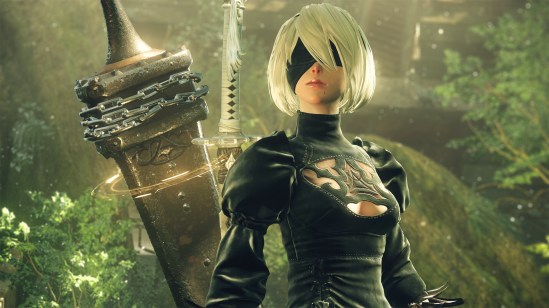
Nier: Automata is not the kind of game I’d normally be into. Character action games don’t usually do a lot for me, and neither do the typical designs and tropes of anime. And while I’ve got some serious reservations about parts of this game, there’s really nothing else I’ve ever played quite like it.
Nier: Automata is a game that takes particular joy in testing the constraints of the conventional video game. From its outset, combat is made up of character action swordplay as well as twin-stick shooter and a bit of bullet hell thrown in. At any point during the hack and slash fights, a button is bound to your floating robot pod’s gun. Hit the button and a continuous stream of gunfire is unleashed at wherever the camera is centered.
As you progress, Nier lets you start messing around with its mod-based upgrade system, which it designates as Plug-In Chips. Each Plug-In chip that provides a buff also comes with a size requirement to apply it. This leads to later game decisions like pulling out the Plug-In chip that allows you to see your own health bar, as well as other various pieces of your taken-for-granted HUD, in order to make room for more damage or healing buffs.
Finally, and where it gets most fascinating, is when Nier starts playing around with narrative and plot structure. The ending of Nier: Automata is merely the end of branch [A] of the story, after which the game switches protagonists and begins branch [B], which is an entirely separate campaign. I didn’t find this particularly exciting however, until I reached branch [C] of the story, at which point Nier: Automata really commits to a lot of the fourth-wall breaking, dark themes, and twisting plot points it had merely hinted at before. As the disparate elements of the game come together, the results are truly a thing to behold.
It’s final sequence, an artistic experiment equal in parts Hideo Kojima and We Are the World music video, is so abstract and out of left field that it shouldn’t quite work. However, it meshes excellently with the rest of the game’s themes about memory, sacrifice, and rebirth, and dammit if I just can’t stop thinking about it. It’s one of the most surreal and frankly bizarre endings to any video game of 2017, and for that, I kind of love it.
No one else is making games quite like Yoko Taro. At the start of the year, I wasn’t even aware of his work. Now, consider me a fan eagerly awaiting his next project.
Life is Strange: Before the Storm – Deck Nine

Life is Strange: Before the Storm probably shouldn’t have worked out. There was a lot working against this game from the start. Not only is it a prequel to the 2015 surprise hit Life is Strange, but it was being helmed by a completely new developer, one which I had personally never heard of before. Then, on top of that, this game was being made during the recent video game voice actor strike, so Ashly Burch was not reprising her role as Chloe Price, who was now being featured as the main protagonist.
Well, consider this déjà vu, because I didn’t expect much from the original Life is Strange back when it was released either, and yet it quickly became one of my absolute favorite games of that year.
Not only is Before the Storm successful in its role as a prequel, it may well be one of the best examples of one in gaming. It reminds me of all the reasons I fell in love with Arcadia Bay and its colorful cast of characters, while deepening my understanding of and attachment to several of them. Chloe Price was already an instantly loveable blue-haired punk rock chick before, but Before the Storm explores her painful history, re-contextualizing her as the series’ most complex and interesting character.
Before the Storm bears an interesting resemblance to David Lynch’s Fire Walk With Me, in that it examines the life of Rachel Amber, Life is Strange’s missing high school student and Laura Palmer analogue. It also largely eschews the supernatural elements of the storytelling in favor of raw empathy. As such, what we’re left with is a remarkably human story about the messiness of youth, about the budding relationship between Chloe and Rachel. This game excellently portrays the magical, not-quite-sober feeling of a teenage crush, and how the strength of that feeling can pull you towards a sort of righteous recklessness, as every other feeling seems unimportant by comparison. That feeling, as well as the melancholy of Chloe’s family situation, is underscored by an absolutely perfect original soundtrack by English indie folk band Daughter. Just like in 2015 with the original game, I’m still listening to Before the Storm’s soundtrack as I write this list. It’s great stuff.
The original Life Is Strange was about that sense of regret, of second-guessing, and about how even the smallest decisions, viewed across time, can become life-altering events. And if we could just go back and say something different, speak up when we were quiet, that maybe, just maybe, we could fix everything.
Before the Storm, by contrast as a prequel, is about the sense that, try as you might, the events of the world point toward a singular conclusion. We might change things along the way -maybe we don’t yell at our mom, maybe we do stick up for the kid being bullied, maybe we share that kiss- but the end result is always the same. Chloe’s dad isn’t coming back. Rachel will go missing and wind up murdered. Step-douche and mom are totally getting together, no question. Like any good tragedy though, Before the Storm is about finding beauty and meaning as it goes. It tells us that our choices in life don’t determine how we shape the ending, but how we tell the story along the way.
 defectivepixeltest