2019 was pretty sparse, relatively speaking, when it came to exciting game releases. It’s more clear than ever that we are entering a transition period, with the next generation of consoles on the horizon, game streaming and subscription services going mainstream, and the ubiquity of Steam being challenged on the PC distribution side. Several games got delayed or missed a 2019 window, setting up 2020 to be a wild year.
And yet, while 2019 was a slower year for releases, it was freed up enough to become one of the most surprising. Some of the games that did land during the calendar year were among the most unique I’ve played in years.
Quick obligatory notes:
– This is a ranked Top 10 list with 3 honorable mentions (unranked).
– Each game features a link to one of my favorite pieces of music from its soundtrack. Feel free to listen as you read.
– I’m never able to get to all the games I’d like to by the end of the year. There are always ones that slip through the cracks. I typically like to list up front the games that I had the most interest in that I admittedly didn’t have time to get to. This year, my pile of shame is as follows:
Fire Emblem: Three Houses
Star Wars Jedi: Fallen Order
Pokemon: Sword and Shield
Void Bastards
Sunless Skies
Now, on to the list…
Honorable Mentions:
Observation – No Code

Observation probably has the strongest elevator pitch of any game released in 2019:
It’s 2001: A Space Odyssey, but rather than play a human aboard a space station, you control the station’s AI. You are playing HAL, just with a slightly different name.
Flipping this science fiction trope on its head makes for excellent horror. You view the entirety of the space station through cold, grainy surveillance footage, cycling control between static security cameras and a mobile probe unit. Everything you see is filtered through a layer of analog video artifacts and fisheye distortion. The human left aboard the titular space station Observation, Dr. Emma Fisher, wanders its interconnected modules floating in microgravity.
Viewed through the slow-panning cameras of the Observation, she looks as alien as any extraterrestrial threat. At the same time, SAM, the AI you control, is given increasingly strange HUD text messages from an unknown source, saying things like “BRING HER”. The result is a game where you can’t trust the human astronaut, and you can’t trust yourself either.
It’s a great and chilling example of how games can immerse the player in a perspective, including those of the nonhuman variety. It reminds of the early days of fixed camera perspective survival horror, but reconstituted in a modern context. It’s very clever.
It’s a bit of a shame that Observation’s gameplay relies on mini-games in its crucial moments, but the slow dread that the game manages to build over its 3-4 hour story more than makes up for it. For every confusing puzzle interface to re-enable the station’s power there’s a moment of silent anticipation as you round the corner into an unknown module of the station.
And when Observation is at its most effective is in those moments where it gets out of its own way, letting visuals alone communicate something spine-tingling. One of the most horrifying moments in the entire game is communicated completely wordlessly; a slow zoom out that lasts for well over a minute and half. It’s masterful in its execution.
Sadly, Observation’s ending lands with a bit a dull thud; a clunky twist that feels at odds with the excellently paced and disciplined horror that came before. But, caveats aside, Observation is breath of fresh air for the horror genre, with enough new ideas and cinematic flair to be one of the most exciting and original games of 2019. Perhaps no game this year has a stronger commitment to player immersion.
And not to forget that title theme by Nine Inch Nails guitarist Robin Finck. Fucking awesome.
Untitled Goose Game – House House
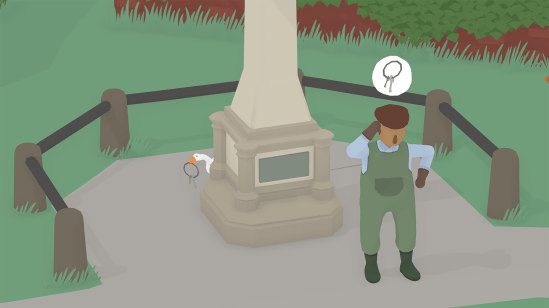
Don’t be fooled by its saccharine depiction of a quaint British village; Untitled Goose Game is a game about being a right fucking prick.
Technically, this is a puzzle game. Some objectives read like any other: “Get into the garden” or “Get someone to buy back their own stuff”. In practice however, you, as the goose, are less puzzle solving sleuth than you are neighborhood miscreant. Your puzzles are in fact things like untying a child’s shoes to make him trip, stealing his glasses thereafter. The puzzle for the man at the pub is to misplace so many of his tomatoes that you have time to drop a bucket on his head from above while he’s tidying up.
In Untitled Goose Game, you play an irritant for irritation’s sake. You play an avian anarchist with no regard for polite society or personal property. You are the villain in every sense. These people have done nothing wrong. And yet, you have no choice but to be a nuisance. You must sneak up behind people and honk to scare them. You must break valuable pottery because, if not you, then who? You must steal the town’s prized bell, because wow, you could be really noisy if you were running around with that bell.
In this sense, Untitled Goose Game is the quintessential goose role-playing experience. You might not have realized you wanted to inhabit the life of a goose, but you do. You want to be the goose, and the goose wants to do crimes.
A Plague Tale: Innocence – Asobo Studio

If you hate to see depictions of children in danger, then French developer Asobo Studio’s latest game will be an absolute endurance test for you.
Set in France in 1348, the game features two siblings – Amicia and Hugo de Rune – forced to flee their family estate after their parents are brutally killed by English soldiers. As the two flee into the countryside, they discover pestilence all around them – entire villages of sick and dead, rats gathering in swarms by the thousands. Nowhere is safe.
Something I love about the way this game handles historical fiction is in the subjective way it presents it. Amicia and Hugo have no larger context for what is happening around them, not the just-beginning Hundred Years’ War nor a name for the Black Death which is beginning to ravage European civilization. It is presented as the harrowing experience of a 15-year-old girl and her 5-year-old brother, fighting against the odds just to survive the chaos all around them.
On the gameplay side of things, what stands out the most about A Plague Tale is how each chapter of the game slowly spools out more and more mechanics. While the early game might seem like basic stealth – throw rocks to distract soldiers and avoid pits of rats like hot lava – by the mid and late-game, the designers begin adding in ways to manipulate and even invert their various systems they’ve spent time teaching you.
For example, one of the first lessons the game teaches you is that the rats hate light, so lighting torches is your best way to create safe havens for yourself in the environment. The enemy soldiers know this too, however, and often carry light sources of their own. You can simply slip by them unnoticed if you have good timing, but you learn later that you can extinguish their torches as they trudge across a river of rats, causing them to be devoured in moments. It’s horrifying, but such is the desperate state of this world. As you progress, you come across even more ways of manipulating the game’s systems to your advantage.
It’s all methodically paced out within the story. Just when you think you’ve seen all the game has to offer, it manages to surprise yet again. And the way these new gameplay mechanics are tied to revelations in the narrative are excellent – quintessential game design.
A Plague Tale: Innocence was one of the most surprising games of the year for me. Coming out of a studio I’d never heard of before, the game is considerably polished and gorgeous in its own right, complete with a haunting score by French composer Olivier Deriviere (who has become a new favorite of mine). There’s clearly a lot of talent at Asobo, and if A Plague Tale has proven anything it’s that this is a developer to watch very closely in the near future.
 defectivepixeltest