If there ever was a year of the indie game, it really does feel like 2025 is that year. Practically everything I played the entire year was from a small or mid-sized studio, and AAA stuff was more few and far between as it feels like it’s ever been.
It’s exciting—even as we’re seeing more and more post-pandemic fallout blow through the games industry, combined with a litany of layoffs and corporate consolidation—it feels like there’s more and more room on the margins for passionate creators to get their stuff out there. Hopefully that continues to hold true into 2026 and beyond, as consumer electronics hardware faces some serious headwinds to its continued price viability.
Anyway, no time to think about all that scary business! Let’s get into my personal favorite games of the year.
Real quick, a couple disclaimers –
Quick obligatory notes:
- This is a ranked Top 10 list with 3 honorable mentions (unranked).
- Each game features a link to one of my favorite pieces of music from its soundtrack or to a clip of the game. Feel free to listen as you read.
- I consider the release timing of Early Access games based on when they exit Early Access, or enter V1.0.
- Remakes (which are becoming even more common these days) can be on my lists, but only if they are substantial enough in that the game is something fundamentally different. Examples of games I counted in 2019 were Pathologic 2 or Resident Evil 2. In 2020, I didn’t consider a game like Demon’s Souls (even though I loved it) because it is mostly a visual overhaul to the 2009 original game. Hopefully that distinction makes sense and isn’t just arbitrary to you.
Pile of Shame (games I didn’t have time to play this year):
- Kingdom Come: Deliverance II
- Vampire: The Masquerade – Bloodlines 2
- Hell is Us
- Ghost of Yotei
- Battlefield 6
Okay, with that out of the way, on to the list…
Honorable Mentions:
Routine – Lunar Software
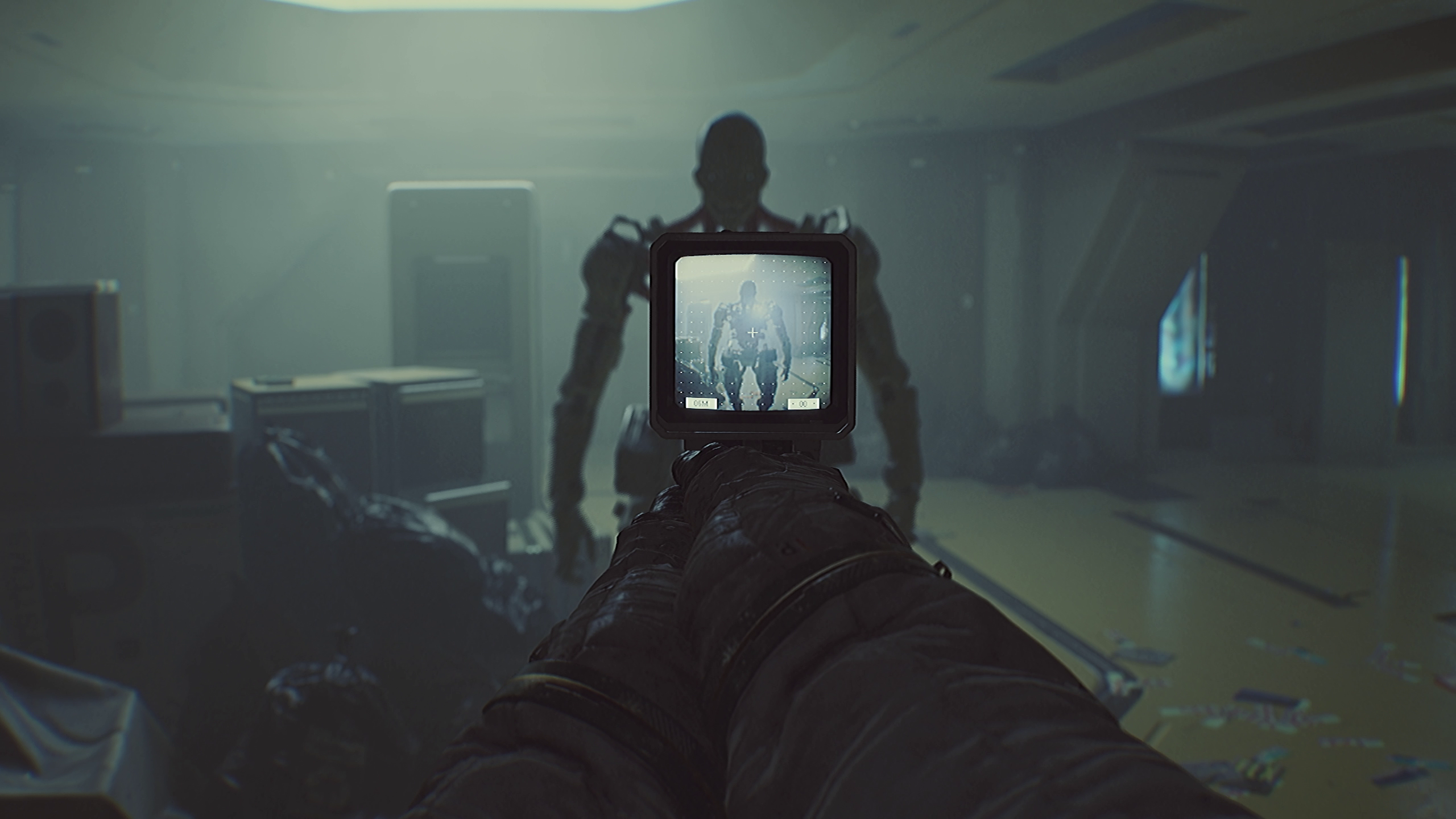
Excuse me, sir. Could you perhaps chill while I degauss my display?
Routine Intro – NJ Apostol
The fact that I’m getting the opportunity to write about Routine at all still blows my mind. This game originally caught my eye all the way back in 2012, when myself and a college buddy first caught a glimpse of its Steam Greenlight page—a Valve initiative to gauge user interest that felt huge at the time, but is now all but ancient history. Back when Routine was first announced, horror games like “Amnesia: The Dark Descent” were still very much in the popular consciousness. This was a world before P.T., before RE7, before Alien: Isolation. A lot has changed in the horror gaming landscape since those halcyon days. So what in the world does a horror game look like after thirteen years of development hell? Well, if Routine is any indication, then the answer is: pretty fucking scary.
Routine is premised on an alternate 1980s vision of the future – a world where we got lunar resorts on the moon, complete with their own shopping malls, where we got handheld computers, but with sub-10Hz CRT displays that needed a dedicated “degauss” button—look that one up, kids. Routine’s embrace of analog technology runs deep – the entire game is presented through a thick postprocessing filter that feels like the stuff of 8 and 16-bit console emulators. Thanks to this , Routine tends to obliterate the amount of detail you’d expect from a modern UE5 game on a 4K panel. That tradeoff, though pretty jarring at first, ends up contributing to a vibe that horror games used to have, albeit by necessity—you can’t reliably make out the finer detail of the things that are hunting you, and that lack of information does trigger your fight-or-flight response that much more. On top of this, Routine’s main defensive and puzzle-solving tool, the C.A.T., is an intentionally clunky device to use, forcing you to fumble with in-game buttons on the side of it, all while a threat is closing in on you. It calls back to old-school horror titles, where the cumbersome controls required you to play out a whole scenario on your controller just to fight back—and do it all under extreme duress.
Routine starts off very simply. You wake up in Union Plaza, the aforementioned lunar resort, and the game teaches you some basic movement controls before turning you lose completely. After the first room, Routine will not be holding your hand any further. This becomes very clear, very quickly the first time you encounter one of the Type-05 robots and find yourself needing to learn under pressure. While most horror games typically allow the player time to familiarize themselves with an environment and its puzzles before ratcheting up the tension, Routine violates this design philosophy, oftentimes asking the player to solve puzzles while under the proverbial gun. There were multiple times in this game that I had to ditch out of a computer console I was investigating to deal with a Type-05 that was marching right up behind me. It’s been a while since I’ve played a horror game where I couldn’t count on the presence of a puzzle being a signal that I was currently in a safe room. To not be able to rely on that is intense.
This is made all the more effective by the top-tier sound design. Apparently Mick Gordon worked on this project for a while as a sound designer before handing the reigns over to current Audio Lead NJ Apostol. Well, regardless of which of them is responsible, I can safely say the scene where the Type-05 is first introduced really fucked me up, in the best way possible. Even more sinister is the gameplay conceit that only one Type-05 can be “active” at any point, making for some tense moments where you try to slink past a handful of inactive machines, only to have one of them loudly sputter to life right behind you.
There’s more to Routine than meets the eye. It has an atypical structure, with an absolutely diabolical Act 2 reveal that caught me off-guard in a big way. It’s a brief experience, but excellently paced. It’s perhaps the scariest game I’ve played since 2020’s Visage. I don’t know if any game is worth a 13 year wait, but I was positively giddy to find that Routine—while not the open-ended game it was originally pitched as—actually ended up as something I loved playing through.
Atomfall – Rebellion Developments
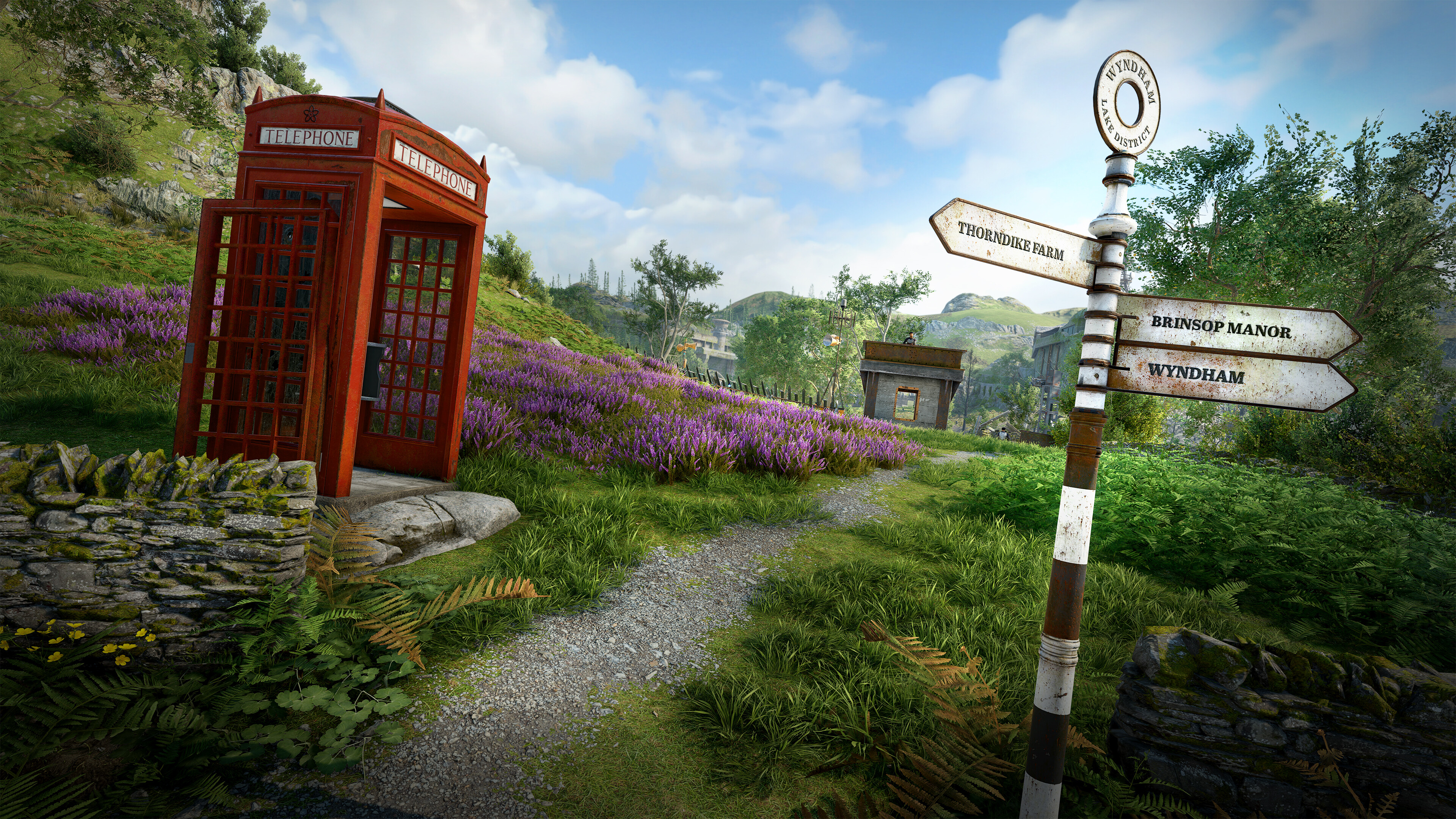
The obligatory Red Phone Booth—in case things weren’t British enough for you.
Credits – Graham Gatheral
Atomfall is based on an alternate British history in which the 1957 Windscale fire nuclear disaster—the worst in the UK’s history—was even more of a total cock-up than it already was. Instead of burning for 3 straight days and releasing radioactive fallout across Europe, it instead resulted in irradiated monsters, reports of people hearing voices, the formation of cults, and an indefinite government quarantine. You know, the usual suspects of the dystopian video game genre. On the surface, you might think this is Fallout: New Birmingham, and well, you’d be half-right. There’s certainly some of the DNA of Fallout: New Vegas running through the heart of Atomfall, but mostly in a structural way. This isn’t a huge, open-world RPG. It’s more condensed—smaller in scope as well as mechanics—but laser-focused on exploration and nonlinear design.
That unique structure is the singular differentiator for Atomfall. From the outset, your goal is pretty clear—get inside “The Interchange” and find out what the government is hiding there—but the way in which you carve a path through the game to achieve that goal is completely freeform. There isn’t any objective marker, or even a traditional quest log, to guide you. Instead, you rely on a journal of leads—which functions like a collection of threads you can tug at to make progress. This makes for a much more organic quest structure, where you can suss out information through dialog with NPCs, exploration of the environment, by bartering with merchants, or simply by accident—if you somehow manage to Forrest Gump your way into key locations.
The layout of the map itself is also a key component of this. The game world is divided up into 5 distinct playable areas, each of which is a large open space with numerous pathways between one another. No matter what, you will start your playthrough in Slatten Dale—a scenic locale showcasing Britain’s distinct green rolling hills, now rife with raiding parties and bombed out infrastructure—and you will end the game in The Interchange—a massive WWII-era bunker and research complex, with Metroidvania-esque shortcuts connecting it to each and every other playable area. There’s no fast travel here, so finding your own personal routing to traverse the map safely and efficiently is a big part of what makes Atomfall’s exploration so engaging.
Atomfall is the type of game that harkens back to the 7th generation of video game consoles, both in ways that are refreshing and in some less so. The combat is serviceable, but nothing to write home about. The environments look great, but can get pretty same-y looking if you really go deep with the exploration. Even the story is pretty wrote and predictable. That said, there is something about the way this game throws you the keys and then rightly fucks off, leaving you in charge of how you want to play it that is hugely welcome.
Elden Ring Nightreign – FromSoftware
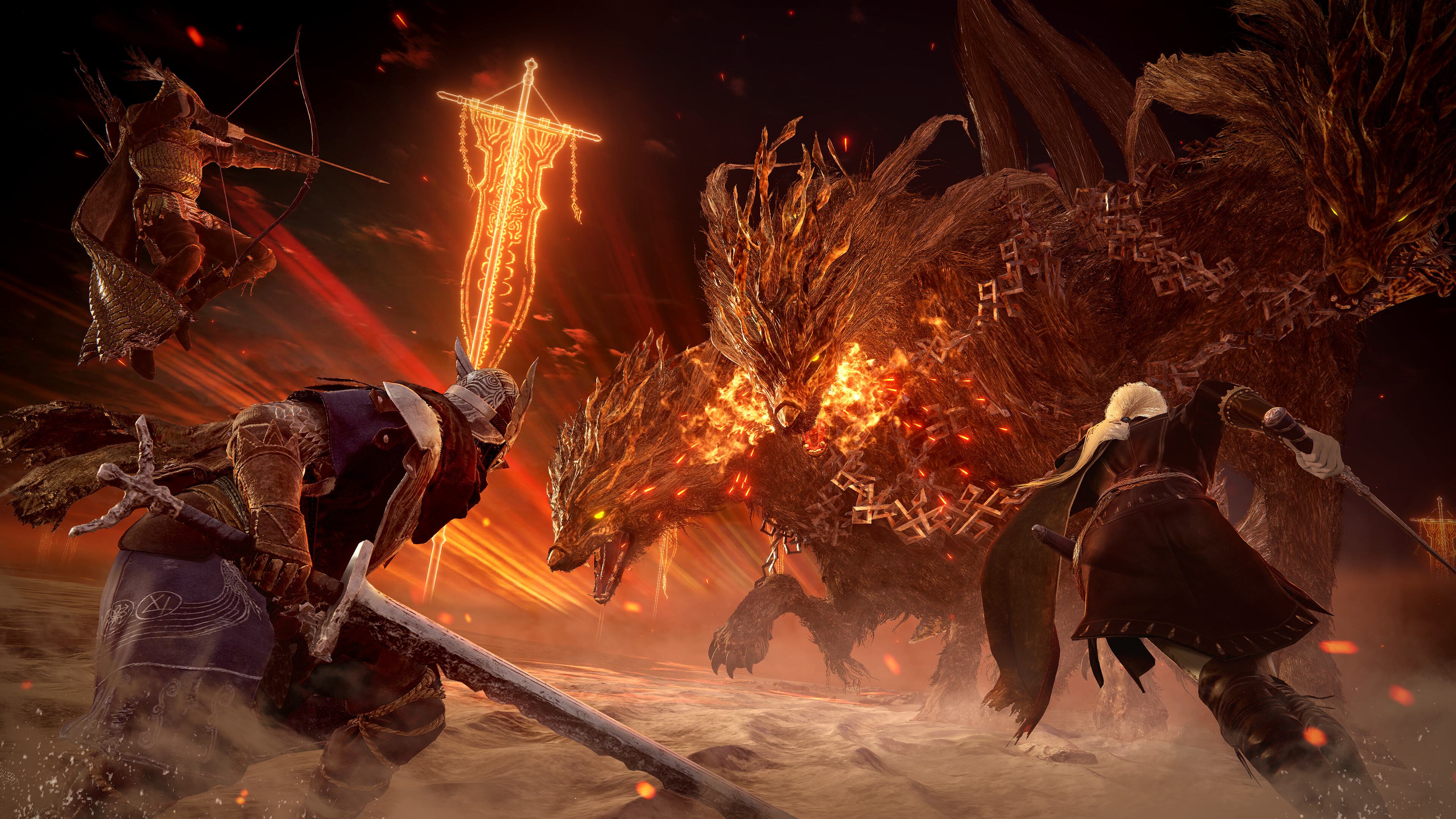
Do you guys think Let Me Solo Her plays this game?
The Shrouded Roundtable Hold – Shoi Miyazawa
On the surface, the concept for Elden Ring: Nightreign is a strange one. It lifts the core combat of Elden Ring and grafts it onto a time-limited, PvE-only multiplayer extraction framework reminiscent of Fortnite or PUBG, then layers on a hero-shooter structure, complete with unique abilities and even ultimates in the vein of Overwatch. For a studio like FromSoftware, whose ambitions have traditionally been obsessively inward-facing, focused on perfecting a subgenre they themselves created, Nightreign feels startlingly reactive to broader industry trends. And yet it’s still unmistakably a FromSoft game, with all the hyper-specific eccentricities that implies—and, more importantly, it’s just a genuinely great time with friends.
When the rubber meets the road, Nightreign still plays like Elden Ring—just with the seats, radio, and air conditioning stripped out, all in the name of going fast. Your character stats are reduced to basic letter grades, sprinting speed is cranked to 11, and leveling up is done in a single button press. For some, this aggressive streamlining of the Elden Ring formula may be a bridge too far. I was genuinely overwhelmed during my first few runs as I tried to learn the map, the loot, and the traversal mechanics while scrambling to keep up with my far more experienced teammates. It often feels as if Nightreign took its cues from Elden Ring’s speedrunning community, and the result is a brutally steep learning curve right out of the gate.
It’s worth sticking with Nightreign through that initial uphill climb—at least to get to the Nightlord bosses that cap off each run. These are seriously excellent fights, made even better because they are actually balanced around a trio of players. You can technically fight these guys solo like an unrepentant tryhard (their HP scales accordingly), but I don’t recommend it. For the first time in FromSoft history, cooperative play doesn’t feel like cheating or trivializing a tough boss—it’s the intended experience, and it’s worth embracing that fact.
One of my favorite aspects of Nightreign is how certain character classes harken back to the unique styles and mechanics of past FromSoft games. Take the Duchess, one of my personal favorites: she evades with a swift double quickstep instead of roll dodges and wields a diabolical ability to replay the last 3 seconds of damage to all nearby enemies, setting her up for filthy riposte-focused builds. If her Lady Maria-esque fashion doesn’t immediately give you Bloodborne, her high mobility and her kit certainly will. Then there’s the Executor, an armor-clad, katana-wielding Dex/Arcane class who specializes in deflecting attacks with his blade—if you ever mourned Sekiro’s lack of multiplayer, this character is a humble apology from Miyazaki to you. And just to shout it out, I loved playing Ironeye—it’s the first time in a FromSoft game where playing an archer felt both fun and totally viable.
The love letter to fans extends to the boss battles too. I can’t even tell you how much I freaked out when my friends and I assembled for a Night 2 boss fight, only to see the health bar for Nameless King pop up at the bottom of my screen—one of the coolest gaming moments from all of 2025, hands down. There are other certified classics for the oldheads out there, like everyone’s favorite psychosexual nightmare from Dark Souls, Gaping Dragon, and The Duke’s Dear Freja from Dark Souls II—a boss whose double-ended design actually makes a lot more sense in co-op. Is it fan service? Absolutely. Am I above that sort of thing when it comes to FromSoftware games? No, I am not.
Nightreign sees FromSoftware taking a well-deserved victory lap after one of the longest running hot streaks in video game developer history. After putting out absolute bangers—as well as top-tier DLCs for said bangers—for the last 15+ years, it makes sense that Miyazaki and team would want to try something smaller in scope, precision-focused on cooperative gameplay (an element present in their games since Demon’s Souls but still hampered by awkward barriers to entry). That’s not to give Nightreign a pass, though. By definition, it’s a bit of a cash grab—most of the art assets, enemies, bosses, and weapons are lifted directly from Elden Ring. I also strongly suspect that Nightreign was, at least in part, a way to financially offset Elden Ring’s extended development time. The thing is, none of that diminishes how much fun it was—the most I had with a multiplayer game in 2025.
I’m someone whose intro to the FromSoft pantheon came via a good—and exceedingly patient—friend who dropped summon sign after summon sign, carrying my hollow ass through all manner of challenge. Eventually, like many in the diehard fanbase—of which I now humbly consider myself a card-carrying member—I got good: I learned to parry, nail dodge timings, and solo bosses. By the time Elden Ring dropped, I saw FromSoft games as purely single-player affairs. In fact, the co-op elements in Elden Ring always felt at odds with the open-world exploration, at least for me. So given my own personal journey, and the fact that I played Elden Ring almost exclusively by myself, a game like Nightreign—where co-op is the sole focus—feels like a homecoming. I’d like to think I don’t need as much carrying as I used to, but I’m not sure if my teammates would agree.
Top 10:
10. Cronos: The New Dawn – Bloober Team
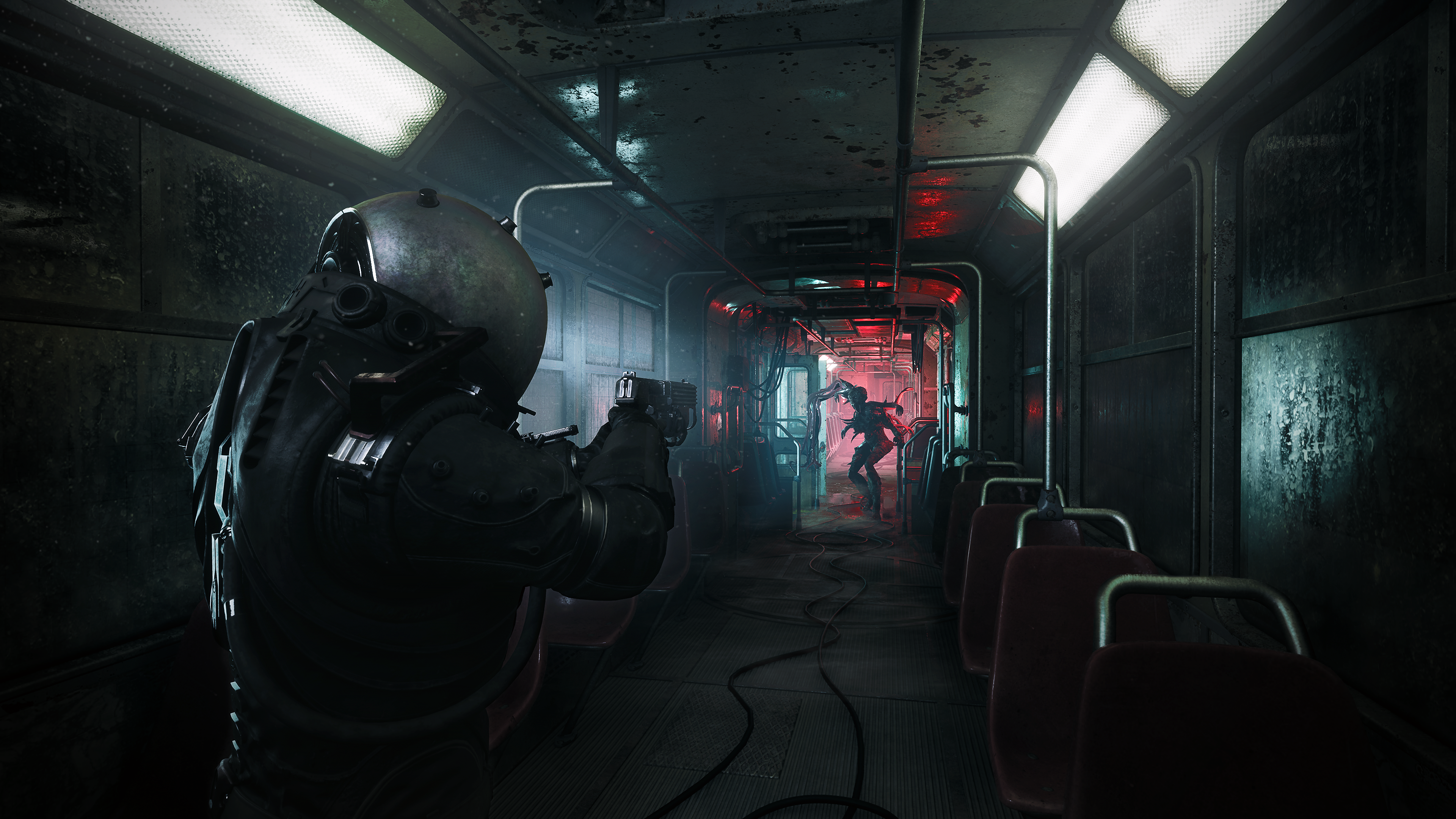
Probably a good idea to start charging my shot now…
The Traveler – Arkadiusz Reikowski
Riding high off last year’s unexpectedly brilliant Silent Hill 2 remake, Bloober Team wasted no time unveiling their next project—an original IP with no existing fanbase or nostalgia to lean on. In many ways, it feels right at home among their earlier horror titles: it’s unmistakably Polish in both setting and politics, filled with uneven dialogue and sudden leaps into philosophical territory, and more than a little inspired by genre heavyweights like Dead Space. However—and this is a big however—the studio applies the combat and level-design lessons learned from the SH2 remake so effectively that it managed to scratch my ultra-persistent survival horror itch better than anything else in 2025.
In Cronos: The New Dawn, you are The Traveler, an entity—whether human or machine is unclear—in a suit of armor whose helmet shape we won’t be acknowledging. You begin the game in a small metal pod, awoken by a synthetic voice which begins reciting something akin to the the Post-Traumatic Baseline Test from Bladerunner 2049. The Traveler and the voice exchange, uh, pleasantries—such is their calling—you are given a gun, and promptly kicked out into the lifeless wasteland outside. Whatever misgivings I have with the story of Cronos, the mood is on-point from the jump—and it doesn’t get any less strange from here.
Cronos is a survival horror game for the OG-appreciators out there. The resource economy is one of the tightest and most well-tuned I’ve experienced in a long time, forcing you to play optimally or die trying. There is barely enough of anything to get by, and you will find yourself going out of your way to optimize everything you can, from your number of shots-to-kill, to how efficient crafting one resource over another is, to trying to corral enough enemies around an explosive barrel before setting it off. Yes, in spite of its dour and ultra-serious atmosphere, this is a game that makes extensive use of the humble red barrel. Far from a novelty, these are a core part of the combat loop in Cronos—so much so that The Traveler’s suit actually resists damage from them. You’ll find yourself seeking them out as a necessary means to “solving” the combat puzzles efficiently, oftentimes walking right up to them in a key moment and melee-ing them like a maniac with god-mode turned on.
One thing every modern survival horror game struggles with is how to make the combat just the right amount of clumsy without being completely frustrating. With the expectations for modern third-person shooter controls, this can be a difficult nut to crack. Do you just add a ton of weapon sway to make aiming ever-so-slightly unreliable? Maybe you allow the weapon to randomly jam? Cronos’s solution to this problem is the charged shot mechanic, which is very elegant in its simplicity. Every weapon in the game can fire normally, or can be “charged”—with the trigger held down for a few seconds—to deal extra damage. When firing normally, your aim is basically perfect, with just a slight amount of sway, but when you begin charging a shot, all bets are off—the gun starts kicking like a mule in The Traveler’s hands, as if it’s struggling just to keep the bullet contained. What makes this design really clever is how it integrates with the resource economy. Regardless of whether you charge your shot or not, a single bullet is consumed either way. When you can deal increased damage for the same amount of bullets, you’re encouraged to charge every shot you take.
So, if you can kill an enemy in 2 charged shots or 3 regular shots, you’d be a fool not charge your weapon. But what if the increased weapon instability causes you to miss? Now, not only are you out more bullets, but your enemy has had more time to close the gap with you. Maybe you should have just fired normally. It’s this kind of strategic decision-making that’s built into every one of Cronos’ combat encounters.
Combine this mechanic with the slow, lumbering movement speed The Traveler has, in stark contrast to her enemies, and you’ve got a situation where you need to make every moment count. Plant your feet and nail your shots in time, or you’re going to have a bad time. And then, layered on top of this, you have the enemies’ main gimmick—the ability to merge. As the bodies of enemies pile up, each one represents a potential threat, since living enemies that come across that corpse can “merge” with it, consuming its biomass and powering up to a more dangerous form. These higher tier versions of enemies will gain additional health and damage potential, but also will gain hard armor on certain body parts, denying damage to a leg or arm or even their head. Put simply—it’s a bad thing that you don’t want to happen.
In order to prevent this, you’ll want to burn the bodies of enemies in order to clear them out, but—similar to dealing with the Crimson Heads in RE1 Remake—you won’t have enough fuel to burn all of them. Yet another strategic decision you’ll have to make, and yet another mechanic that forces you to keep moving during combat, in order to ensure you aren’t clogging up a single hallway with piles of carbon-based snacks for your enemies to feast on.
All of these moment-to-moment decisions that the game asks you to make, plus some really nicely designed levels—the hospital and the abbey being real high points—make for a really great survival horror experience. The story has some great situational horror beats—the idea of The Traveler suddenly showing up at your apartment during a COVID-like lockdown seems freaky as hell—but ultimately it’s a pretty huge mess to make sense of what exactly is going on. Cronos definitely has some of that Bloober Team baggage weighing it down, but I’m blown away that a team once known for crafting combat-free run-and-hide type horror is now somehow pushing the genre forward with new ideas about horror combat. I’m still cautiously optimistic about what the future of Bloober Team might be like, but I’d be lying if I said they weren’t winning over my trust, one game at a time.
9. Doom: The Dark Ages – id Software
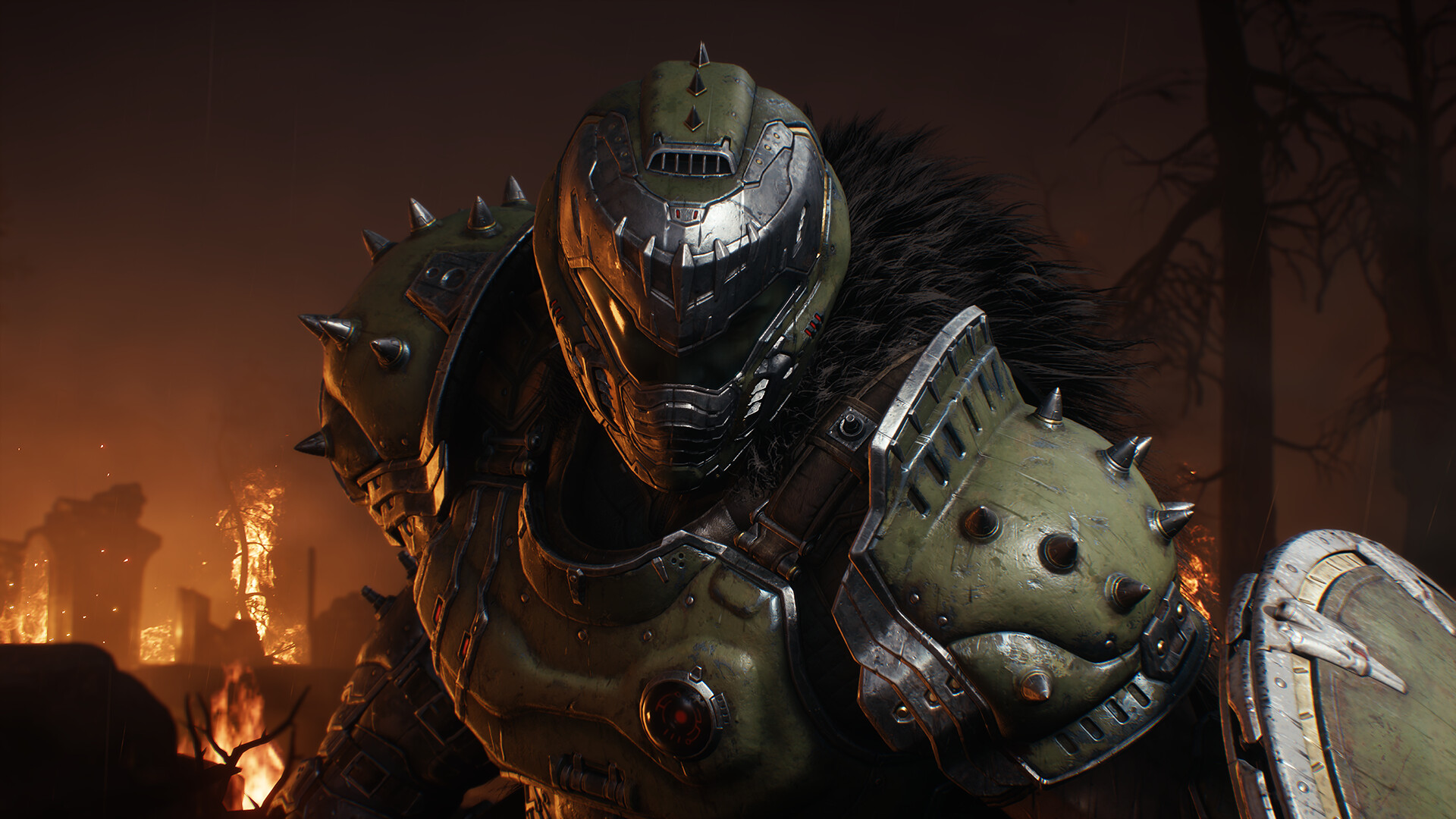
Bitch, I slay.
Unchained Predator – Finishing Move Inc.
“In Doom Eternal you felt like a fighter jet. In Doom: The Dark Ages, you’ll be an iron tank.” That pithy pitch is from Hugo Martin—game director of The Dark Ages at id Software—and, try as I might, I’ve yet to come up with a more succinct way to describe how it feels to control the Doom Slayer in this third entry in the modern Doom trilogy. In The Dark Ages, when you sprint down a hall, the heavy impact of the Slayer’s stride reverberates through the space like you’re tearing the terrain apart just by passing over it. When you land from a fall, the impact is less like a guy in armor leaping down twenty feet, and more reminiscent Titanfall’s namesake—a mech suit, deployed from orbit, colliding with the battlefield. If we’re to use Shigeru Miyamoto’s age-old litmus test for making a 3D game fun, in that you start from the movement and go from there, then The Dark Ages absolutely nails it—the power fantasy of controlling the Slayer starts from the very moment you first press the W key.
The changeup from Eternal’s fighter jet flow is very intentional. id Software, ever the ambitious developer, seems hell-bent on not repeating themselves. Rather than graft new mechanics atop the high-flying acrobatics of late game Eternal in a desperate attempt to 1-up themselves, id Software have instead built a completely new, less gravity-defying combat model for this latest entry. And, as if to signal this dramatic shift, the time and place of the game is a similarly radical departure.
The Dark Ages is a prequel that goes extremely deep into Doom’s lore—here, we’re leaving both Mars and Earth behind in favor of Argent D’Nur, and winding the clock back what can only be assumed is thousands of years—to depict the ancient war between Hell and the Night Sentinels and their Maykr allies. Here, at the onset of the story, the Slayer is a psychologically-controlled super soldier who is deployed into battle by the leader of the Maykrs in order to combat the forces of Hell. It’s a very in-the-weeds, very Warhammer 40,000 setting that, for those of us normies not totally awash in Doom lore, means that we’ve got some seriously over-the-top designs: cyber dragons, kitted out like Meta Ridley—complete with holographic wings and saddle-mounted chain guns—as well as weapon concepts like the Skullcrusher, a profane device that mulches down runic skulls as ammunition before spray-firing the white-hot bone fragments out of its proverbial business end. Honestly, it’s sick. No notes.
Of this new Doom trilogy, this is the entry that goes the hardest with both the amount of narrative and the design of its world. And while the story more or less falls completely flat for me, the designs that id’s art team created here are working overtime to sell this mythic science fantasy world. This is certainly one of the coolest looking games of the year, and seeing it in motion—running like a butter-smooth dream on the new and improved id Tech 8 engine—might just be worth the price of admission alone.
These days, there’s a lot of gnashing of teeth about the state of PC gaming optimization—whether it’s the epidemic of shader-compilation stutter, the scourge of traversal stutter as map chunks stream in and out of memory, or the glut of overly taxing ray-tracing settings that bring all but the most ostentatious Nvidia GPUs to their knees. That’s why it’s worth calling out something great when you see it, so let me stake my claim here—The Dark Ages is, for my money, the most optimized PC title I’ve played in years. Yes, the caveat here is that the engine requires dedicated ray-tracing hardware—a bit of an aggressive system requirement in this day and age. But seeing what can be done when a developer like id Software designs their entire lighting pipeline around ray-tracing from day 1, it’s hard to argue with the results. Yes, everyone likes having options, but relegating ray-tracing to a graphics option effectively means that developers have to make 2 entirely separate lighting passes over the game—one for rasterized lighting and one for ray-traced lighting. It turns out—like many aspects of technology—sometimes ripping off the Band-Aid is the best form of optimization.
Of course, the main draw of any Doom game is its combat—not its lighting or art design—and thankfully, this is an area where The Dark Ages delivers. Its combat is centered around the Shield Saw, a ridiculously versatile tool that’s like the unholy lovechild of Kratos’ Levianthan Axe and the Buckler from Dark Souls, filtered through Cliff Blezinski’s design sensibilities. It’s simultaneously a boomerang-like projectile, a tool for deflecting attacks, a warp-speed ticket to quickly dash across the map, and—if you embed it it a Mancubus’s chest—a pretty gnarly stun. Clearly, the team at iD felt strongly that if they were going to add a prominent new gameplay mechanic, like a shield, it needed to have impact across every vector of the combat design.
The more “boots on the ground” combat formula means that there’s significantly more emphasis on good, old-fashioned strafing. The different enemy types will fire off patterns of projectiles, often in a grid-like formation, for you to weave between. When things really pop off, and there are lots of different enemy types onscreen at once, things can get very bullet hell, very quickly. That said, this isn’t your dad’s Doom, and what I mean by that is—you guessed it—there’s a parry mechanic. Whenever you see a green projectile within the grid of hellfire, that indicates that a particular attack can be returned to sender via your shield for a huge stun.
The parry mechanic was a bit eye-rolling for me at first (the Slayer would never resort to such tactics), but it serves a particular role in the combat loop—it encourages players to take enemies head-on, charging directly into a Hell Knight’s aggressive attacks or a Mancubus’ soft, fleshy undercarriage. In The Dark Ages, the Slayer is all about staying aggressive and unrelenting. There is rarely a situation where sitting back and playing things safe from a distance is the move. Instead, you want to keep the pressure on the demons, forcing them to respond to you as you shield dash your way through their ranks, knocking parry-able projectiles out of your way as you careen toward your next victim.
One thing I really appreciate about The Dark Ages is that it feels less prescriptive about how to play it than Eternal did. With Eternal, hotswapping weapons was a core part of the gameplay loop, and if you weren’t cycling through your weapons like a chain-smoker running through a fresh pack, you just straight up weren’t playing optimally—and would end up having a bad time as a result. The Dark Ages, by contrast, corrects for this—letting you roll with just about whatever weapon you see fit. I still found myself swapping frequently, but I appreciate the fact that if you find yourself really vibing with blowing demons apart using the new grenade launcher it is totally viable to roll with it for the whole level.
Another big change The Dark Ages makes is the inclusion of two unique types of gameplay sequences. One involves climbing inside a gigantic mech and punching your way through colossal demons. Another involves those cyber dragons I mentioned before—the Slayer gets one of his own to mount and take into aerial combat.
While these spectacle segments aren’t the best designed sequences in the world, they provide a nice way to break up the flow of the action, serving as refreshing turn-your-brain-off-and-just-appreciate-the-mayhem palette cleansers between the denser levels. The mech sequences aren’t my favorite thing, but the dragon sequences do provide some compelling ways to break up the level’s space without resorting to simple corridors between each one. For example, in the midgame chapter “Spire of Nerathul”, you find yourself flying around a gigantic tower surrounded by an enormous waterfall. Each individual chunk of the level is divided by hundreds of meters, so after you rip and tear your way through a combat scenario near the upper reaches of the tower, you’re back on the dragon and divebombing down toward the seafloor to begin the next section. Simple, but effective.
Now, at the risk of making myself really sad, I do have to say that Mick Gordan’s absence is keenly felt here, and is one of the biggest downgrades about The Dark Ages. The soundtrack is now done by video game music conglomerate and very corporate sounding composer team Finishing Move Inc., and while it’s serviceable—even what I’d call good in some places—it’s far from the groundbreaking, sub-genre defining tour-de-force that Doom 2016 or Eternal’s music were. I’ll put it this way: while writing this piece, do you think I had the The Dark Ages’ soundtrack in rotation, or do you think I listened to Mick Gordon’s Doom Eternal score for the umpteenth time? Yeah, it’s hardly a fucking choice.
It’s insane to me that across the last decade, id Software has put out a trilogy of new Doom games where the combat framework is different for each of them. Yes, the broad strokes are similar—you’ve got your glory kills, your shotgun and plasma rifle, your chainsaw or chainsaw-like apparatus—but the way the combat flows, the movement tech, the way the levels are designed—it’s all very different. Show me 2 seconds of gameplay—hell, Photoshop out the HUD, it doesn’t matter—and I can immediately tell you which game I’m looking at based on movement alone. And the fact that all 3 of these games still manage to feel like Doom games, in spite of how different their approaches are, is crazy.
None of this makes The Dark Ages a better game. Frankly, it’s not a better game than Doom 2016 or Eternal. But the fact that they had a formula for success and still felt the need to experiment goes a long way in my book. The Dark Ages doesn’t feel like a retread—it feels like its own thing, with its own identity and vibe. Sometimes, that vibe wasn’t quite my thing. But when it was—The Dark Ages was just an undeniably good time.
8. Silent Hill f – NeoBards Entertainment
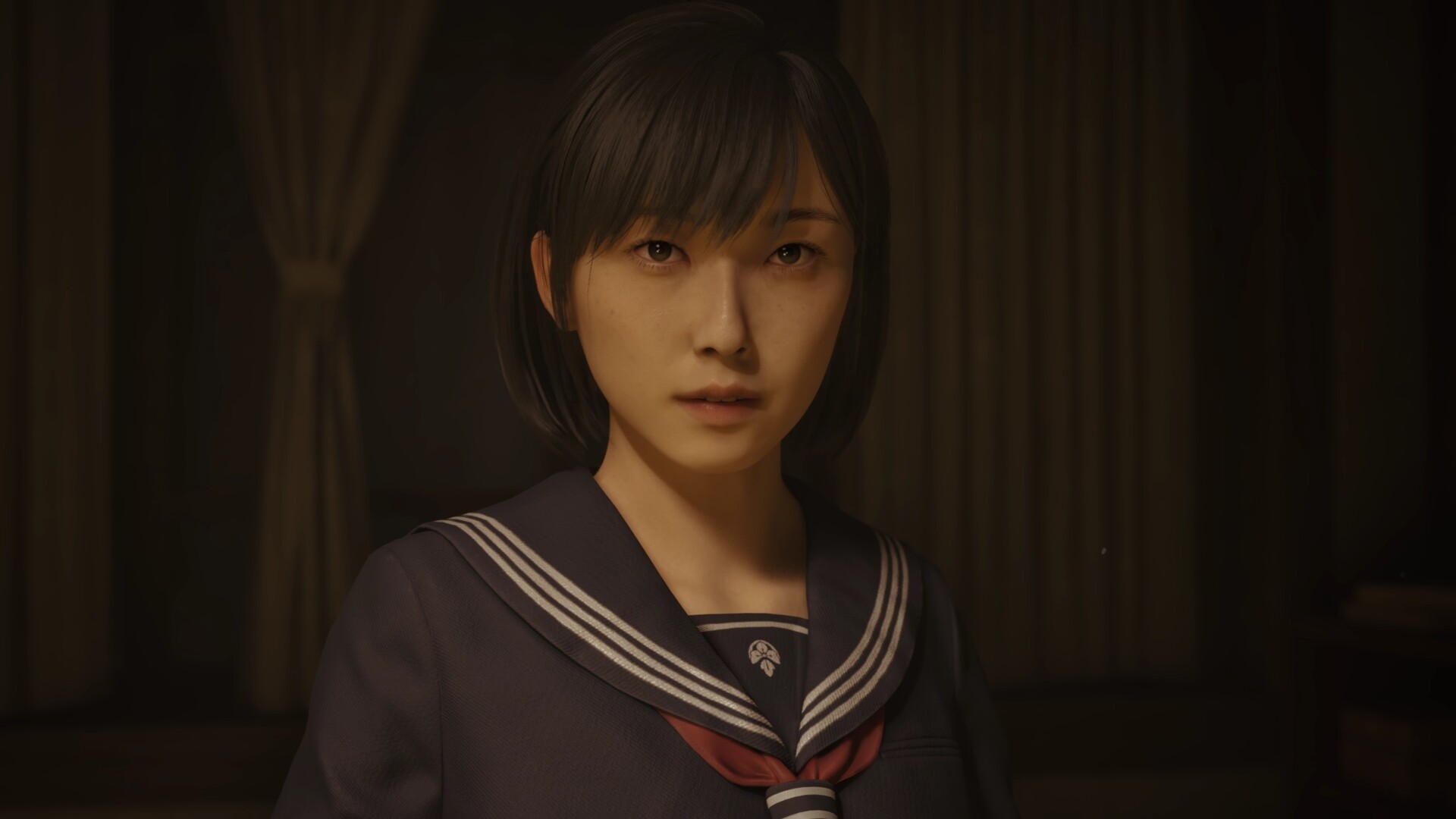
This game has some truly stunning character models.
Dizziness Drawn to a Faint Flame – Akira Yamaoka
In the final hours of Silent Hill f, the protagonist Hinako, caught in a twisted, malformed version of her family home, enters a version of her bedroom, only to confront another version of herself there. Our Hinako is in a bad way—her Ebisugaoka High School uniform is in tatters, revealing cuts and scrapes, evidence of the bloody traumas she’s had to endure over the past few hours of hellish torment. This other Hinako—Shimizu Hinako—there’s something wrong about her. She’s immaculate, untouched by the yokai-like monstrosities now twitching their way down the narrow, Shōwa-era corridors. “Tell me. Who are you…?” our exhausted Hinako demands. Facing the the wall, face shrouded in darkness, the other responds, “I think it’s weird too. To not have a grasp of yourself, to not understand your own feelings.”
It’s a chilling moment, one the game has been building towards for hours now. It’s become increasingly clear over the course of the game that Hinako is struggling with her identity and her sense of self. By this point, we’ve seen her psyche fracture, tugged down multiple paths by forces outside of her control. Now she faces one of those splintered personalities head-on, fighting for agency in a world where it’s anathema. The other Hinako turns to face our Hinako, her face stretched into a teasing smile: “I think…you’re me, but I’m not you.” This statement, spoken in an eerily mocking tone, perfectly encapsulates the horrors of social pressure, obligation, and shame at the core of Silent Hill f’s story. It also inadvertently mirrors my own personal struggle while playing through this game. There are two versions of me as well—one who thinks this game represents a brilliant revival of a horror series that has been with me for decades now, and one who thinks of this game as a monotonous slog that continually undermines itself at every turn.
Let’s start with my more charitable self, and with me stating, unequivocally: Silent Hill f is the best Silent Hill has been since the original Team Silent was at the helm of the series, over 20 years ago. While this game marks the beginning of a potentially controversial revival concept from Konami—reimagining Silent Hill as a horror anthology across varied locations and eras—I personally find this to be an exciting new direction for a series more coherently defined by its mood, atmosphere, and psychological approach to horror than to any specific aesthetic surrounding its namesake town.
What impresses me most is how developer NeoBards stitches together a schism that has been a part of the Silent Hill fandom since its inception: one side sees Silent Hill in the way that SH2 conceived of it—conceptually, as a sort of personal hell born out of the repressed sins of the people trapped there—while others see it through a more classic lens—mythologically, with strong connections the occult. Silent Hill f, set in the sleepy rural Japanese town of Ebisugaoka, manages to integrate the two concepts in a beautiful way, interweaving Shinto concepts like kitsunetsuki (fox possession) and tsukumogami (spirits of old tools) with Buddhist Sanzu no Kawa (River of Three Crossings) imagery into a fabric depicting the most raw and personal tale of inner turmoil the series has been able to muster since its 2001 high watermark, Silent Hill 2.
Silent Hill f wears its Japanese identity proudly on its sleeve. Written by Ryukishi07—creator of the visual novel series When They Cry—the game centers on Shimizu Hinako, a high school student in rural 1960s Japan, an era defined by rapid post-war technological advancement and the social tension between tradition and modernity. The story opens with Hinako’s difficult home life, rife with emotional and physical abuse from her father—tolerated and passively abetted by her mother. We follow her as she runs away from a worsening situation to meet her high school friends, her closest being Iwai Shu, whom she’s called “partner” since their early-childhood friendship began. They remain just as close, but now Hinako draws sideways glances and rampant speculation about her platonic relationship with this male classmate. We get flavorful dialogue between Hinako, Shu, and her friends Rinko and Sakuko before things unravel fast. Suddenly, Sakuko seizes up as strange crimson plant life bursts through her skin and eyes, and she collapses. Before anyone can help, thick fog rushes down the street, carrying a tide of similar red flora. In the ensuing chaos, the group gets separated. Fast forward a few more hours and we’re introduced to scarecrow monsters in rice fields, we’re shoved down the stairs by jealous friends, and we’re being inexplicably led around a dark Shinto temple by a strange man in a fox mask.
Even after your first playthrough of Silent Hill f, it won’t be entirely clear what’s going on with Hinako. The first ending that everyone gets will only prompt more questions about the events of the game and whether you actually understood things in their proper context. Then begins the most interesting part of Silent Hill f—the way it handles New Game+. As you replay through the game, armed with the knowledge of how to get a different ending, you will also experience new and altered cutscenes, discover documents to read that simply weren’t there before, and even trigger an entirely different final boss fight. Along this journey, new details will be slowly drip-fed to you, such that your interpretation of certain scenes is completely transformed. Your understanding of the story will evolve as new information comes to light. You will actually need to do this again and again, 3-4 times in total, in order to gain a complete picture of Hinako’s journey.
And this is where my other self wants to start arguing their points. This core element of Silent Hill f’s storytelling—where it reveals more information each time you play through it—while certainly one of the most unique and experimental aspects of the game, also works to undermine the whole experience. Because, while the story wants you to revisit its scenes multiple times, meditating on their significance, the gameplay end of Silent Hill f seems actively hostile to the idea.
Take the game’s combat system, for example. It’s totally serviceable, and the focus around melee weapons with a durability mechanic ensures you’re always weighing the cost of fighting against the possibility of just running away. Sure, it’s a bit clumsy and fussy—but that’s core to the horror-game design ethos: ensuring you never feel 100% confident when facing an enemy, sowing just that little bit of doubt in your head. What’s mystifying then, is the way the game triples down on forced combat arenas as the main impediments to progression in the third act of the game. This was already a pacing issue that burnt me out on playthrough 1. To then be asked to relive these more than 3 times each in order to experience the full story? What a nightmare.
The design of the spaces in and around Ebisugaoka are immaculately realized—with a stunning, almost photo-real level of detail—but are quite boring from the perspective of navigating a level. In fact, I’d argue these are some of the worst level designs in the series. Most gameplay sections have only a single way forward, with very minimal options for exploration, and the center section of the Ebisugaoka map is recycled several times over per playthrough, as Hinako is compelled to run back and forth between her home and Chizuruya, the local family-owned candystore. There’s certainly narrative significance to doing this, and I’d be willing to forgive the repetition more if I was only playing through the game a single time, but alas.
Another issue is the way this game handles its horror elements. While Silent Hill f does have moments where it builds tension effectively, a lot of the scares in the game have to do with cheap moments in which an enemy falls from the ceiling or darts around a corner, and these are all tightly scripted. For better or worse, it’s typically in cutscenes where most of Silent Hill f’s horror occurs. It’s completely baffling then that one of the most shocking and disturbing moments of the entire game—involving a series of escalating rituals that the fox-masked man asks Hinako to perform—is somehow one of the only sequences that gets skipped in all your NG+ playthroughs. Ostensibly this was done to speed up replays, but it’s one of the few I’d have welcomed revisiting: it’s fucking ghastly, making manifest Hinako’s internal horror in such an effective way.
Don’t get me wrong. There’s a lot to love about Silent Hill f and the direction it has chosen to take the series. Its story wrestles with themes that gaming rarely, if ever, bothers to touch on. While some narrative details are made a bit too literal by playthrough number 4—leaving a lot less up to interpretation than I originally thought there would be—I still can’t tell you the last time that a game like this stuck around in my thoughts for weeks after playing it.
This was a game that came out during a difficult time in my personal life, with lots of stressful situations related to family. Considering that, some of the last unique scenes of the game—buried deep in the final playthrough—between Hinako and her parents, absolutely gutted me. Those scenes in particular are Silent Hill at its absolute best—beautiful and sad and cathartic, all at once—just two characters talking to one another, trying to figure out how they can ever go on living again, after all that’s happened. For moments like this, Silent Hill f will be talked about for years to come as a beautiful personal story that captures the horror of societal expectations, the commodification of women’s bodies, and slow death of childhood. It really is a game with a lot to say. It’s just a shame that it asks its players to tolerate so much in order to listen.
7. Donkey Kong Bananza – Nintendo EPD
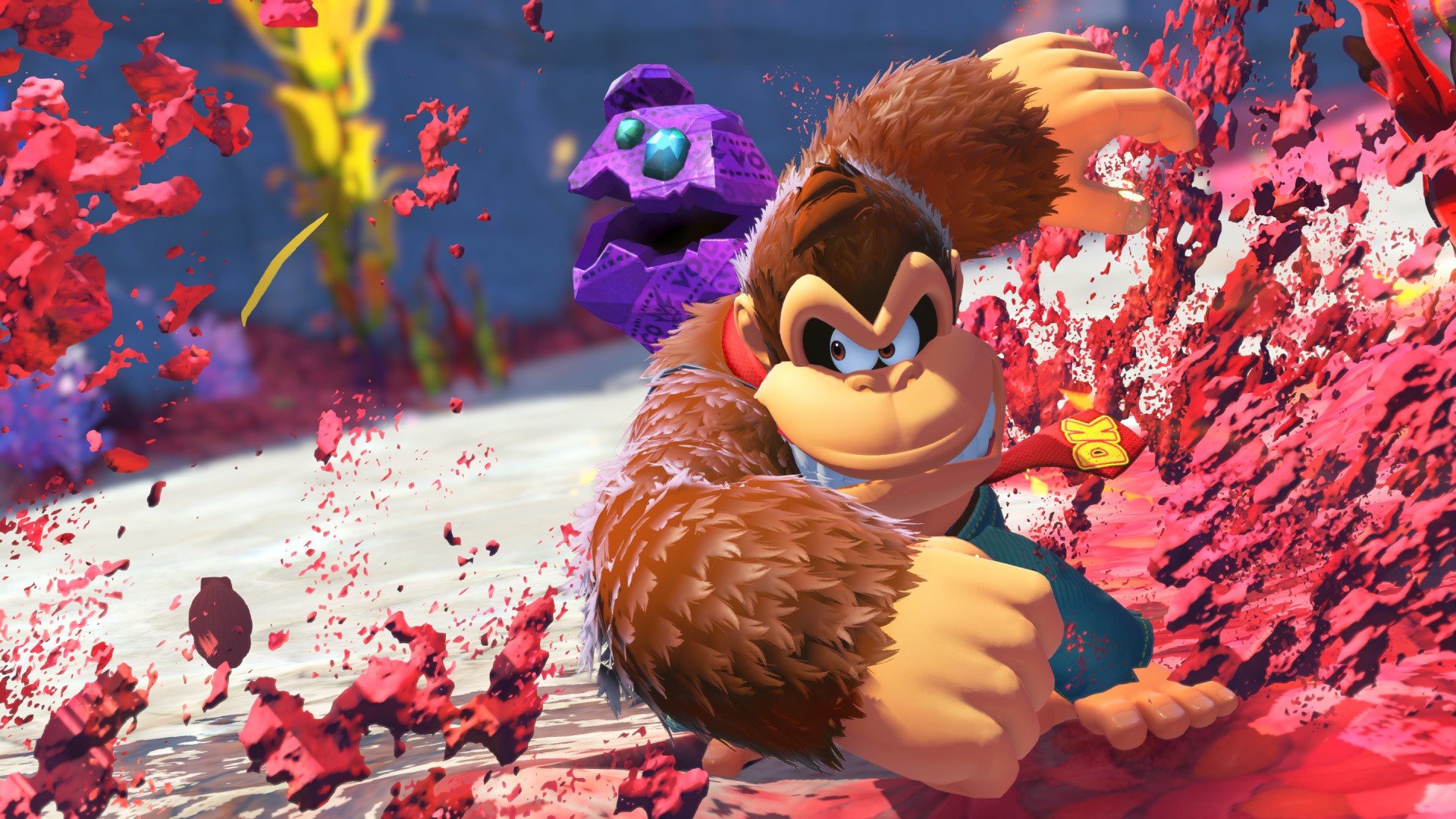
New Donk City!
Disco Hall (Groove Layer) – Nauto Kubo, Daisuke Matsuoka, Reika Nakai, Yuri Goto, and Tsukasa Usui
Nintendo, more so than perhaps any other developer I can think of, has the impeccable ability to pluck a mundane gameplay ingredient off the shelf, extract the core essence of what makes it fun, and commit to that flavor so thoroughly in their design recipe that the resulting dish tastes better than you ever thought possible. Such was the case with Donkey Kong Bananza, a game whose stated premise, when I first heard about it, didn’t exactly set my world on fire. A Donkey Kong game centered around destructible environments? How interesting could that be? Well, very interesting, as it turns out. Destruction in Bananza is no mere party trick—it’s the fulcrum around which the entire design hinges. Bananza is 3D platformer by definition, but the way you navigate the world is fundamentally different from anything else in the genre. I’ve never played anything else quite like it.
To achieve the level of environmental destructibility that they wanted, the developers at Nintendo made the ambitious decision to utilize voxels for everything—from the terrain to the enemies. Think of voxels like the 3D equivalent of pixels. When you render 3D graphics traditionally, you describe surfaces with meshes of polygons. When you render graphics with voxels, you are describing a volume—an array of points in 3D space with associated color, opacity, material, etc. Typically, games that use voxel rendering have a very specific “look”—objects and terrain appear blocky, as you’re literally seeing the voxel grid in front of you. Minecraft is the most famous—and famously blocky—example of this. The magic at the core of Donkey Kong Bananza’s technical achievement isn’t just that they got all of this environmental destruction running on mobile hardware—lest we forget, Switch 2 manages all this using as little as 12 watts when in handheld mode—but that they were able to leverage the flexibility of voxel rendering without inheriting the harsh visual appearance typically associated with it.
The end result of all of this is that levels in Donkey Kong Bananza are all fully destructible down to their lowest, underlying foundations. The only real limits are that, by necessity, the game retains a basic skeleton of the level made out of indestructible material, so as to protect the player from completely cutting themselves off from progression. Your goal in each of the game’s various “sub-layers” is to collect the crystalline Banandium Gems that are littered throughout, but these are oftentimes sequestered into underground caves or wedged into the sides of cliffs, where the only way to reach them is to bore a tunnel from elsewhere in the level.
A heavy emphasis on hidden collectibles in a game where you can literally spend minutes upending half the map could have easily devolved into tedium, as you waste time checking every nook and cranny. However, thanks to some hugely welcome quality of life mechanics, Donkey Kong Bananza wisely avoids this pitfall. The hand slap ability allows DK to briefly echo-locate nearby Banandium Gems and other significant collectibles through the walls and floors around him, all while auto-collecting any stray gold currency around him. Not only that, but you can discover maps pointing you to the next collectible as you—what else—smash your way through more and more terrain. This all contributes toward a platformer experience where you get to spend more time doing what feels good—smashing—and less of what doesn’t—scouring the map for that one trinket you missed.
Bananza’s smashing feels so good largely because the audio-visual feedback creates such a tactile sensation. There are real textural differences to each of the various terrain materials in the game. Oftentimes, you can identify the material that DK is punching by ear alone. Some materials break easily while others require much more force to destroy. Each of the materials has distinct behavioral properties as well—sand sticks to other terrain when thrown, gold explodes creating large craters, and thorns cannot be smashed directly by DK’s fists, requiring you to get creative.
I’ve always had a soft spot for Nintendo when they eschew their safe, conservative tendencies and go all out with strange, off-the-wall ideas. Think of how Zelda dove headfirst down an Alice in Wonderland rabbit-hole with Majora’s Mask, or how Super Mario Wonder felt like Nintendo’s lovable plumber had suddenly begun experimenting with consciousness-altering drugs. Super Mario Odyssey had this in spades, with some of the wildest capture transformations reconstituting Mario’s body as a spark of electricity or a piece of two-dimensional clip art. For as many criticisms as I have of Nintendo, these are always the types of moves that inevitably win me back. Bananza keeps the wonderful tradition of “weird Nintendo” alive, and is all the better for it.
The level designs are some of the best of any game in 2025, with an experimental verve that steadily increases the further into the back half of the game that you get. One of my favorites, the Landfill Layer, is an entire level built around a giant trash heap, where most of the collectibles and points of interest are stacked vertically, separated from each other by significant amount of terrain. It’s only by digging downward, like an overzealous dumpster-diver, that you create your own passages and connect the level together. Meanwhile, the Racing Layer—a complete non-sequitur—drops you into a racetrack for a few laps on a rhinoceros that eats terrain before launching into air, building ramps behind it for use in subsequent laps. Better still is the Feast Layer, an entire amusement park—complete with tram access and a guided tour—where all of the terrain consists of high-calorie fair food—skyscraper towers of burger, lava pools made out of hot frying oil, and salt piles that can be used to dissolve globules of acidic mucus.
Donkey Kong Bananza is a game about the simple pleasures. It turns out that smashing stuff is a good-ass time. And while it may be a game primarily about collecting stuff in order to collect more stuff, Bananza is proof positive that gameplay is more about the journey than the destination.
6. Split Fiction – Hazelight Studios
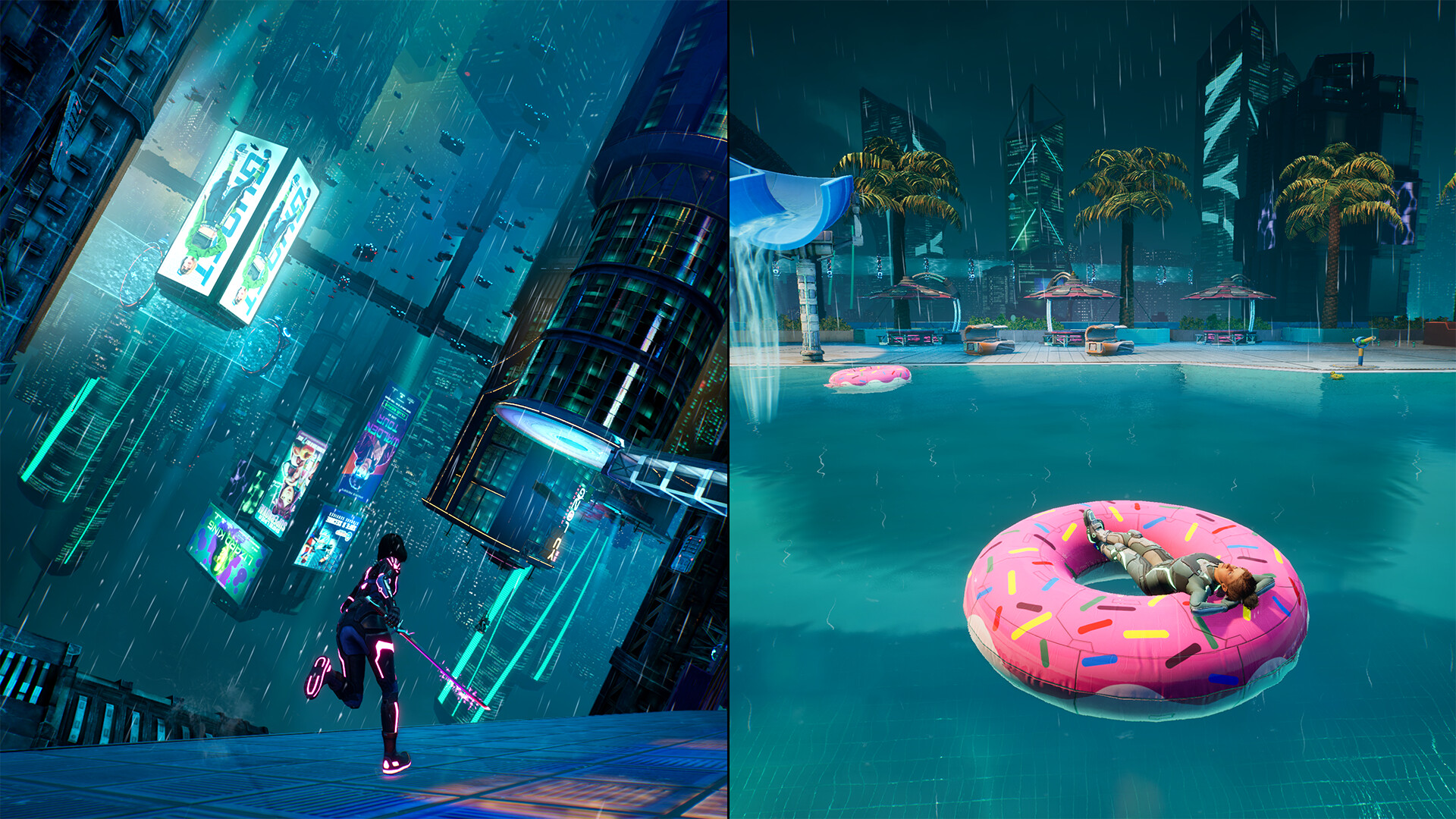
Typical rando behavior from the right side of the screen.
Split Fiction Main Theme – Jonatan Järpehag
I really like the niche that Swedish developer Hazelight Studios has carved out for itself. Over the course of its existence, the studio, under the direction of former filmmaker Josef Fares, has a specialized in crafting cooperative narrative experiences that make very intentional use of splitscreen. They are an absolute gem of a developer, somehow thriving under the often-suffocating influence of publisher EA. Their latest game, their most fast-paced and ambitious, is the excellent Split Fiction, which is some of the most fun two people can have over a moderator-sanctioned Discord VC.
Josef Fares actually started his journey in the game industry before founding Hazelight in 2014. Before all of that, he was the director of the Starbreeze developed Brothers: A Tale of Two Sons, which itself was a sort of experimental “singleplayer co-op” game where you controlled each of the playable characters simultaneously—with one brother mapped to the right side of the controller and the other, the left. This concept was Fares’ own idea that he had been pitching to different studios after participating as a guest speaker during a six-week game design and theory program in Orebro, Sweden. Eventually, Starbreeze took up the mantle develop the title, with Fares in the director role, and the rest is history. It went on to be a critical darling release in 2013, and I wrote about it on this very blog all the way back then.
It was 2021’s smash-hit It Takes Two that really put the industry spotlight on Fares, however. A true co-op experience, It Takes Two focused on May and Cody, a married couple whose soured relationship had led them to plan a divorce. They informed their young daughter Rose of their plans to separate, and in a magical “tears of a child” moment, May and Cody found themselves trapped inside Rose’s dolls—forced to work together to break the spell and reconcile their relationship.
Split Fiction uses a similarly high-concept story to set the stage for its co-op gauntlet. It stars Mio and Zoe, two struggling genre writers who meet for the first time at a strange publisher event where they are asked to test “The Machine”, a virtual reality device that allows them to exist in the worlds of their submitted stories. At the last minute before entering the virtual world, a freak accident occurs, and Mio and Zoe get stuck in the same simulation with one another—something The Machine was never designed to handle. From there, the various mainline levels of the game alternate between Mio’s action-laden science-fiction stories and Zoe’s cozier fantasy worlds. In a very Psychonauts way, the levels themselves are what flesh out the personalities, interests, and diverging worldviews of Split Fiction’s two, at-odds protagonists.
What makes Split Fiction so immensely enjoyable is its masterful sense of pacing. Previously, with It Takes Two, Hazelight opted for a more rapid-fire swapping of mechanics to keep things engaging. It worked well most of the time, since you were never stuck on a single gameplay gimmick for too long, but it meant that very few of the gameplay ideas were able to mature and compound into something more interesting. It felt a bit like Mario Party, in that there was always some new mechanic or mini-game to keep things fresh, but that same onslaught of new ideas also made it easy for things to become a slog when the ideation never quite finishes a complete thought before moving on.
Not so with Split Fiction, which gives its gameplay mechanics a longer lifespan and more room to evolve. As an example, in the early chapter “Neon Revenge”, Mio wields a sword and can shift gravity to walk on the walls or ceiling, while Zoe utilizes a glowing energy whip capable of manipulating heavy objects. The game uses this as the basis for how you and your partner will solve puzzles and fight off enemies for the next 90 minutes or so, all while navigating a rain-slicked sci-fi world that is clearly derived from Mio’s love of cyberpunk aesthetics and techno music, as well as her extreme aversion to paying parking tickets. As the chapter plays out, increasing in scope and challenge, the game layers in driving sequences, 2D sidescrolling vignettes, multiple boss fights of escalating complexity, and one of the funniest hacking minigames of all time. There’s a great sense of flow to it, one that had my friend and I constantly asking each other “How far are they going to take this?”
At the risk of losing some of the magic that comes with suddenly pulling the rug out from under its players, Split Fiction instead packs its weirder and more eclectic design ideas into bite-sized optional levels that it calls side stories. The narrative justification is that these are smaller story ideas that Mio and Zoe wrote but left unfinished—much the same way that Hazelight uses them as playgrounds for one-off ideas that couldn’t sustain full levels. One such side story from Zoe’s childhood places you and your partner into the bodies of two pigs—one can stretch its body vertically like a spring while the other can long-jump via fart-based propulsion. This is a very silly and very chilled-out playground level that ends with a horrifying realization about, quite literally, how the sausage gets made—just one of the many small horrors of growing up. Another side story drops you into a world with a dying star on the horizon. The star releases deadly pulses of energy every few seconds, forcing you and your partner to time all of your platforming as you race from cover to cover—a great concept that quickly builds into a tricky challenge. These types of palette-cleanser activities were some of the high points of the entire game, and were an excellent way to break up the core pace of the larger levels. Whenever you see a side story’s glowing portal, there’s an immediate excitement as you and your partner begin speculating what could be next. It’s pure fun, every time.
Finally, I just want to take a moment to comment on the sense of spectacle at work in Split Fiction. There are some seriously impressive moments throughout the experience—whether it’s shifting gravity during the cyberpunk city’s “superhighway” sequence or platforming across the fingers, bellies, and nose rings of giant Norse guys—and all of it culminates in a finale that had me practically jumping out of my seat, I was so excited about what the game was doing. It’s one of those rare moments where the game begins playing around with the very constraints of the format itself, and it does this in a way that simultaneously creates a new challenge for the player and a mindboggling flex of Unreal Engine 5’s capabilities. It’s my favorite single sequence of any game this year—a fusion of gameplay and technical prowess so cool that it makes me want to replay the game all over again.
Split Fiction is the kind of game that you will never find yourself bored while playing. At the end of the day, a lot of what it wants to achieve narratively—spinning an allegorical tale about the vacuous, vampiric nature of big corporate tech bros and Artificial Intelligence—is so ham-fisted and clumsy that it doesn’t really land. But for all its dialog and character foibles, Split Fiction does work for me in a meta-narrative sort of way.
This is a game that wears its inspirations on its sleeve—you won’t have to look hard to find very direct references to Assassin’s Creed or Halo—and it feels like a love letter to gaming as a whole just as much as it does to the creative spirit, with all the effortless ways it manages to stitch together new idea after new idea. Even if Split Fiction can be cringey as all hell, it’s still got a cringiness, and rhythm, and drive that are all distinctly human. The pastiche of gameplay ideas here are lovingly rendered as a new thing, not the statistically-most-likely output of a soulless Large Language Model, and I think Josef Fares wanted to draw that distinction.
If good artists copy but great artists steal, then what does that make LLMs? I think Spit Fiction had ambitions around answering this question—and I think Fares rightly understood AI for the all-consuming plagiarism-machine that it is—but ultimately wound up short. Even still, the proof is in the proverbial pudding: if AI had been asked to create a genre-bending co-op game, would the result have been half as fun as Split Fiction? That’s not even a question.
5. Dispatch – AdHoc Studio
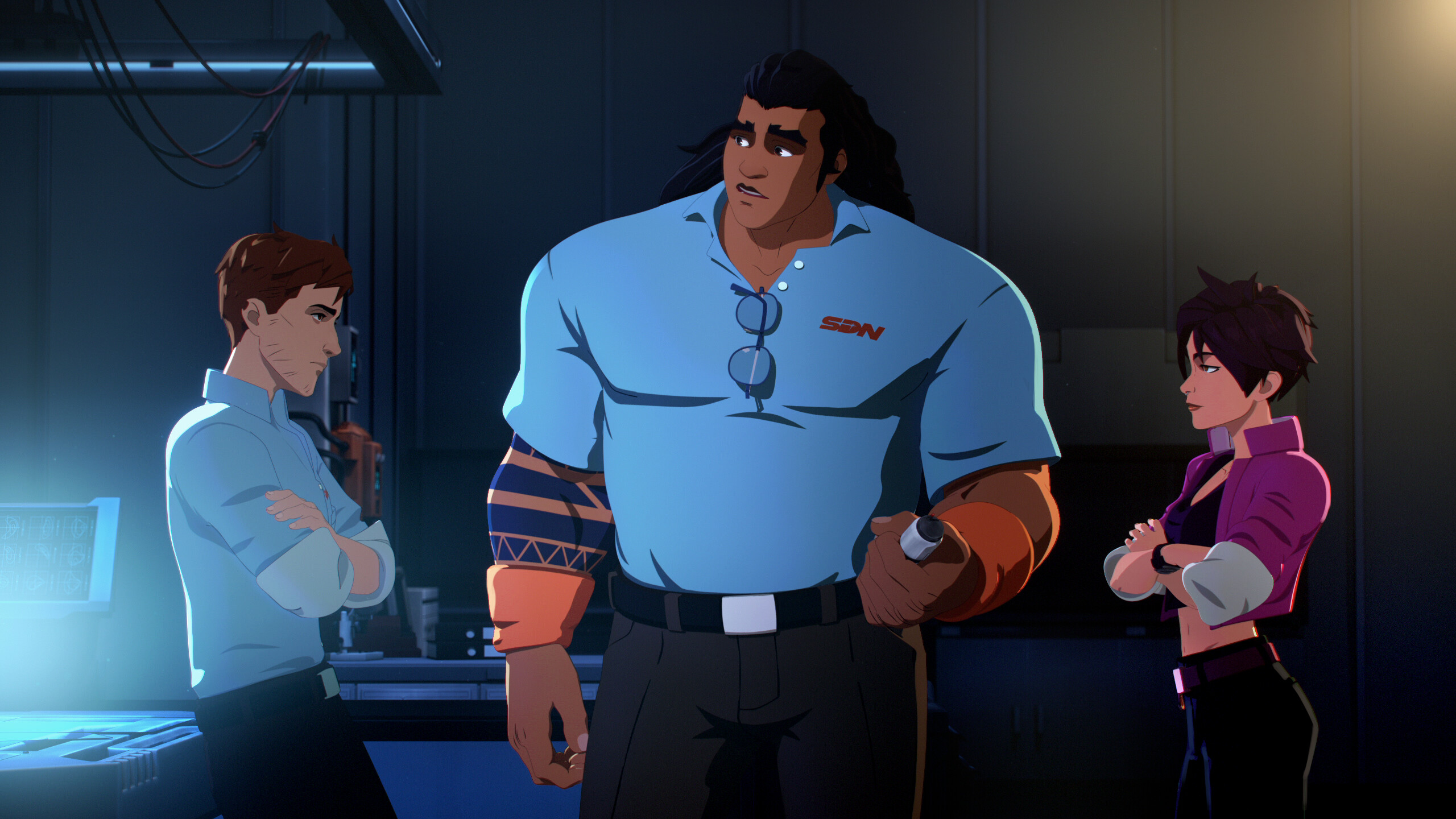
It’s hard to imagine being upset in any room with Royd in it.
Pound Cake – THOT SQUAD
Anyone who’s known me over the past couple of decades knows that one of my guilty pleasures is the narrative adventure game. Whether it’s episodic releases like Telltale’s The Walking Dead or Dontnod’s Life is Strange, or standalone titles like Supermassive’s The Quarry or Until Dawn, I have a deep fondness for these types of choose-your-own-adventure narratives. Call them wannabe TV shows, call them self-hating video games if you want—I don’t care. When they’re done right, they’re some of my favorite comfort games, the kind I love to revisit every few years.
That said, with the tragic dissolution of Telltale and the slow deterioration of both Dontnod’s and Supermassive’s output in recent years, people like me have been genuinely starved for quality. Enter then new kid on the block: AdHoc Studio, formed like a phoenix from the flaming piles of burnt shit that Telltale left behind, and their tremendous debut game, Dispatch.
A game like Dispatch lives and dies almost entirely by its characters. Thankfully then, it should come as no surprise that this game is positively bursting with a memorable ones—often lovable, frequently hilarious weirdos, each with thoughtful, distinct designs that leave an impression on you the instant they appear onscreen.
Dispatch unfolds in a universe where superpowers are as ubiquitous as they are mundane, where superheroes function more like gig-workers than superhuman marvels, being deployed via a “crimefighting-as-a-service” model by office workers wearing Bluetooth headsets. The superpowers aren’t always the most practical either—having the ability to secrete large quantities of moisture from your body, for instance, makes you far better suited to janitorial work than to beating up criminals or saving kittens from trees. Even the classic powers often feel gimped in cruel ways: turning invisible only while holding your breath as an asthmatic, or moving at super speed but at the cost of rapidly aging. There’s a certain tragic-meets-pathetic quality to Dispatch’s take on superpowers that pairs perfectly with the ritualistic humiliation of the corporate desk job.
We play as Robert Robertson III, a hero who used to equip his father’s mech suit to fight supervillains as Mecha Man, before it was destroyed in a showdown against the supervillain Shroud and his syndicate of crime, the Red Ring. Now, down on his luck, he gets presented with an opportunity to come work for SDN as a superhero dispatcher. From here, he is introduced to his own Superhero team—the Z-Team—made up of reformed ex-villains who have decided to turn their lives around and do some honest work.
One half of Dispatch is dialog choices and typical, Telltale-like gameplay, while the other is the titular dispatching work. For the latter aspect of the game, you sit behind a 90s style computer terminal, assigning the different members of the Z-Team to various crimes and degrading oddjobs around the city. The conceit is that the descriptions of the job contain keywords hinting at the ratio of skills that will be required to succeed, and you try to interpret these keywords and send the most appropriate hero. It starts stupidly simple, but over the course of the game, as you level up your heroes and customize their abilities, the juggling act that you need to manage becomes a fun challenge. Basic as it is, it works exceedingly well as a reset between story beats, and provides just enough gameplay variety and player choice to elevate the game as a whole.
That genre-blending spirit I hinted at earlier is also reflected in the game’s casting decisions. The ensemble spans seasoned voice talent like Laura Bailey and Matt Mercer, Hollywood stars Aaron Paul and Jeffrey Wright, Twitch-famous figures Alanah Pearce and Seán McLoughlin, and even niche indie performers such as rapper THOT SQUAD and comedian Lance Cantstopolis. Those riskier bets end up paying off in spades, selling the Z-Team as a truly ragtag group of aspiring heroes from all walks of life. Besides that, it provides Dispatch with the kind of geek credibility and word-of-mouth hype that it needed to reach an audience—a savvy move in today’s age. If you’re even remotely in-tune with internet nerd culture, you’ll find a lot to love here—whether that’s the involvement of Critical Role as a collaborator or the casting of Charlie White (AKA MoistCr1TiKaL) in the role of the bat-headed character Sonar. Dispatch is hands down some of my favorite voice acting of the year—the riffing back and forth is so sharp that it’s hard to believe the actors recorded their lines separately.
Key to all of this working so well is Aaron Paul, who delivers a heartfelt, understated performance as Robert. It’s his first real foray into video game voice acting, after cutting his teeth in animation with Netflix’s BoJack Horseman. Here, he provides the heart and soul of Dispatch: a world-weary, sarcastic everyman grounded by a strong moral compass. Over the course of the story, we see flashes of his fierce drive to do good and his knack for bringing out the best in those around him.
It’s worth noting that the love triangle at the heart of Dispatch—a will-they/won’t-they dynamic between Robert and either Blonde Blazer or Invisigal—is handled remarkably well. Video game romance, so often the stuff of fan art fodder or Bioware-type cringe, doesn’t exactly have the best track record. The writing in Dispatch, however, is strong enough to sell both romances—whichever you choose—as believable adult relationships, with clear and distinct motivations for each character. I’ve seen both versions, and while I have my own favorite, they’re both exceedingly cute in their own ways. And they’re not inconsequential to the story, either: one of the relationships, if pursued in Episode 4, reveals key information about a character that other players won’t uncover until the peak of the finale.
And speaking of the finale—holy shit. The way Dispatch switches gears in its final hours, nearly stripping the transmission as it shifts from goofy superhero office drama to desperate fight for survival, is wild. From the moment Shroud reenters the story through to the closing moments, Dispatch doesn’t let up. It nails the big, climactic team battle so well that it almost recalls a time when Marvel movies were actually good. Matt Mercer delivers one of the best performances of his career as Shroud—a legitimately unsettling villain whose powers feel eerily salient in the era of Large Language Models and statistical dehumanization. I was already loving Dispatch going into the final episode, but after seeing it all the way through, I was completely blown away.
Dispatch is the kind of hangout game whose deeply heartfelt story and magnetic cast leave you feeling nostalgic for it the moment it ends. It’s the sort of emotional pull I’d normally expect from something sprawling like the Persona series, not from a game shorter than most seasons of television. What makes it work so well, above all else, is that beneath its ironic detachment and wall-to-wall dick jokes—very funny ones, by the way—lies a genuinely sincere story about heroism, sacrifice, and the belief that everyone deserves a shot at redemption. While some of the standout moments are naturally things like that one Invisigal dream sequence or Flambae’s karaoke rendition of a certain Meredith Brooks song at Robert’s expense, just as memorable are the quieter beats: the housewarming party where every Z-teamer shows up with a different lamp for Robert’s apartment, or the impromptu therapy session Robert shares with Waterboy. It’s hard not to fall in love with these characters, which is no doubt why there was such an immediate clamoring for a “Season 2” after launch. AdHoc didn’t really seem ready for that, and who can blame them—they’re probably just relieved to get their first game out the door. Whatever they decide to work on next—whether it’s got dick jokes or not—I’m here for it.
4. Hades II – Supergiant Games
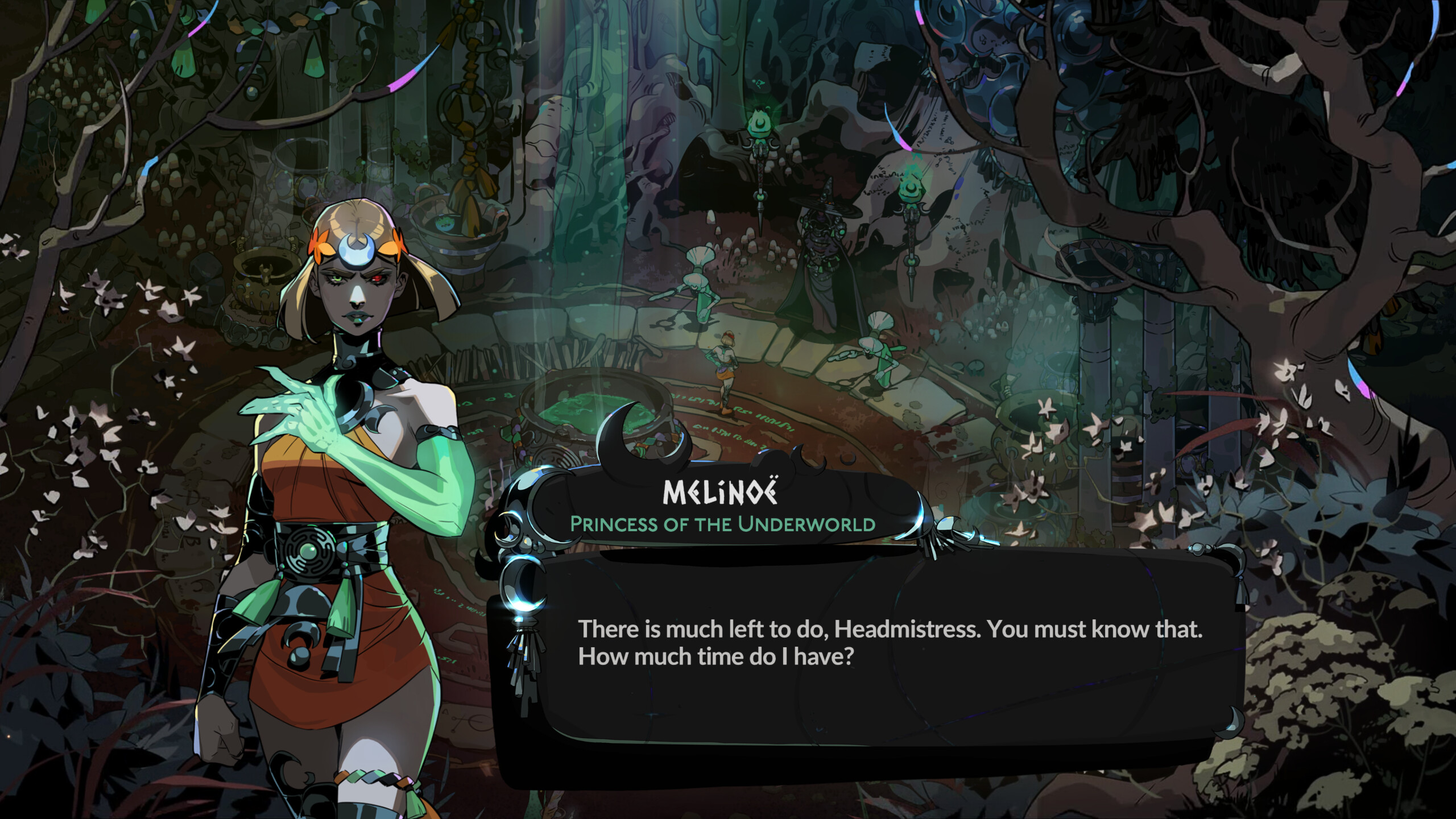
I bet you’re wondering where Melinoë got that ghost-arm, eh?
Coral Crown – Darren Korb (feat. Erin Yvette, Ashley Barrett, & Judy Alice Lee)
The story of the original Hades was one of teenage angst and rebellion. As Zagreus, you would hurl yourself night after night from one of your father Hades’ palace windows, carving a bloody path through Tartarus and beyond in a desperate attempt to reach the surface and reunite with your mother, Persephone. Hades II keeps the familial drama center stage, but flips the script to tell a story of revenge. This time, you play as Melinoë, Zagreus’ younger sister, and your mission is as straightforward as she declares in her first spoken line: “Death to Chronos.”
In the aftermath of the first game’s events, Chronos—the vicious and monstrous Titan of Time—has reconstituted himself and immediately seized the House of Hades, imprisoning everyone within and taking control of the Underworld. Unbeknownst to him, however, a few members of the House managed to flee in time—most notably the infant Melinoë, spirited away by the great witch Hecate. In the ensuing years, Melinoë has grown up in hiding, living in the Crossroads, a liminal space betwixt the Underworld and the surface, and training under Hecate’s magical tutelage for her lifelong quest: to slay the Titan of Time and free her family from his clutches.
It’s a great setup and a clever inversion—where Zagreus spent his nights trying to escape the Underworld and a life he never wanted, Melinoë spends hers attempting to break into that same Underworld to reclaim the life that was stolen from her.
It’s a testament to the design of the original game that Supergiant took a scalpel approach to its sequel—refining what already worked well while sharpening the rougher bits. The biggest change—though so cleverly disguised that you may not notice it at first glance—is that Hades II uses 3D character models atop its gorgeous hand drawn environments, rather than relying on dedicated spritework. Far from being a mere technical curiosity, this shift fundamentally alters the feel of Hades II’s combat for the better.
The action this time around feels less twitchy overall, with a greater emphasis on positioning, context, and flow. Representative of that shift is the complete rework of the original game’s rather awkward Cast system, which is now a single-use area-denial spell that locks enemies in place. The dodge ability has also been scaled back—it now has only a single charge and a longer cooldown—with the trade-off that holding down the dodge button now allows Melinoë to sprint. Other spam-rewarding mechanics, like wall slam damage, have been removed entirely. This all results in a slightly slower, more technical nature to the combat that rewards timing and improvisation over button-mashy speed—a change I deeply appreciated.
This more technical approach to combat is bolstered by an expanded set of options. In the original game, Zagreus’ basic moveset was bound to the four controller face buttons—Attack, Special, Cast, and Dodge. Occasionally, a weapon might feature a unique action triggered by holding a button, but that behavior was inconsistent. In Hades II, this mechanic has been standardized across all weapons and given a name—Omega Abilities. Holding down the button for Attack, Special, or Cast now charges a more powerful Omega version of that move in exchange for a portion of the new Magick resource. When timed well, these abilities can carve wide openings through a swarm of Satyrs or take a king‑sized chunk out of a boss’s health bar—a very satisfying additional piece of kit.
This all contributes to a greater range of build variety—perhaps the most exciting aspect of Hades II. The Mirror of Night, Hades 1’s progression system—the “lite” to its “Rogue”, so to speak—has been fully reworked, in true witchcraft fashion, as a grid of Tarot Cards, each with their own effect and requisite cost. Melinoë is able to create a “spread” of cards, forming the build, by spending a finite resource called Psyche. And, in a fun twist, certain special cards only activate based on the position of other cards in the grid—e.g. activating all cards in a single row or column to make a straight line. You can save one Tarot formation for Omega-focused builds, another that synergizes well with a particular weapon, one focused around Death Defiance, or another on forgoing the Death Defiance system altogether in favor of raw stat increases. The Mirror of Night system, by contrast, gave you everything you needed to simply make the game easier, with the only player choice being whether to take one buff over its alternate—a decision largely in name only, as I rarely found those tradeoffs to be particularly well balanced.
It’s impossible to talk about a game from Supergiant without touching on the music of Darren Korb. He’s been the heart and soul—and sometimes, in the case of Zagreus, even the voice—of Supergiant’s games since the beginning, bringing his unique acoustic rock/trip-hop stylings to bear on their games, elevating them to truly memorable experiences. And while Supergiant’s games have always been known for incorporating a standout musical interlude of some significance, these have historically come in the form of swooning ballads or otherwise acoustic tracks highlighting the vocals of Ashley Barrett. In Hades II, Supergiant instead pays tribute to their longtime musical collaborator by giving him the space to fully rock out, dedicating an entire boss fight to his and Ashley’s musical talents. At the climax of Oceanus—the game’s second area—Hades II kicks the doors off for a operatic showdown between Melinoë and Scylla—the sea monster of Odyssey fame—and her bandmates of sirens. One part gank fight, one part rock concert, it’s one of the coolest moments of the entire game. As each of the band members are slain, one by one, their part of the track falls out of the audio mix—whether drums, electric guitar, or the vocals themselves. And not only that, but because this is a Hades game after all and they know you’re going to be doing this fight over and over and over again, they recorded a whole setlist for Scylla to rotate through over the course of your playthrough. It’s so dope.
The Scylla fight, as wild and reminiscent of Remedy-style musical sequences as it is, is not the sole standout boss fight—far from it. Hades II has a significantly expanded pantheon of bosses versus the original, and nearly every fight is a huge step up in terms of boss design. This helps enormously when it comes to replayability—as there are significantly more bosses to test your builds against, as well as mini-boss fights that don’t appear on every run. That focus on replayability also extends to the runs themselves, as there are two distinct paths from the Crossroads you can take—one downward, to the bowels of the Underworld and Chronos himself; one upward, ascending Mount Olympus, where the monster Typhon is laying siege. Each run has unique maps, enemies, resources, and bosses, providing an enormously welcome way of mixing things up.
Of course, at the end of the day, it’s the characters that breathe life into Hades II and give it distinction among the increasingly crowded roguelike genre. Rather than rely solely on previously written characters to push the narrative boulder uphill, lead writer Greg Kasavin clearly saw the change in protagonist as an opportunity to explore an entirely new cast of characters from Greek myth. Most notably, Hades II dives deeper into Nyx’s brood of asexually created children—adding Eris (strife), Moros (doom), and Nemesis (retribution) into the mix, as well as some others I won’t spoil. A particular standout for me is Eris, whose spiteful playfulness made for an excellent foil to the mission-minded Melinoë—while you and Hecate somberly form summoning circles with the shades for new incantations—so mote it be—you can rest assured that Eris is off in some remote corner of your camp, littering and talking mad shit.
The Supergiant signature, for which the workaholic Greg Kasavin is largely responsible, is having its games respond to the actions of the player in meaningful and oftentimes surprising ways. It’s a great way to create player agency in the story without outright offering up dialog options. There’s a ton of dialog in Hades II, but it rarely feels like you’re passively listening to NPCs drone on, because more often than not they’re discussing something that you—the player—did. Characters will comment on the last thing that killed you or even what weapon you’re carrying. Bosses will note if you arrive to their arena with particularly low HP, as well as give you a nod of respect if you manage to beat them without ever getting hit. The gods, petty hotheads that they are, will remember how many times you picked another god’s boon over theirs, getting increasingly insecure about it—for me, it was Poseidon, which was especially funny given his otherwise “chill bro” demeanor. The sheer amount of written and recorded dialog in Hades II is actually absurd. After well over 100 hours put into this game, I was still blown away, finding new and increasingly sillier edge cases that—well wouldn’t you know it—the developers had accounted for. At the risk of spoiling an easter egg, I will say that one of my absolute favorites involves a particular boss who will take issue with your adjustment of certain in-game volume settings. For longer than you could reasonably expect, Hades II is engaged with you in conversation, riffing on every little thing you do. That cycle of acknowledgement and self-awareness should wear thin eventually, but it honestly never did for me.
But it’s the postgame where Hades II truly won me over into total obsession—having access to more and more of the gods’ unique keepsakes, the purging pools, dice of the fates (that’s what I’m gonna call them), the various weapon aspects, as well as Melinoë’s own ragtag squad of animal familiars all provide just enough probabilistic control over the RNG to dial-in some hyper-specialized runs. With these tools in hand, character builds feel less like “I’ll take whatever I can cobble together” and more like “I’m going to take the Aspect of Circe with Raki as my familiar, Zeus’ cast boon plus Double Strike, then stockpile Hera boons until I can cash them out later via King’s Ransom”. Once you start being able to pull off nonsense like that consistently, it’s really difficult to pull yourself away from this game. Not only that, but the Heat system from the first game—which makes a return here as the quite similar Fear system—still remains one of my favorite postgame difficulty modifier systems for a roguelike game. It allows you to strategically weigh your risk versus reward, and evaluate what kinds of difficulty modifiers are fun for you versus which just seem like a bad time. There’s always some new way to increase the challenge and keep the game interesting.
Unfortunately, it’s not all sunshine and rainbows. It pains me to say this, but Hades II’s ending left me feeling pretty cold. I’m sure there was a temptation to have Hades II cap off its story on a similar emotional note—where its central Cthonic family is able to reconcile and grow stronger from the trials and tribulations they’ve endured together—but that worked better given the first game’s more lighthearted and playful tone. Here, the situation presented all throughout the story leading up to the ending is so bleak and so dark—which I don’t mind as a change in direction on its own—that to pull back from that in the 11th hour feels unsatisfying at best and like a betrayal at worst. Regardless of those misgivings however, Hades II is still hands down the most addictive game of the entire year, and a real evolution in Supergiant’s ability to craft a deeply satisfying action game. Death to Cronos, long live Supergiant.
3. Blue Prince – Dogubomb
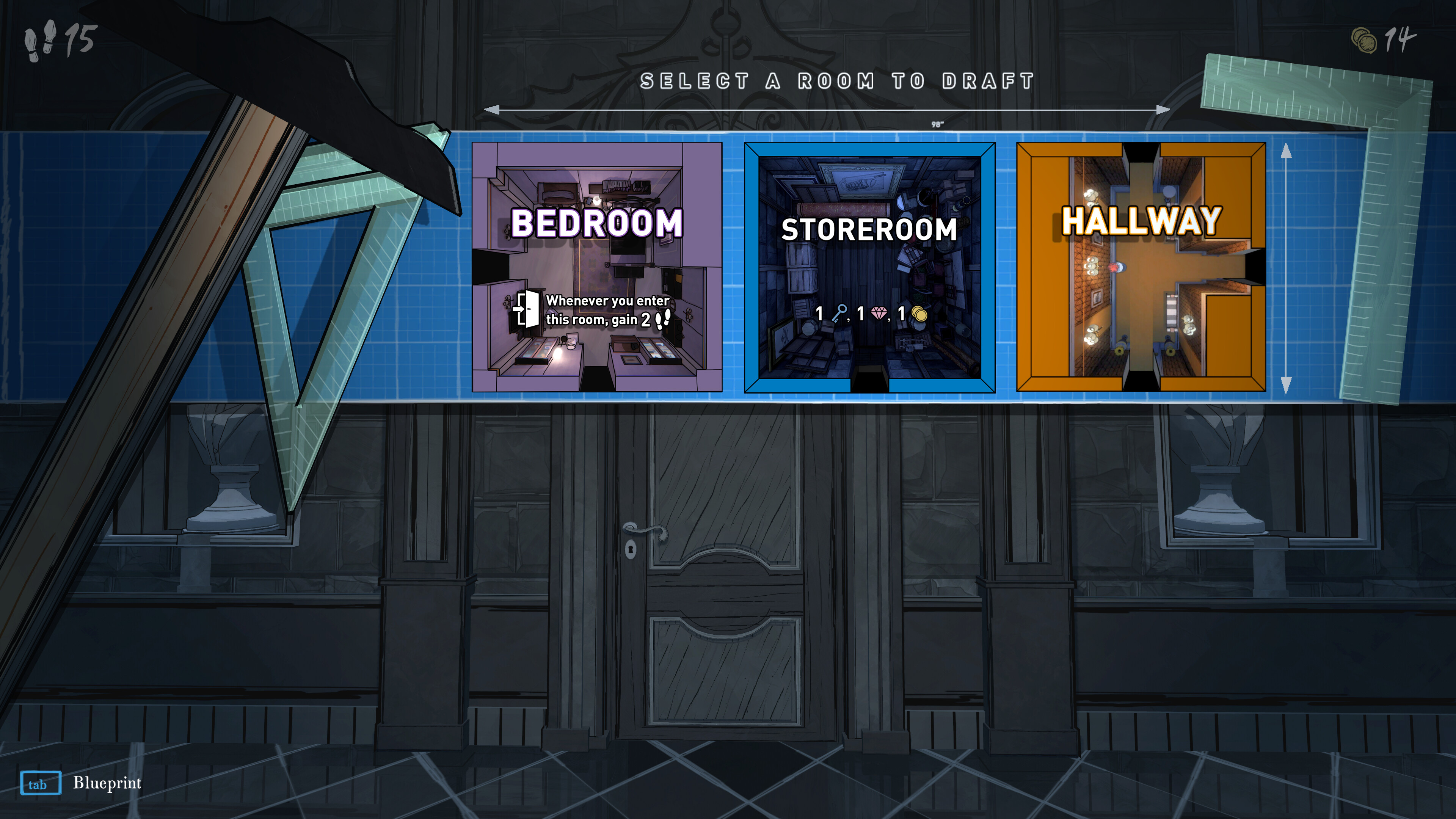
You’re gonna wanna build the Storeroom here, trust me.
Bequest – Trigg & Gusset
When you think about it, there’s nothing about the roguelike formula that requires a game to be an action title with a high skill ceiling—that’s just the way we typically conceive of them. Last year’s knockout hit Balatro drove that point home in a striking, unexpected way, shuffling roguelike ideas like run-based structure and RNG elements into a poker-themed deckbuilder. The result sounded strange on paper but ended up being one of the most addictive roguelikes in years. This year, the title for most unconventional piece of roguelike genre origami goes to Blue Prince, a wild concept that fuses the puzzle-solving and secrets elements of Myst with the house-building components of tabletop games like Betrayal at the House on the Hill, all while sticking to the core roguelike tenet that your progress and resources reset with every attempt. And let me tell you, even though it is dramatically different than Balatro—or any other roguelike yet made, for that matter—it is every bit as difficult to put down.
The core concept of Blue Prince starts out simple enough. You play as Simon P. Jones, who inherits a sprawling 45-room mansion from his late great-uncle, Herbert S. Sinclair. There’s a classic mystery stipulation in the will, though: to claim it, Simon must find the mansion’s secret 46th room. Tricky, since the mansion reconstitutes itself nightly, wiping all but two fixed rooms and leaving the rest’s layout up to you. The house is a 5×9 grid of tiles, forming the 45-room canvas for your builds to inhabit. Each day, approaching a door presents three randomized options for the next room to be built—or drafted, in the game’s architectural parlance. Some, like the Corridor or Spare Room, push straight forward; others, like the Walk-in Closet or dreaded Lavatory, are dead ends with no onward doors. Each time you draft a room, it gets removed from that day’s Drafting Pool—no repeats.
So yeah, at the start of Blue Prince, you’re arranging rooms like Lego bricks, connecting their doors to one another in an attempt to get from one end of the grid to the other, and all the while trying to manage a handful of resources that limit your ability to make progress, such as keys, gems, coins, and steps. Most of your runs will end prematurely, as your lack of resources soft-locks you out of making further progress—e.g. a locked door is your only way forward and you have no source of keys.
You’ll eventually learn which rooms are likely to contain these resources, as well as discover the hidden synergies between certain rooms, slowly improving your drafting strategy as you accumulate this knowledge. You’ll learn how punishing the various Red Rooms can be, when and where to best strategically deploy them, and how to mitigate the worst of their damage. You’ll tinker around with the Laboratory’s experiment mechanic, finding the best ways to turn the RNG of the current run in your favor, maybe by making it so that every time you dig up some trash with your shovel, instead of getting the usual nothing, you have your allowance permanently go up by 1. Now that entire run can be about maximizing the number of dirt plots you can find, so you’ll want to venture toward the east and west edges of the house to focus on building Green Rooms.
This is all great stuff, but this is still just the surface level of the Blue Prince iceberg. Where things get really interesting is when you start noticing puzzles and motifs that span across multiple rooms of the mansion. Eventually, you learn to make sense of all those framed sketches that hang inexplicably in mise-en-scène of every room, or figure out how to crack your first of game’s many locked safes, revealing the red letter inside. You might even start taking note of all the rooms that have a particular kind of duct system running along their ceilings. Or maybe, as you notice that things outside the manor’s walls don’t reset each day, you begin exploring ways to unlock permanent upgrades out there. Tugging at one thread inevitably leads you to several more, and before you know it, you’ve spawned a lengthy task list of ideas to explore.
In this way, Blue Prince is the unmitigated, ultimate note-taker’s game. Whether you opt for a digital document or you’re more the pen and paper type, you will absolutely want to have a notepad of some type by your side as you explore the Mount Holly Estate. There is such a wealth of information to take in, from letters and books to photographs and strange glyphs. It’s not always clear when and where these details will become relevant again—due to the ephemeral nature of certain rooms—so it’s best to take a healthy number of screenshots to have an easy way to reference information.
That said, keep mind not to go totally overboard with it. The beauty of Blue Prince’s puzzles is that, in spite of how tempted you might be to jot down every insignificant detail of a room, the solutions rarely require huge leaps in logic or galaxy-brain levels of guesswork. If you find yourself counting the number of candlesticks in a room or experimenting with the clocks in the Den, it’s very likely that you’ve gone too far. Explore thoroughly enough, and the game will almost always give you all the evidence you need. In fact, most of the mysteries in this game have quite a few onramps to usher players toward discovering them. If you miss one hint, you’ll likely pick up another later down the line. In this way, Blue Prince is a much more forgiving experience than it might initially appear.
There’s a tension at the foundational heart of Blue Prince that undergirds the entire experience. The roguelike wing—where you throw out your resources and room layouts every day, starting over from scratch—is in constant contention with the puzzle-solving wing, which demands time and leeway to meditate on problems and experiment with ideas. If you keep waiting for the game to resolve this fundamental design contradiction, you’ll have a tough time. If you’re prone to tunnel vision, powering through one puzzle at a time, the RNG will constantly throw wrenches into your plans. It’s not that you can’t play this way—Blue Prince is remarkably flexible—but you can very easily come away feeling like the game isn’t respecting your time. If, however, you accept the game for what it is—embracing those massive gaps between the information-gathering phase and applying that knowledge—you’ll foster a mindset where no run feels wasted, sustaining the intellectual curiosity to push through when stuck.
What I like about this dynamic, in spite of its friction, is that it always presents the player with other things they could be doing at a given time. Rather than the pacing of a more traditional puzzle game, where the whole momentum grinds to a screeching halt, with you staring dumbfounded at your screen until you eventually manage a kind of eureka breakthrough, that “negative space” of the design is instead replaced with a reliable meta-game that you can lean on—i.e. placing rooms end to end and seeking to up your allowance—keeping your mind active while you ponder the problem or let yourself switch contexts to something else entirely. My favorite moments of Blue Prince often happened by near-accident, when I was pursuing some other near term goal, but found an opportunity to do something I had clocked a dozen runs ago. Being able to pivot on the fly like that when the stars align is a core ingredient of the Blue Prince secret sauce.
It’s difficult to put into words exactly the things about a puzzle game that you love so much without just outright revealing secrets. Blue Prince is a game that evolves based almost entirely on “what you know”, and so I could forever alter someone else’s experience with it by sharing the things about it that absolutely floored me. Puzzle games are also very subjective—their appeal is tied into how we each like to learn and problem-solve, and what is satisfying to one person’s brain might seem totally obtuse or unpleasant to another’s. What I can say then, is this: Blue Prince kept me captivated for dozens of hours, trying to unearth it’s enormous trove of secrets, and a huge portion of those hours were well after I saw the credits roll. It’s an embarrassment of riches.
2. Hollow Knight: Silksong – Team Cherry
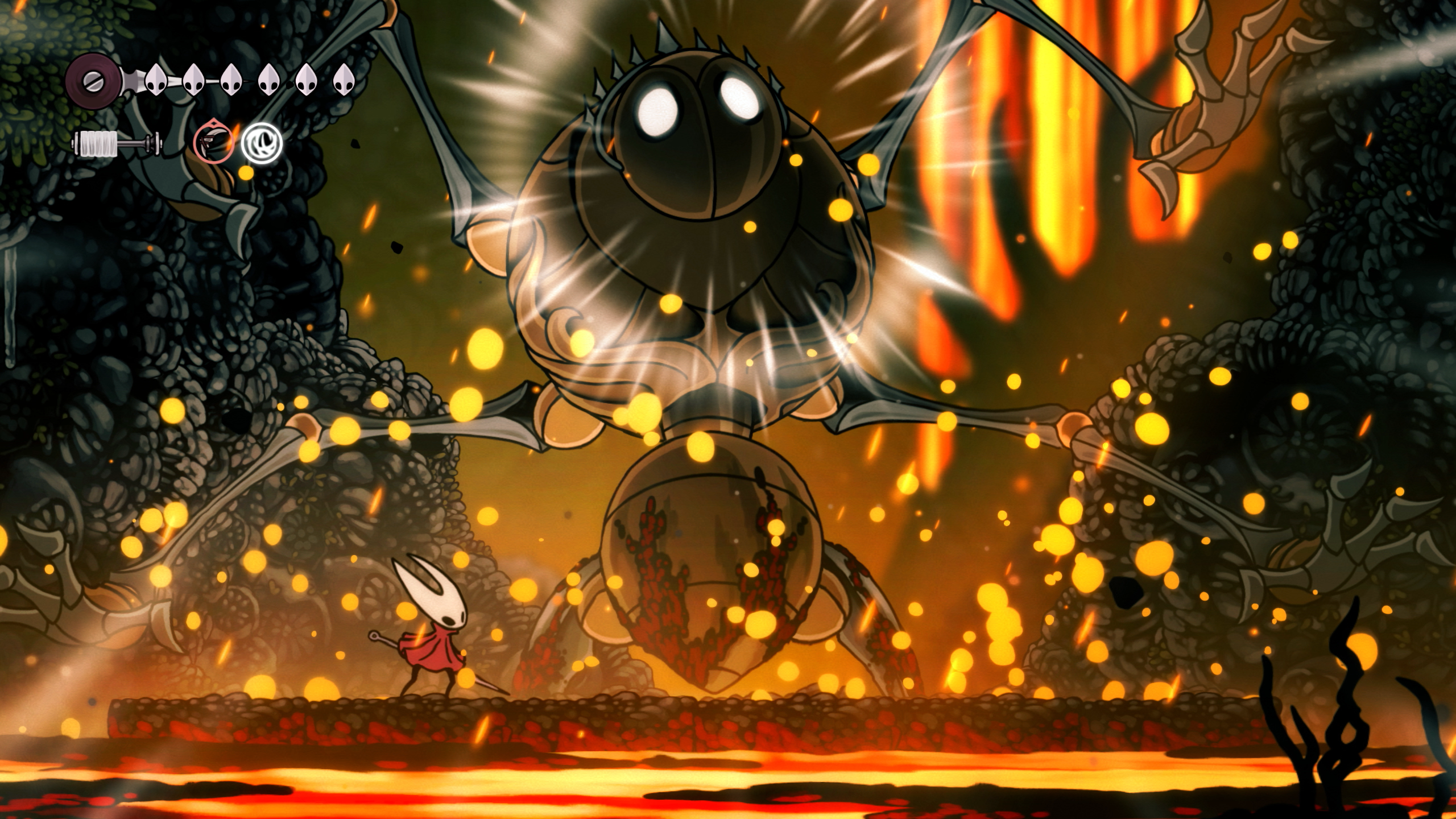
You’re dead, big guy. As soon as I figure out this new pogo, you’re dead.
Widow – Christopher Larkin
It was just last year—while writing about Prince of Persia: The Lost Crown—that I made a wisecrack at Team Cherry’s expense. I feel a bit guilty about that now. At the time, my joke was that, with Hollow Knight: Silksong entering its fifth year since its reveal trailer with more or less no new information, it was starting to sound like a doomed project. In that context, I surmised, the criminally underrated The Lost Crown—which drew clear inspiration from the design of the original Hollow Knight—might be the closest thing we’d ever get to the increasingly elusive Silksong.
Then, in late August of 2025, Team Cherry—seemingly out of nowhere—dropped a new trailer for Silksong and announced it would be releasing just two weeks later. It’s a move I respect the hell out of: having enough faith in not only your game, but your community, to forgo the hype cycle in favor of an “it’ll come out when it’s done” mindset is a much more honest and reasonable way to launch a video game. What I respect even more, though, is the quality of what all that development time produced. Silksong, as it turns out, was worth the wait. This is easily one of the best Metroidvanias ever made—and maybe my personal favorite of any I’ve played.
Hollow Knight was originally conceived by Ari Gibson and William Pellen during a pair of Ludum Dare game jams between 2013 and 2014. The theme of the second jam was “Beneath the Surface”, and—in keeping with that prompt—Hallownest was envisioned as a subterranean network of interconnected tunnels, an ecosystem in which a variety of bug tribes coexisted. Silksong’s Pharloom—and Hornet’s journey by extension—inverts this concept, asking the player to ascend to its highest peaks to reach the Citadel, a holy site for the region’s bugs, many of whom have died attempting the same treacherous climb. Where Hallownest’s atmosphere was tinged with a cool blue, Pharloom instead bursts with vibrant greens, golds, and reds.
Pharloom is a spectacular Metroidvania setting—an intricate assemblage of diverse locales, both lively and desolate, woven together by a network of tunnels that intersect in surprising and occasionally confounding ways. The charming characters that populate it are bursting with personality; their little vocal-stim bug-greetings lodge themselves in your brain, compelling you to call back to them in warm response, their presence such a welcome sight amid the storm of hostility you typically face. Exploring this world feels at once incredibly dangerous—doubly so until you discover the telltale breadcrumb trail of the map merchant Shakra or find a reliable bench nearby—and endlessly compelling as you sniff out shortcuts and poke-test every wall for secret passages. Team Cherry knows this, and frequently dangles the comfort of a safe haven in front of you, only to cruelly yank it away at the last moment—a move perhaps a bit too mean-spirited for some, but I couldn’t help marveling at the sheer audacity it took to use a bench as bait to get me killed, the Aussie cunts.
I have to own up never particularly loving the platforming feel in the original Hollow Knight. The controls were extremely tight—a choice that served the combat beautifully—but the jumping and air control felt too rigid and stiff for my taste. (Maybe that’s a hot take; you can’t design Super Meat Boy-level gauntlets like Path of Pain without dialed-in controls.) Silksong, though, strikes a much better balance between precision and fun. Hornet’s movement feels both lithe and forgiving: she auto-mantles platform edges when close enough, and later uses her cloak like a parachute to slow her descent. Outside of just the controls themselves, the quality of animation really sells the intention of her movement—she leans dramatically into the direction of her run, her crimson cloak billowing around her—and this more expressive animation strengthens the feedback loop of controlling her. By the late game, Silksong throws some seriously challenging platforming scenarios your way, but they always feel manageable and achievable, even if they demand practice. All of that learning culminates in a gloriously volcanic escape sequence near the game’s end that feels right out of the Ori series—only better, because every inch of airtime was hard-earned.
This greater sense of aerial mobility extends to the combat as well. Hornet is much more agile and fast than the Knight, and Silksong’s enemies and bosses are all designed around that fact. As you acquire more of the mid-game and late-game abilities, bosses respond in kind, forcing you to make fuller use of the combat stage’s vertical space. Positioning is everything here, and the absurdly punishing contact damage dealt by certain bosses is meant to tip you off to that idea. Actually, the process is a bit more forceful—and painful—than I’m making it sound. There’s a particular way Silksong wants you to play: don’t get greedy, prioritize movement over damage, and always be mindful of your distance from the boss’s hitbox. You can try to fight it, forcing your own ideas about how much DPS you’d rather be doing, but Silksong will happily kick sand in your eyes until you get the message. In this way, Silksong’s combat model is fairly rigid—less Elden Ring, more Sekiro—but it’s within that rigidity that the game’s boss fights truly shine. With less room to cheese fights, each boss demands a certain degree of respect from the player.
When Silksong is operating at peak, it’s a true tour-de-force of boss design. Whether it’s the frenetic speed of fights like Widow or The First Sinner, the graceful dance of Skarrsinger Karmelita, or the melodramatic theatrics of the Trobbio fight, the game packs in so many memorable and imaginative bosses that you start to understand where those eight years of development time went.I have to shout out the Cogwork Dancers fight, which ranks right up there with FromSoftware’s best for how it tells an evolving story through pure combat—a highlight in a game already frothing with quality bosses.
Silksong is a game for the true sickos—a Metroidvania that makes white-knuckle boss fights the reward for exploration, rather than the impediment blocking it. Okay, maybe that’s only partially true, since the game does have a few straight-up gatekeeper bosses that are there to skill-check you, but there’s certainly far fewer of those than you might think. To explain why involves diving into Silksong’s design philosophy, world structure—and most importantly, the biggest reason I love it so much.
Let’s start with the numbers and work backward. In Hollow Knight: Silksong, to finish Acts 1 and 2 and see the normal ending, you only face 9 required boss fights—just 9 gatekeepers standing between you and the credits. If you’ve played the game and know how sprawling its world is—and how extensive its boss roster—you’re probably thinking that sounds wrong. I did too. But it’s true. In and of itself, that information isn’t particularly useful outside of Any% speedruns, but here’s what it illustrates: when a challenge in Silksong feels insurmountable, there’s almost always another path. The game guides you down a clear main route, but if you double back from the meat grinder, you’ll find plenty more to explore—and rewards for doing so.
Take my favorite example: the end of Act 1, and the boss fight against the meta-textually named Last Judge, who normally bars your final entry to the holy Citadel. This is one of the game’s bigger difficulty spikes—not least because the punishing runback from the nearest bench demands precise movement and platforming. (Not for nothing, though: optimizing that runback for speed and safety actually makes you a better player.) You can keep bashing your head against this wall, or you can double back and go map-poking—checking all the unfilled edges of your map you were previously locked out of—and, if you manage to find it, discovering a secret backdoor route into the Citadel that skips The Last Judge entirely. This alternate route requires a greater emphasis on puzzle-solving and ingenuity, and will still ask you to clear a boss fight—albeit a much easier one—but serves as a rewarding secondary path for players more interested in exploration. This is just one example of a design philosophy that runs throughout Silksong—things are never as straightforward as they first appear.
If Silksong’s design philosophy is my favorite aspect, its player customization system gives me the most pause. The original Hollow Knight used a simple but effective Charm system, letting you spend a budget of Notches on upgrades weighted by power level. Silksong keeps the core idea intact but dramatically rebalances it. These buffs—now called Tools—fall into three color categories: red for active combat abilities, blue for passive combat abilities, and yellow for passive utility. You slot them into various Crests, each offering a specific mix of colored slots. This setup largely eliminates Hollow Knight’s awkward trade-offs, where combat Charms competed for space with navigation quality-of-life upgrades. Now, for instance, you don’t need to unequip your compass just to fit in one more combat buff.
The Crests, each with their own unique spread of Tool slots, are inextricably tied to Hornet’s moveset. Swapping the Hunter’s Crest for the Wanderer or Reaper changes your attack speed, range, and—most critically—your down-swipe (“pogo”) attack. It’s an ambitious system: Team Cherry has effectively given Hornet 7 distinct movesets, each with their own strengths and weaknesses. Yet despite this flexibility on paper, most players will find one Crest they like and stick with it for the entire game. Too many elements are bundled into the same piece of kit—changing Crests means overhauling your combat moveset, mobility options, and Tool slots all at once, a daunting prospect in a game with razor-thin margins for error. Want longer-range attacks for a tough boss? Good luck relearning the runback with completely different pogo muscle memory. Want to try those new red Tools you’ve collected? You might have to scrap your entire moveset just to make room.
At the end of the day, Hollow Knight: Silksong is a towering Metroidvania with unique contributions to the genre. Chief among them is its gorgeous, expansive soundtrack by Christopher Larkin—one of my favorites of the year. The scope of what he created is tremendous: “Blasted Steps” and “Cogwork Core” evoke the otherworldly mystery and awe of Kenji Yamamoto’s Super Metroid and Metroid Prime scores, while tracks like “Greymoor” and “Underworks” carry the sort of haunting ambience and dreamlike strings of Ryan Amon’s compositions for the Hunter’s Dream in Bloodborne. Then you’ve got just absolutely gorgeous ambient piano pieces like “Choral Chambers” and “High Halls”, that I’d imagine are going to be featured as the background music for many a YouTube video essay in the coming years.
Hollow Knight: Silksong is one of those singularly cohesive games that, even with my nitpicks, simply overwhelms them all with its presence. I’ve complained about it more than any 2025 release—as you tend to do when your ass is continually handed to you. Hell, I’m not even particularly good at it, something I have no problem admitting. Forget all that, though: Silksong is an incredible achievement, and I’m already itching for a second playthrough.
1. Clair Obscur: Expedition 33 – Sandfall Interactive
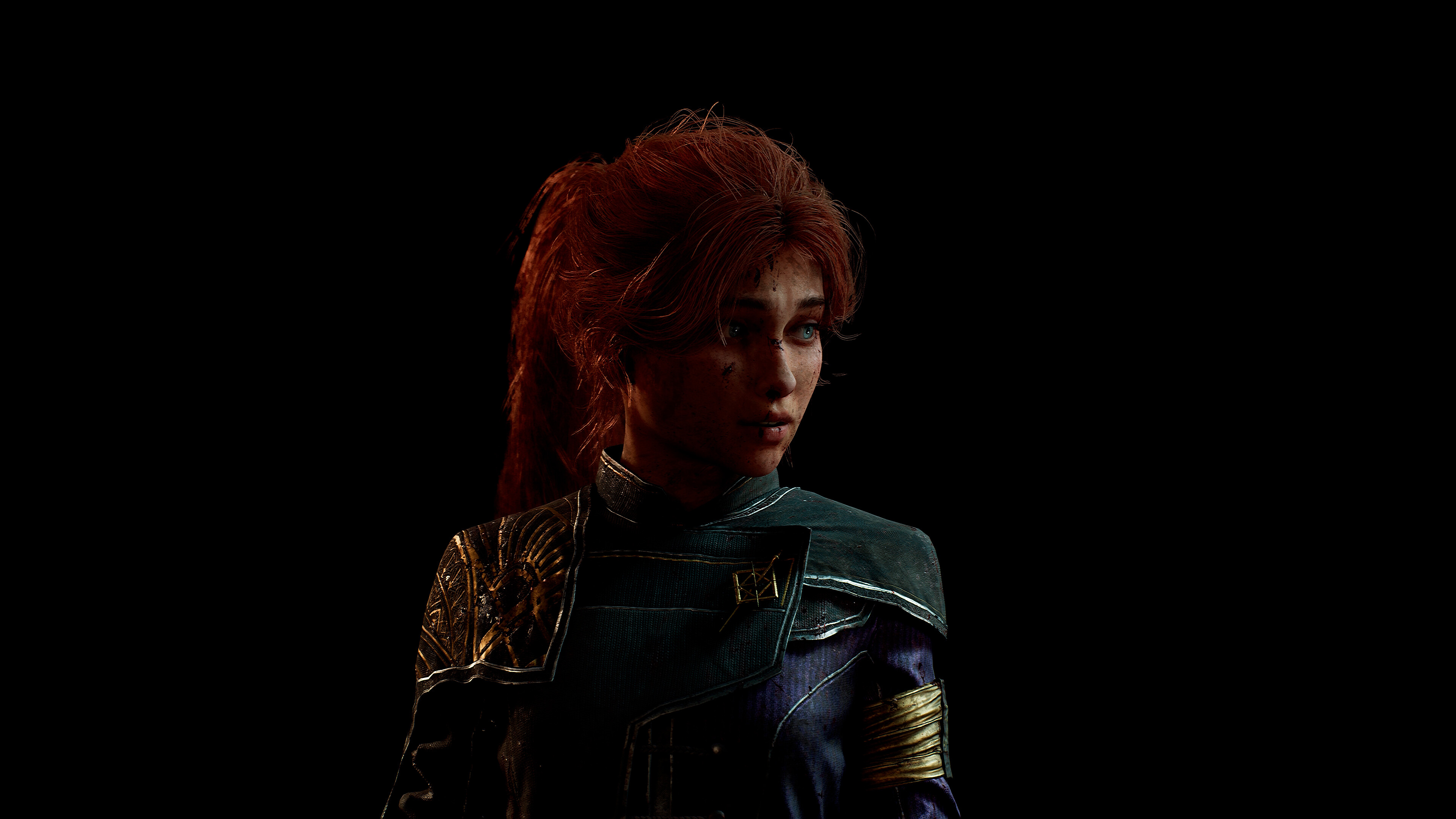
I wouldn’t look so distraught if I were you, Maelle. You’re the best character in the game.
Lumière – Lorien Testard & Alice Duport-Percier
In a year which saw indie game after indie game racking up dubs in the fight for the soul of the games industry, none landed a more definitive knockout than Expedition 33. Were this an anime, Sandfall Interactive would be the quiet guy in the corner who starts laughing the moment someone else claims to be the strongest. And for good reason: not only is Clair Obscur the best game of 2025—so says me—but it’s easily one of the best JRPGs of the last two decades – so says the French government, who quite literally knighted the developers. I don’t throw around terms like “instant classic” lightly, but if there ever was one, I’d say Clair Obscur fits the description to a tee.
Clair Obscur is one of those rare games that’s great not because one element towers above the rest, but because it’s firing on all cylinders—gameplay, story, music, and art design mutually reinforcing each other like carbon bonds. This synergistic quality kicks off with the game’s exceptional opening hour, introducing us to the city of Lumière—a fractured, uncanny version of Paris, complete with an Arc de Triomphe inexplicably split in half and an Eiffel Tower swooped sideways like a careless brushstroke—and our core cast, already discussing concepts like the Paintress, the Gommage, and Expeditioners well before we grasp what any of it means.
This is an early example of Sandfall’s worldbuilding approach: no exposition dumps or lore codexes, just story unfolding naturally while trusting players’ intelligence, curiosity, and ability to piece things together. You’ll feel it keenly during the prologue as the horror and heartache of Expedition 33’s premise slowly dawns on you—well before you grasp the logistics of it all. This gutpunch of an introduction primes you for the central story arc of the game: you will spend a very long time with this game before you actually understand what is going on, but it will draw you in so closely with its characters that you won’t mind being left in the dark. Expedition 33 trusts its audience to lead with their hearts, saving the raison d’être for later—a bold choice in this age of fantasy storytelling, where things are usually overexplained sooner rather than later, lest the story lose anyone at the first brush of confusion. Without spoiling anything, this is some of my favorite game fantasy writing in at least a decade, and the prologue serves as a thesis statement for how these types of stories should be told.
Now let’s talk gameplay, since I’m not spoiling Expedition 33’s story here. Clair Obscur features a combat system it calls Reactive Turn-Based. Sounds fancy, but here’s the genius: it takes the most boring part of any turn-based JRPG—the enemy’s turn—and completely inverts that dynamic, transforming it into the most exciting aspect of combat. Rather than being a passive observer during the enemy’s turn, watching your party members face-tank any number of attacks thrown their way, Expedition 33 instead gives you the tools to become an active participant, potentially negating all enemy damage in the process. Whenever an enemy starts a chain of attacks, Clair Obscur temporarily becomes a rhythm game, asking you to dodge or parry the enemy volley with the right timing. Dodges are easier to execute, as they have a wider window, but you’ll find that it’s almost always worth it to go for the parry—the tighter timing is offset by rewarding you +1 AP for every time you deflect a blow, and, should you parry away the entire attack sequence, your character will counterattack for huge revenge damage. Given this, you might wonder whether your party ever needs to sustain damage. Technically, no. Played perfectly, this could support a fully hitless run—one of the only turn-based RPGs where that’s remotely feasible. For 99% of us, that’s just a fun thought experiment, but it shows how radically Clair Obscur reinvents genre conventions.
Clair Obscur breaks more rules with its character progression. The interconnected Picto and Lumina systems are tremendous, letting you heavily customize each character—often with game-breaking combos of passive modifiers. One of the best parts is how they constantly evolve: as you unlock increasingly avant-garde Lumina and your party’s capabilities expand, optimal builds shift dramatically. Act 1 combat looks nothing like Act 3.
For example, in the early game, when your party members are AP-starved, you need perfect dodges or parries just to survive and build up for your biggest single-hit attacks. Deeper into Act 2, though, the 9,999 damage cap becomes the real bottleneck—pushing you toward weaker, multi-hit attacks. Act 3 flips it again when the cap lifts: gloves off, back to prioritizing massive single strikes. Dive deep into endgame, and you’re consolidating around one-shot trick builds—a single main damage dealer with two teammates handling setup, buffs, debuffs, and turn manipulation, setting the stage for your damage dealer to alley-oop a 40-kiloton bomb onto the boss. If you’ve ever been a “big numbers go up” enjoyer, Expedition 33 is a dream come true.
When it comes to party-based RPGs, I’m a big fan of characters that play completely different from one another. Whether through class systems like Baldur’s Gate 3’s D&D foundation or character-specific approaches like Final Fantasy 7 Remake’s action-hybrid style, it appeals to me in a deep way—requiring you to spend one-on-one time with a character rather than learn one universal combat system. It’s closer in nature to learning a fighting game or a MOBA, where your estimation of which character is “best” evolves as you experiment. Clair Obscur clearly shares this philosophy, giving its five playable characters fully distinct mechanics and movesets that suggest class roles without rigidly enforcing them.
For example, when playing as Gustav, your kit is centered around overcharging his prosthetic arm for a single, devastating blow. You build up charges, empowering his arm after every hit—gaining two for each critical hit you land—and are incentivized to attack with as many multi-hit strikes as you can during your setup turns before discharging the arm for huge, single-target damage.
As the elemental spellcaster Lune, you alternate between generating elemental tokens—the game calls these “stains”—and spending them to buff your subsequent attacks, creating fluid elemental combos you can drop into anytime.
Then there’s my favorite: teenage fencer Maelle, the party’s premier damage dealer. Her combat style is centered around her three sword fighting stances. Each attack leaves her in of these stances at the end of her turn—either Offensive, Defensive, or Virtuose—with each one providing passive buffs and/or debuffs to her while she remains in that stance. Many of her attacks are more efficient when executed from a particular stance—either costing less AP or adding extra stacks of burn damage. So the goal with her is to find creative ways to switch between stances at the right times, based on what you need—ending up in Defensive stance for the enemy’s turn can be useful when you need to build AP, but you’ll want to find a way to land in Virtuose stance (granting her +200% damage) before unleashing her strongest attacks. And, if you can have time it such that the enemy is Marked at the same time, then you really start to glimpse her true damage potential.
In this way, Clair Obscur’s combat system is always asking you to think multiple turns ahead, establishing patterns of setup and payoff that feed into one another. These start simple enough—use this attack followed by the next, rinse and repeat—but as you begin acquiring new weapons and Pictos that expand the possibilities open to you, you’ll begin to consider things like turn order and how different characters can be the setup for one another instead of thinking in purely isolated terms. This is the wellspring from which all of the game’s build variety springs forth—no matter what, Lune is going to play, more or less, like Lune, but nothing says that her role in your party can’t be in service of marking targets at the end of her turn so that Sciel—who’s been quietly building up her Foretell in the background—is ready to press the “fire everything” button.
This gets even more interesting given the game’s difficulty and your party’s general squishiness: it’s one thing to have a game plan going into every fight, but what happens to your setup when you miss a critical parry, and suddenly Lune goes down? Does your team fall apart completely without her, or can you improvise? In an easier turn-based RPG, where the threat of losing a party member is a rarity, this wouldn’t matter, and you could always rely on your comfort strategy—and hence, the negative stereotypes of repetition that JRPGs are known for. Clair Obscur, at its best, is built around those moments where you do make a mistake, and the suddenly, the pressure’s on—can you lock in and pull this out? It’s why nothing sounds quite as good as that parry sound, and why those brief moments of slow-motion just before a huge hit will have anyone with a pulse ready to throw a fist in the air. Sure, to some extent, it’s because the number is big, the sound effect is hitting all the right psycho-acoustic notes, but it’s more than that—it’s because you managed to pull a victory from the jaws of defeat. And, if that feeling is not in perfect harmony with the story of Expedition 33—about carrying on in the face of the impossible odds—I don’t know what to tell you. That, my friends, is game design—in it’s purest form.
Voice actor Ben Starr has, in numerous interviews for both Final Fantasy XVI and Clair Obscur—games where he plays central roles—spoken with reverence about Final Fantasy VIII, and how his experience with it in childhood got him into gaming. This got me thinking about Expedition 33’s role as a modern heir apparent to Final Fantasy’s golden age, a core influence cited by Sandfall Interactive. While FF6-10 had their shortcomings (VIII especially), what they nailed was centering everything around core concepts and universal themes. That’s the signature quality making Clair Obscur feel so distinctly nostalgic for that era. This is a game which, from its outset, is centered around a high concept idea, and you can feel that idea drawing thematic inspiration from Square’s greatest era—there’s the resilience found in VI’s story, the breaking of fated cycles that VIII hinges upon, and especially the sense of loss that is so central to the plot of VII.
Every character in Expedition 33 has been touched by death in some way. For some, the grim certainty of its approach makes the idea of bringing new life into the world feel like cruelty. For others, death cannot claim them directly, condemning them instead to bear witness as it snuffs out everyone around them. There are even those for whom death took more than its due, leaving behind a grief so consuming that it devoured what remained of the loved ones who survived. Some know exactly when their loved one’s own end will come—the curse of that knowledge altering the course of time they still have left. Some are blindsided by it, and the sudden void of it proves too much to endure. Expedition 33 wrestles with the existential crisis of death in all its tragic incarnations.
When the veil is finally pulled back, deep into the game’s third act, and you finally discover the true nature of what is going on, there was a real chance that Expedition 33 could have undermined all that came before, reconstituting its story and characters as something smaller—their feeble struggles with mortality irrelevant in the face of this new information. There is no truer testament to the quality of the game’s writing then, than the fact that the story walks right up to that cliff’s edge, without ever falling. Instead of invalidating all that came before, the big revelation at the heart of Expedition 33 instead refocuses the story beautifully around the lengths that people will go to in order to escape their grief. It’s powerful, it explains everything about the game world—even the weird shit you didn’t think needed explaining, like Monoco or the Gestrals’ appearance—but never lets you forget the core of how it all makes you feel. It’s brilliant, pure and simple.
Not only is Expedition 33 an incredible RPG, its development story is inspiring in itself. Key contributors like writer Jennifer Svedberg-Yen and composer Lorien Testard were total unknowns—discovered by director Guillaume Broche on random internet forums and Reddit posts—with no prior game experience. If you haven’t, it’s worth watching any one of the multiple making-of videos that paint a picture of Expedition 33’s unbelievable development—perhaps one of the most captivating underdog stories that I’ve heard in a while.
I also feel compelled to mention the soundtrack for this game, which is an absolutely sprawling work of such sonic variety that I couldn’t believe what I was hearing was from a first-time composer. Tracks like “Lumière” capture the game’s haunting beauty and deep sadness, while “Flying Waters – Goblu” and “Ancient Sanctuary – Megabot#33” feel like you’ve stumbled onto B-sides from a long-lost Dreamcast masterpiece.
It’s hard to say enough nice things about Expedition 33. The game doesn’t need my endorsement—it’s already swept The Game Awards, earned BAFTA nominations, and generated endless word-of-mouth buzz. It’s one of my favorite games of the decade, lingering in my thoughts months later. It reminds me why I fell in love with video games, and I hope I’ve captured even a fraction of that magic here. Whatever Sandfall Interactive makes next is a mystery, but they’ve proven huge games can still come from small teams of fiercely passionate creators—a truth more valuable and hopeful than any single title.
 defectivepixeltest