2020 was a great year, with lots to do, places to go, and people to meet. If there’s one thing we can all agree on, it’s that 2020 was dope, and we can only hope that 2021 can be anywhere near as cool or memorable. However, supposing that you, for some reason, had a bad time in 2020 while all of your friends were out living it up, traveling to all the international cities you want to visit, and hooking up nonstop while you were at home playing Quiplash on Zoom with your family for the 18th time, then hey, at least you still have video games to make you feel better, right?
Well, sort of. 2020 was filled to the brim with disappointing games, games that were cool but ran like shit, games that were just pachinko machines dressed up to look like other video games, games that thought they were really smart and insightful but really were just didactic drivel with a hatred for their own characters and players, games that were Disney cash-grabs, and games that resented the notion that they need to entertain you in some way and couldn’t just focus on being the real them: a crypto-miner that installs itself on your PC.
But I mined the depths of the gaming-sphere this year in search of actual good shit, mostly because all the bars were closed but also because I had some time between my vacations to Tokyo and London, and figured I might as well write 10,000 words about my hobby so that I could kill time on the plane. Def real shit.
Quick obligatory notes:
- This is a ranked Top 10 list with 3 honorable mentions (unranked).
- Each game features a link to one of my favorite pieces of music from its soundtrack. Feel free to listen as you read.
- I consider the release timing of Early Access games based on when they exit Early Access, or enter V1.0.
- Remakes (which are becoming even more common these days) can be on my lists, but only if they are substantial enough in that the game is something fundamentally different. Examples of games I counted last year were Pathologic 2 or Resident Evil 2. This year, I didn’t consider a game like Demon’s Souls (even though I loved it) because it is mostly a visual overhaul to the 2009 original game. Hopefully that distinction makes sense and isn’t just arbitrary to you.
- I’m never able to get to all the games I’d like to by the end of the year. There are always ones that slip through the cracks. I typically like to list up front the games that I had the most interest in that I admittedly didn’t have time to get to. This year, my pile of shame is as follows:
The Pathless
Twin Mirror
Immortals Fenyx Rising
Now, on to the list…
Honorable Mentions:
Animal Crossing: New Horizons – Nintendo EPD
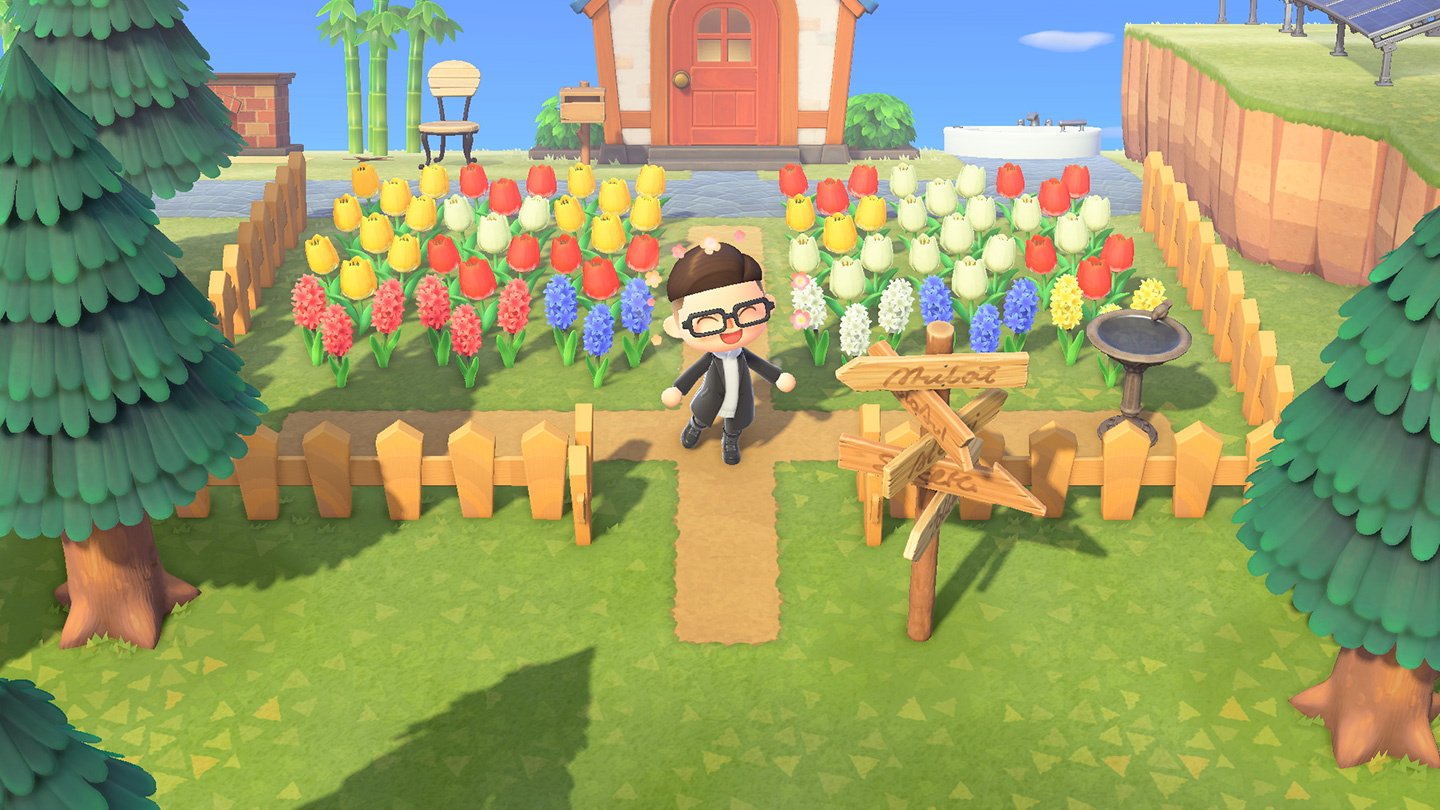
There were a lot of good reasons to be conspiratorial in 2020. It’s not every year that a worldwide pandemic breaks out and the entire government apparatus trips over itself in a rush to make large corporations and Wall Street speculators whole. There were, of course, a lot of bad reasons to be conspiratorial too, but I’m sure that goes without saying. But here’s the best reason to be conspiratorial – in June of 2019, Nintendo delayed their new Animal Crossing game into March of 2020. That’s riiiight as the first wave of lockdowns were happening in the Western world. Color me a bit skeptical that they didn’t know that millions of people would be at home and needing some wholesome escapism.
But it wasn’t all just good timing. There were a lot of welcome changes to the series too. For New Horizons, the series dons a Casual Friday Hawaiian shirt, becoming much more chill-vibes when it comes to allowing its players to tweak their own personal animal forest. Instead of letting new neighbors move in wherever they want, air-dropping their domiciles in shock-and-awe campaigns against your perfectly curated garden of golden roses, Tom Nook finally allows you to be the zoning coordinator for your island community. Nothing gets built without your explicit permission. Even the landscape itself is just, like, a suggestion, man. If you don’t like the energy that a certain river is giving off, just you know, turn it into land. And if you decide that the town museum would look way more feng shui on top of a mountain, that’s actually extremely cool with Blathers.
I for one really appreciate when a series as conservative as Animal Crossing can pack up the beach chair, grab a tall glass of vacation juice, and just vibe. 2020 was a year of extremely bad vibes, and despite Nintendo’s definitely-super-real conspiracy to release the game alongside a pandemic, ACNH did provide a way for everyone to socialize with their friends and do some light gambling on stalks while we waited for the bad vibe storm to blow over. Okay, maybe it’s been almost a year now and we’re still not seeing the light at the end of the tunnel, but hey, these were more innocent times. Just listen to that 5:00AM theme, ya?
Visage – SadSquare Studio
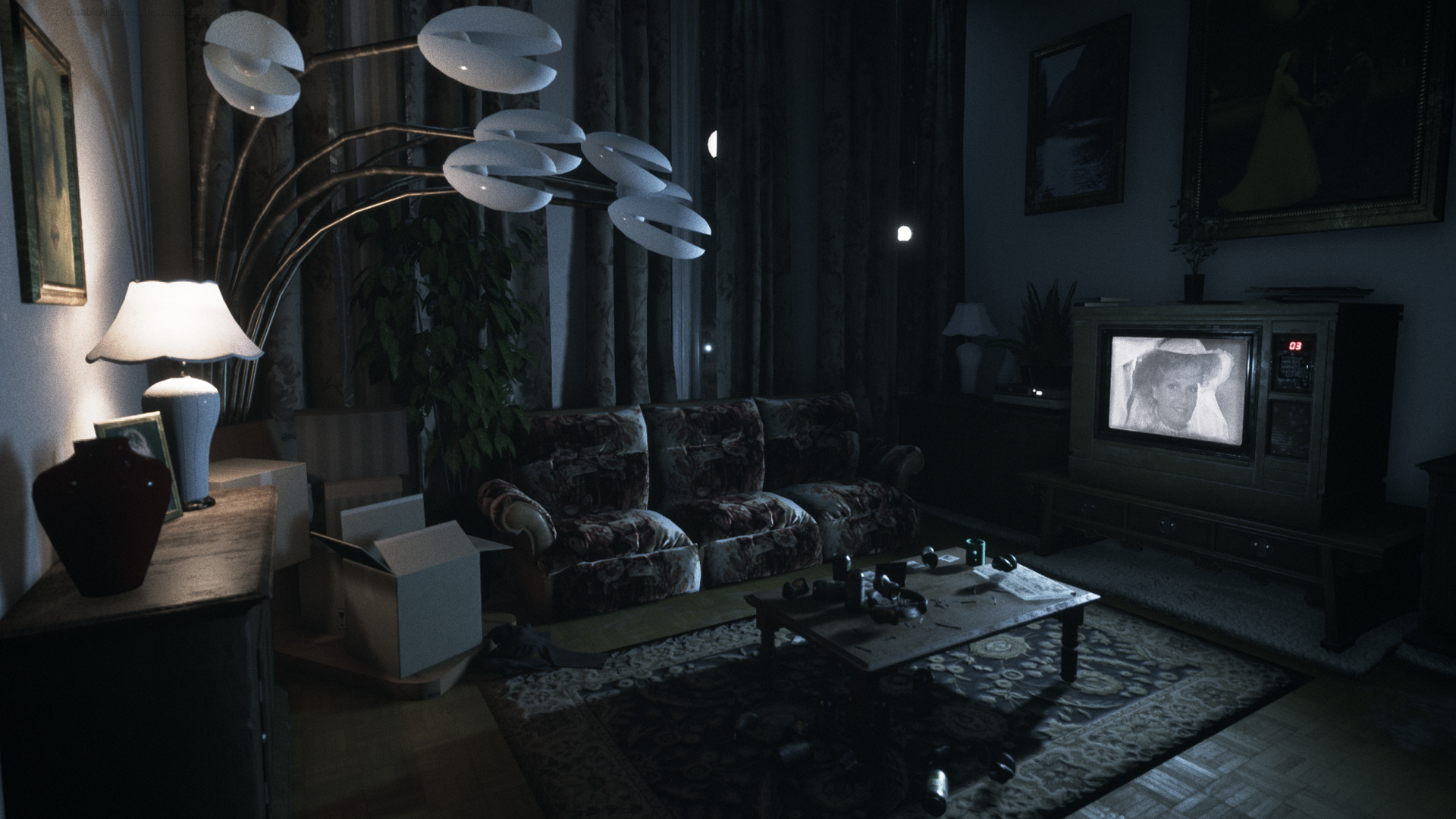
Probably the most tragic thing in the past decade of the games industry was the killing of the Silent Hills project. P.T., the brief glimpse we got of Hideo Kojima’s vision for the future of survival horror, spread through the imaginations of people everywhere like wildfire. It didn’t take long for a litany of copy-cat games to begin development. To this day, I don’t think I’ve ever seen a cancelled game that was so influential.
While there have been plenty of me-too attempts to recapture the magic of P.T., none of them have quite worked for me. That is, none of them until the early-access game Visage dropped onto my radar. It finally released in full in 2020, and gave me more than my year’s supply of screams in the process.
The premise of Visage isn’t anything novel. You’re trapped in a house with the vengeful spirits of those who lived there before haunting you. There’s a sanity mechanic where, if you stay in the dark too long, you will begin experiencing more and more spooky shit. The path to progress the game is very much like P.T. – intentionally obtuse and occasionally frustrating. Yes, there’s an old lady ghost, a creepy little girl ghost, and her imaginary friend she’s communicating with (think The Babadook). Even the architecture of the house is strikingly similar to the house from P.T. And the controls? Don’t get me started on how jacked up the controls are in this game.
But here’s the thing. Visage is scary. Like, really fucking scary. It doesn’t give a shit whether you can handle it or not. You agreed to be scared when you launched the game, and Visage knows what its one fucking job is.
First off, the imagery in this game is uncanny in ways that almost no other horror game has been for me. There’s a certain type of horror film, where, after you walk out of the theater to head home for the night, it can be hard to unsee a particular frame. Get in your car, check the backseat, you’re still thinking about it. Go home, close your eyes to go to sleep, and you still see it. That leave-a-light-on, don’t-let-your-mind-wander shit. That never really happens for me with video games. Horror games, in my experience, can be more intense in the moment than a horror film, but they don’t have that staying power. You can be scared shitless while playing them, but turn them off and it’s over. Have a good rest of your night.
Visage, on the other hand, fucking stayed with me. The lighting in the game is so good that it makes you nervous about every dark corner. The game gives you candles to light your way, but those are a limited resource that you’ll eventually run out of. The backup? The game gives you a handheld camera and you can use its flash to see where you’re going when you’re out of other options. That either already sounds like nightmare fuel to you, or you just need to get to the first time you flash a pitch-black corridor to reveal a ghost girl coming toward you with a syringe in her hand. Yeah, good luck unseeing that one.
Then there’s the game’s sound design, which is unpleasant in a way that’s hard to put into words. Sometimes it’s nails-on-a-fucking-chalkboard, running straight down your spine, and sometimes it’s just so fucking quiet. The quiet is what really worms its way into your amygdala. Because things are never actually silent in Visage. There’s always something happening in the sound mix, whether it’s the subtle hum of the house’s HVAC system, the droning of a lightbulb, the pained creaking of the old house itself, the tick-tick-ticking of an old grandfather clock, or just the pitter-patter of rain beading up on the windows. You likely won’t even be conscious to its effect on you while you play, but after enough time, even the most mundane rooms of the house will just feel off.
Visage is a game that’s hard to play. Both because of those controls I alluded to before, but also because it’s just so effective at what it does. Is it my favorite horror game I’ve ever played? No. Is it the scariest horror game I’ve ever played? Probably.
Resident Evil 3 – Capcom

Mr. X was one of my favorite concepts from any game in 2019. The idea of a relentless pursuer enemy that you can’t kill no matter how hard you try is just fantastic horror. 2014’s masterful Alien: Isolation is still probably the gold standard of how to do this, but in that game’s case, the entire experience was designed around the Xenomorph. Resident Evil 2’s remake, on the other hand, used Mr. X as a sort of complicating factor in a game that already had plenty of other threats to juggle. The best moments in that game were when you were busy trying to dodge a zombie bite while remaining juuuust quiet enough so as not to alert a nearby Licker, and then Boom!, that fedora-wearing asshole opens the door at the far end of the hallway – the one that was supposed to be your escape route.
After experiencing moments like that, it was hard not to think ahead to the next game from the series – the 1999 Resident Evil 3 – and its titular villain, Nemesis. The prospect of remaking that game next, complete with a modified Mr. X AI system, was immediately thrilling. Turns out that Capcom was way ahead of us. In a move that echoed the time between the original PS1 classics, Resident Evil 3’s remake dropped one short year later.
And while the game that we got felt like a missed opportunity to take more creative liberties, open up the scope to a larger city-scale, and to make Nemesis a constant threat, the end result was still an absolute blast of a game that I played through over and over in 2020.
With Resident Evil 3, Capcom chose to stick closer to the tone of the original game – namely, a tighter, more action-driven experience than RE1 or RE2. This game wastes zero time in setting things in motion, with the Nemesis quite literally busting through Jill Valentine’s apartment wall within the first 5 minutes. This intro sets the stage quite well for the pace of the game to follow, which is a mad dash to get out of Raccoon City.
I think they push a bit too far in this direction, cutting back on the winding, puzzle box level design that made RE2’s RPD so special. However, while it may be a step back in terms of map design, RE3 features significantly better boss encounters, a delightfully playful script and some excellent voice talent who really sell it, tighter combat thanks to the inclusion of a an immensely satisfying dodge move, varied encounter design with no one thing overstaying its welcome, and not to mention Nemesis – who, while most of the time is too tightly scripted and underused, is in fact, quite scary when he suddenly appears and rushes you down.
The experience itself is brief, with the game lasting only maybe 6 hours for an initial run. But I was never bored by the game, a compliment I can’t necessarily extend to last year’s RE2. While the RPD was phenomenal, S-tier level shit, the back half of that game could really drag, in keeping with franchise tradition. Resident Evil 3 is one of the only RE games I’ve played that didn’t start spinning its wheels by the final hours, and that was really refreshing to see.
So despite the shortened playtime, I probably sank 30 hours into RE3, speedrunning it again and again on various difficulties, with different modifiers, etc. It gets to be quite the challenge, but the game moves at the pace you set – get brave enough with that dodge and you can bypass tricky situations in a flash.
For me, Capcom’s renaissance has been one of the most exciting things happening in the games industry. It’s been such a joy to see Resident Evil, a franchise I’ve loved for a long while, back from near-irrelevance. If RE3 is to be considered one franchise’s “missteps”, then consider me excited as hell for the future.
Top 10:
10. Cyberpunk 2077 – CD Projekt Red
The scope of Cyberpunk 2077 as a project was clearly enormous. At some point, CD Projekt must have had to scrap a lot of ideas it was experimenting with in order to finally ship a finished product. Those choices, along with lots of questionable decisions along the way from the business end of things, rubbed a lot of people the wrong way. Some of that is the problem with following a big budget game’s marketing cycle too closely, but some of it you can spot from within the final release itself. Playing the final game, you can feel a lot of the alternate directions things could have gone in. Some ideas are toyed with for only a single mission, some for only a handful of scenes sprinkled throughout. Others are heavily implied or set up and never revisited again.
For all these reasons and more, Cyberpunk 2077 does not, sadly, live up to the studio’s previous game – the masterful Witcher 3. And while that’s a shame to say, it’s by no means damning. Behind the rough edges of T-posing NPCs, alleyways of exploding physics objects, and rain-soaked rooftops of unloaded textures, there’s a game world positively bursting with creative energy, populated with excellent characters, hidden quests, and deep lore that is worth uncovering. So while I could go blue-in-the-face making a caveat to each and every thing I say here, I think the ambition on display in Cyberpunk more than makes up for its flaws. So instead, let’s talk about what I think is great about it.
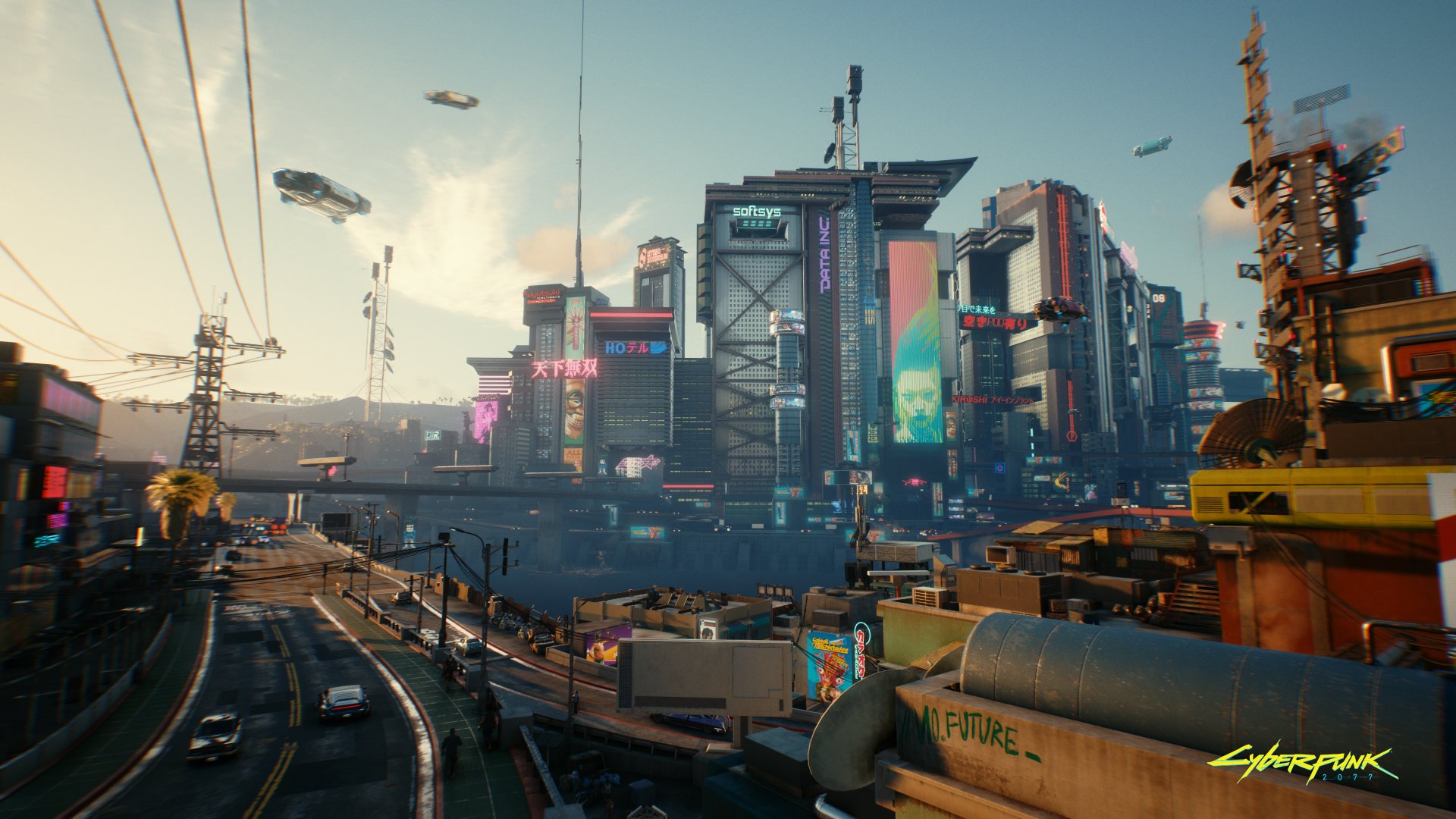
Up front, there’s the setting itself. Night City is Cyberpunk’s crowning achievement. Visually stunning and geometrically dense to the point of feeling overwhelming, Night City’s structures are stacked and arranged in disjointed ways that feel completely alien for an American city. Instead, much of the architecture of the game is inspired by Asian cities, where space is at a premium. The game’s monolithic Megabuildings – cookie-cutter apartment blocks seemingly built straight up into the stratosphere – call to mind the shockingly utilitarian apartment structures of one of the real world’s most overcrowded cities: Hong Kong.
The game world itself has a way of constantly reminding you that you are small; only a bit player. The towering buildings of the Arasaka Corporation, Biotechnica, and Militech loom over the city like the hands of gods while the ground level is flooded with abject poverty, the harsh, bloom-lit neon advertisements of everything from synthetic meats to sexual VR experiences with real MILFs in your area, all the while the loud PA systems blare “Walk!”, “Don’t walk!” from every street corner. Vending machines pock-mark nearly every pseudo-public space, even invading the interior spaces of apartments themselves, droning repetitive marketing until you can’t hear anything else but “Nicola! Taste the Love!”. It’s a hellish city of sensory overload that operates entirely on the logic of profit – armed paramilitary medics serve the highest bidders while repossessing the body parts of those who can’t pay debts, police departments rely extensively on freelance crime fighting contracts to deal with everything from gang violence to kidnapping, and labor strikes are criminal offenses to be met with immediate and violent retaliation. You can see the lack of a functioning government presence in the spaghetti junction roads, nonsensical outdoor elevators, buildings constructed on stilts above overpasses, and mass landfills wedged directly against the poorer districts of the city. Night City is beyond a housing crisis – it has reached housing Armageddon – and any concept of urban planning has been completely eroded. These bits of visual storytelling are littered positively everywhere, and they serve as a constant reminder that this is a world beyond saving.
So with as cold and dehumanizing as the city is, why should you as the player care about any of it? Well, fortunately the game’s diverse cast of characters is just as in-focus as its cityscape. All throughout The Witcher series, CDPR had a talent for making friendships, romances, and comradery feel worthwhile. That’s no different here. While many of the game’s characters, including V him/herself, can make abrasive first impressions, dig a little deeper and you can discover a strong humanity in almost all of them. Even the most hardass, cynical, and obnoxious characters, like rockerboy Johnny Silverhand, grew on me by the end of the game, eventually winning me over and solidifying himself as one of my favorite video game sidekick characters of all time. Hanging out with Kerry Eurodyne on his yacht or going diving with Judy Alvarez were beautiful moments that stood out to me as some of the most memorable in the entire game.
It’s that dichotomy between a debauched world of gaudy fashion and hyper-exploitation set against people just trying to survive that makes the game world so absolutely captivating for me. And that’s something that a shocking amount of dystopian fiction forgets about in the arms race to make an edgier, sadder, more violent hellworld. In keeping with Mike Pondsmith’s vision of his tabletop RPG system, Cyberpunk 2077 isn’t about saving humanity – it’s about saving yourself and those that you care about. I love that the game remembers this, and gives you plenty of people worth saving.
Finally, and because I still haven’t gotten to the gameplay at all, I really appreciate the build variety in the game and how fluid the class system is. Just about every mission in the game is designed to facilitate the various playstyles, whether that’s a non-lethal stealth ninja, full-aggro solo with heavy weapons, or even a netrunner build, hacking cameras and enemy cybernetics without ever needing to even leave cover. And if you get bored with a given playstyle, you can just start doing something else at any point and you’ll start spec’ing into those skills naturally. There’s enough limitations there to make subsequent playthroughs worthwhile, but you’ll still be able to dabble in everything. Combined with the perk system, cyberware, and the Deus Ex-style level design, there’s a lot of sandbox tools to solve challenges creatively. It’s just a shame that the enemy AI is so poor and each build can so easily become overpowered that you are rarely required to get imaginative with things.
Cyberpunk 2077 is a game I really want to love. It’s got excellent world-building, environment design, characters, writing, voice acting (female V, as played by Cherami Leigh is perhaps my favorite voiced protagonist in an RPG), and an absolutely killer soundtrack that I’m still addicted to. But the near-constant stream of bugs, AI issues, limited ability to roleplay V in dialogue, slippery driving controls, and absolutely crumby hand-to-hand combat were a near-constant distraction from the things this game does excellently. Over time and with a combination of patches and mods, it’s possible it will get closer to a state where I can unapologetically love it for what it is. Until then, it’s an emotional roller coaster of a game for me.
9. Factorio – Wube Software

Remember that feeling, in your high school or college, when you’d walk into a classroom or lecture hall just as a previous class was being dismissed but before the whiteboard had been erased – and let’s just say it was a higher level calculus or chemistry class in there before you – and the sprawl of the formulas just seem to stretch out so far in every direction that you couldn’t even begin to make heads or tails of what you were seeing? A lot of people get that feeling when they’re suddenly presented with hundreds of lines of computer code. Maybe, if you’re a STEM-lord, none of this is relatable. But then fine, nerd, imagine it’s an entire blackboard written edge-to-edge in Japanese Kanji. That’s how us normies feel sometimes.
And that’s exactly how it can feel when you see the end result of what the absolutely massive toolset in Factorio allows you to build. Zoomed all the way out, the game might look like abstract art to you. Just lines and shapes and arbitrary colors everywhere. Zoom in a little further and it might look like an ant hill or a bee hive – just buzzing, continuous activity that seems completely nonsensical. Zoom in a bit more, and it might look more like a printed circuit board, but still some impossible machine that overwhelms you. When it’s someone else’s factory, learning this game can seem like an impossible task.
But when you’re playing the game from square one, you realize how simple all the building blocks actually are. The basis of Factorio is simply to navigate a tech tree until you reach its end. Each new technology requires a certain quantity of “science packs”, which is a resource that you can manufacture and send as inputs to science labs. You can do this all by yourself, manually mining ore, smelting it, carrying it to an assembly machine, turning it into copper plates and iron gear wheels, and then combining those into “red science packs”. But the entire point of Factorio is automation. Doing things manually would take an unbelievable amount of time. Instead, you can create a mining machine, output the ore to a conveyer belt, send it over to the smelter, use an automated picker arm to insert the ore, and then ship the output over to your manufacturing, then those manufactured goods over to your science labs, and then that makes progress researching your next segment of the tech tree. Set things up right, and you won’t need to manually intervene at all. Click the segment on the tech tree you want to research, and watch the machine you built go to work on it.
Factorio starts simple, and builds to the absolute madness I mentioned before. Later in the game, there’s automated drones that exist within a network, and can be programmed to fetch whatever is needed and run it across the factory floor. There’s a complete railway system, more complex and customizable than some entire city builder games, which allow you to ship large quantities of resources or manufactured goods from one district of your factory to another. There’s even a blueprint mechanic, allowing you to copy and paste entire sections of your factory from one place to another in an instant. And yes, you can automate those blueprints too. Meaning you can have a factory that builds itself. Galaxy brain.
The beauty of all this, and what makes Factorio so much more special than a typical city builder or crafting game, is in how hands-off the designers are with telling you how to build. Everything in the game is just X number of inputs to make an output. Beyond that, how you choose to make things efficient is entirely up you. It results in remarkably organic gameplay, especially in the game’s co-op mode, where you’ll end up talking through your thinking with your friends and discussing the best way to tackle the next problem. It’s not so different from a programming team, where you need to break the task down into its smallest components and determine the best ways to approach each bite-sized bit.
All of that either sounds like an extremely satisfying gameplay loop to you, or it sounds like work. Factorio toes that line incredibly closely, and your mileage may vary with it. It’s not for everyone. But there’s nothing quite like getting your factory operating juuuuust the way you want it, zooming all the way out, and now, instead of being bewildered, you think: “Yeah, I made that.”
8. Ori and the Will of the Wisps – Moon Studios

It’s not often that you have the opportunity to play a sequel to a beloved game that outclasses the original in just about every respect. Ori and the Will of the Wisps is one of those games.
Moon Studios has truly outdone themselves here. The first thing you’ll notice immediately is the game’s visuals. The Blind Forest had some very impressive 2D art – it looked great. Will of the Wisps, however, is in a whole other league. This is without a doubt the most visually stunning 2D game I’ve ever played, and the only one where I would implore you to play it on an HDR screen, if possible. The dynamic lighting, the way the camera uses a parallax effect with multiple background layers, the bokeh depth of field, even the use of color theory is top notch. Just pull up any screenshot of this game. Seriously, any of them. There’s hardly a frame of this game that doesn’t look spectacular.
Then there’s how this game sounds. Gareth Coker has created a score for this game that will remind even the most dead-inside among us that they do, in fact, have a soul. The music here can be beautiful, soaring, majestic, even terrifying, and will surprise you at how effortlessly it can transition between those moods. Just listen to the track I have embedded above, and how much feeling is communicated in just those 2 short minutes. Its final 40 seconds or so is bold in a way that orchestral video game soundtracks are rarely afforded the luxury. Not to talk in circles, but if you can play this game on a good speaker system or pair of headphones, you owe it to yourself to do so.
Okay, but then, gushing about the audio-visual experience aside, what does Ori and the Will of the Wisps actually play like? Well, it turns out, really damn good. The controls are some of the most dialed-in and finely tuned of any game on this list, and the simple act of moving through the world can be exhilarating. As tricky as its platforming sequences can get, it always feels like Ori is moving exactly how you want him to, but that you just need to execute things properly.
The level design is expanded beyond the scope of The Blind Forest, with more diverse biomes and ways to traverse across the map. There’s a desert, an icy mountain, even an underwater level now. It feels closer to a Metroid game than ever before, especially when you consider the addition of true boss battles this time around. I was never really a huge fan of how combat worked in The Blind Forest, where you more or less pressed a button to send damage numbers at an enemy. Will of the Wisps abandons this idea in favor of direct melee combat, and it’s all the better for it. The boss fights you are presented with are great tests of your timing, movement, dodging, and creativity use of your abilities.
The game also adds a decent amount of sidequests and optional secret areas, which helps give you a bit more motivation to explore every inch of the world map apart from just getting 100% of the collectibles. It does still overly rely on collectibles though, and I do feel that the design is strong enough that they really could have dialed back their emphasis on picking up every little orb.
Regardless, Ori and the Will of the Wisps is a game you absolutely should play. It’s got charm for days and the gameplay to match. I was actually pretty shocked at how much more I enjoyed it than the first game. The bittersweet ending of Will of the Wisps seems to imply that Moon Studios will be moving on to something new as their next project. I really hope that’s the case, because I think they’re quickly becoming one of the most exciting indie studios out there. Cheers to whatever they decide to try next.
7. Risk of Rain 2 – Hopoo Games

It’s not often that you see a sequel that successfully makes the jump from 2D to 3D. Not since the heyday of Shigeru Miyamoto and the Nintendo 64 anyway. So maybe it’s appropriate then that Risk of Rain 2’s art style is reminiscent of that era of gaming. While the original Risk of Rain was a game that flew almost completely under my radar (save for the soundtrack, which I heard plenty of praise for), Risk of Rain 2 was something that landed smack dab in my Steam library the moment in left early access in the summer and has been on heavy rotation ever since.
Risk of Rain 2, just like its predecessor, is a rogue-like. Here’s the premise and the game’s namesake all in one: when it rains, it pours. Once the enemies start spawning on a given level, they never relent. The difficulty just ticks up and up forever as your run carries on. You can either take valuable time to hunt for loot, or rush your way through before things get too difficult to manage.
It’s the unlimited nature of things that makes Risk of Rain 2 so addicting. Not only will the game continue its barrage of bedlam until it brings either you or your CPU to its knees, but the game’s items are also unlimited in their effects on you. Pick up one of the game’s Hopoo Feathers, and sweet, you’ve got a double jump now. Pick up 12 of them? Well, now your double jump is whatever the fuck a 13x jump is called. Tredecuple, so says Wikipedia. Find 10 of the Lens-Maker’s Glasses, which each give a 10% chance to crit, and yep, you’re going to be doing critical damage with every single attack. Or, there’s my personal favorite item – the Soldier’s Syringe. Each one increases your attack rate by 15%. Just stack those bastards until your Commando is putting more rounds per minute downrange than TF2’s Heavy Weapons Guy.
Combine that with the 10 wildly different characters available, from the aforementioned Akimbo pistol boi, the Commando, to the pirate with a shotgun arm and an orbital strike in his back pocket, the Captain, to the certified boss-cheek-clapper-extraordinaire, the Engineer, and you’ve got yourself some seriously enormous build variety to experiment with. And the whole game is playable co-op, so you can even play builds off of one another and create team compositions with your friends.
Risk of Rain 2 is my personal favorite co-op game of the year and my game of choice for socializing during quarantine. It’s just so easy to chill with, vibe to some spacey synth music, while talking about whatever else you feel like. When your run really gets going, you have to focus a lot more on what’s going on, and that ramp-up is just the right pacing for what I want out of a cooperative multiplayer game. It’s one of my favorite rogue-likes I’ve ever played, and I will likely be coming back to it throughout 2021.
6. Half-Life: Alyx – Valve

The single best moment in any game of 2020 wasn’t some crazy shootout. It wasn’t a big scripted set piece or some dramatic story beat. It was putting on a Valve Index for the first time and stepping into the first 5 minutes of Half-Life: Alyx.
A lot of hay gets made in the gaming community about “immersion”. It’s a word that’s been thrown around so much and in so many different contexts, that I think it’s fair to say it doesn’t convey a whole lot of meaning anymore. So instead of immersion, screw it, I’ll use Oculus VR’s word: presence. When the skyline of City 17 opens up before you, with the massive, obelisk-like Citadel yawning over everything like some sort of spike dropped from orbit, it’s not that you are immersed – you are present. I’ll put it to you like this: I’ve played Half-Life 2 at least half a dozen times over the years, and I don’t think I ever realized just how big the Citadel actually was. It’s not that they made the thing larger in Half-Life: Alyx. I just wasn’t there to see it before. Think of it like the difference between seeing a picture of Manhattan versus actually being in the center of Times Square.
Listening to people talk about their VR experiences can get extremely navel-gazing and hyperbolic extremely quickly. Like listening to someone describe a dream, their first time on acid, or the hottest person they ever hooked up with. So I’m going to try to be conscious of that and not go too over-the-top, but trust me when I say that I was in that camp before too. “Okay, yeah buddy, I get it. VR is revolutionary.” Jerk-off motion into infinity. Remember the way every games writer used to talk about the Wii, and what motion controls were gonna do for the future of gaming? Yeah, I fuckin bet. Remember the 3D craze that ripped through gaming in the aftermath of James Cameron’s Avatar? Oh yeah, huge paradigm shift off that shit. So you’ve got a technology now that effectively combines motion controls and 3D screens and now that’s supposed to make it relevant?
Yep. It actually does. What it took though was a game designer as talented as Valve Software to come along and solve all of the low-level engineering and design problems around what a full-length AAA VR experience should be. Gabe Newell likes to say that they reserve the Half-Life games for when they have a problem that they need to solve. Well, okay, sure, then I guess the whole “making a game with a 3 in the title” thing must be like dividing by zero for them. Clearly unsolvable.
But in all seriousness, Half-Life: Alyx is a game that feels every bit as revelatory as Half-Life 2 did. Before playing it, it wasn’t clear to me exactly how you could adapt the mechanics of a full FPS game into VR. Now, I feel like there’s an entire roadmap to not only do that, but the basic template for a horror title as well.
It might sound basic, but think about the act of firing a gun in a Half-Life game. How should that work in VR? Should there be a reload button? How should a crosshair be shown onscreen? How should you check your ammo? Check your inventory? There’s actually a lot of basic building blocks, which are essentially on autopilot for traditional FPS games at this point. Sure, you can just map all the traditional stuff straight to VR the same way, but that would be clumsy, and would beg the question: why can’t I just play this on a monitor?
Rather than take the easy road, Half-Life: Alyx tackles each of these to come up with elegant solutions that create novel new gameplay experiences. So, to aim your pistol, you hold the pistol how you actually would, and look through the holo lens to line up shots. The ammo counter is on the weapon itself, so you need to physically hold the weapon up to check. There’s a button to eject the magazine from the gun, and reloading involves reaching over your shoulder into Alyx’s backpack, grabbing onto a new magazine, and physically inserting that into the weapon. Then you need to chamber a round. What would normally be a routine animation in most shooters becomes a sequence of actions that can be satisfying when you run through them smoothly, yet extremely stressful when under enemy fire.
And speaking of taking enemy fire, getting into shootouts in this game is seriously intense. There’s no such thing as a cover button when you’re in VR. Your body is the hitbox. If you want to get into cover, then you literally get behind a wall, duck your head, or even lie down. Wanna peak out and take a shot? Blind fire around the side of cover? That’s all you, baby. After some of the major firefights in this game, I would actually find myself out of breath, such was the physicality of doing all of these actions myself. You have to work a bit harder at everything in Half-Life: Alyx, whether that’s reloading, taking cover, or even throwing a grenade. But it’s so worth it, because every little moment becomes that much more rewarding.
Half-Life: Alyx, more than any other game in 2020, gave me an experience I’ve never had before. It singlehandedly sold me on the idea of VR after years of skepticism. And, perhaps even more impressively, it won back my love for Valve as a developer. The last decade of Valve’s trajectory has been frustrating for me, to say the least. Maybe if I was more interested in DOTA 2, I wouldn’t be quite as bitter, but to see them completely jettison the phenomenal single player experiences they used to be known for was just so disheartening. Half-Life: Alyx went a long way in justifying the years they spent focusing on head-mounted displays and engineering problems, but it also reminded me why, when it comes to linear game design, they’re still the best in the biz.
5. Doom: Eternal – id Software

I wouldn’t have wanted to be in id Software’s position. Trying to follow up 2016’s critical darling series-reboot Doom must have come along with a lot of pressure to get it right. But not only did they get things right with their follow-up, I daresay that Doom: Eternal is actually a better game.
Listen to the soundtrack and you can hear it, play the game and you can feel it – this is an extremely confident sequel from a developer firing on all cylinders. The combat has been cranked up to a blistering pace, making 2016 Doom’s already-frenetic combat loop feel slow by comparison. The toolkit has been significantly expanded, with grenades, flamethrowers, and even a shit-kicking laser sword thrown in. If the original game’s combat loop was akin to juggling – managing a delicate balance between chainsaw for ammo, glory kill for health, and all the weapon swapping in between – then Eternal is more like trying to keep six plates spinning all at once. There’s less time to think, and there’s more to think about.
That might seem overwhelming, or like there’s too many cooldowns to manage in what is supposed to be an FPS, and not an MMORPG. But here’s the thing: Eternal has a significantly higher skill ceiling, and the combat is all the more rewarding for it. As good as 2016’s Doom was, you would eventually get good enough at the combat’s dance, so to speak, that things would start to become formulaic. Not so with Eternal, where there are always more options for how you could be killing faster, more efficiently, and keeping your various resources topped off in the process. I felt that I was getting better at the combat all the way until the game’s final boss fight, and I still scraped by that by the skin of my teeth.
Then there’s the level design, which I found vastly preferable in Eternal. There’s a refreshing amount of variety, and an embrace that Doom is, in fact, very much a video game. Many of the game’s maps, whether they be strange castles, otherworldly demon realms, or just a bunch of debris floating above the surface of Mars, seem designed first and foremost around creating interesting gameplay encounters, rather than fleshing out a believable world or telling a coherent story. And when it comes to Doom, I am 100% okay with the story being relegated to an excuse for portal-hopping to cool maps and Super Shotgunning the fuck out of some Cyber-Mancubi.
It’s not without its missteps, however. One of the new enemy types, the Marauder, is such an awkward fit for the combat loop that his presence nearly always brought the game to a screeching halt for me. The designers clearly intended him as a monkey wrench to the typical gameplay flow, but he was so far out of left field, and the options for dealing with him so artificially limited, that he felt like he was simply in the wrong video game. Like I’m playing Doom and then all of a sudden, Artorias from Dark Souls spawns in.
Overall, Doom: Eternal was a significantly better sequel than I thought we would get, and some of the most instant fun to be had with a game in 2020. And, in keeping with a great theme of 2020 games, that soundtrack is absolutely incredible. Mick Gordon – king.
4. Final Fantasy VII Remake – Square Enix Business Division 1
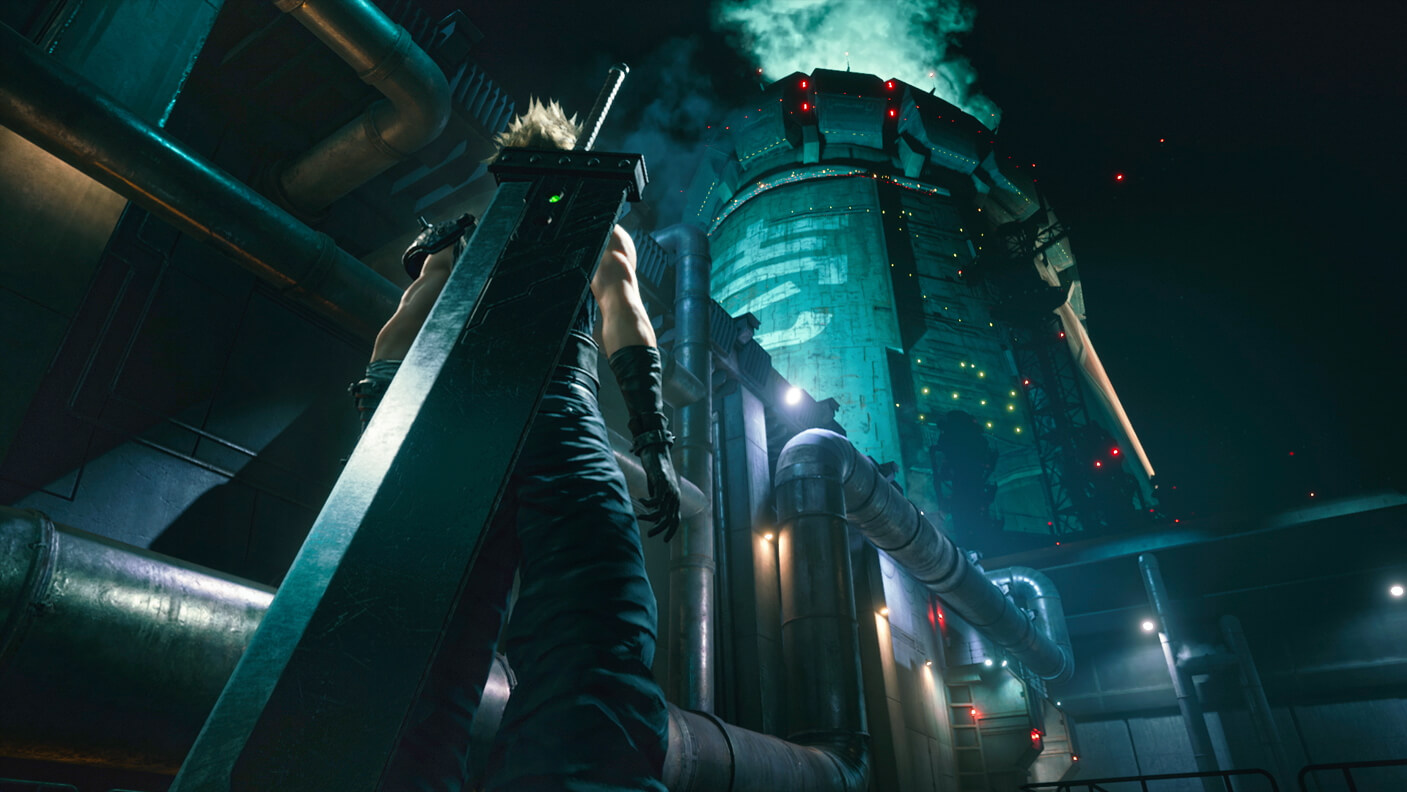
I am actually still a bit shocked that I’m putting a Final Fantasy game on this list. I’m not typically a fan of the series, and even though I did enjoy Final Fantasy VII on the PS1 back in the day, it doesn’t hold the same place in my heart that it does for millions of other people. I think it should speak volumes about the quality of this remake then, that I still think it’s a strong contender on this list, regardless of its value as a nostalgia piece.
Back in 1997, Final Fantasy VII’s story was pretty daring. Its opening act, in the rotting pizza-city of Midgar, followed a band of ecoterrorists and their merc-for-hire, Cloud Strife, as they went on multiple bombing runs to destroy the city’s Mako reactors. The fact that the story feels even more relevant today is both a testament to the storytellers at Square Enix, and an indictment of how little the world has changed, 23 years later.
Perhaps one of the most impressive things about this remake is the quality of the writing. The script has all the same story beats as the original, and pays deference to it in broad strokes, but at the same time isn’t afraid to modernize, tweak, deepen, and most importantly, have fun with the source material. Entire new sections are added, which really help to flesh out characters like Jessie. And the Wall Market sequence from the original has been reworked into what is perhaps the high point of the entire game. That uncomfortably 90s moment of Cloud dressing in drag for laughs is, amazingly, still in here, but recontextualized into something vastly more respectful and yet, infinitely funnier at the same time. It’s a deft approach to remaking a classic, warts and all, and it impressed the hell out of me.
This smart retooling of the script extends to the characters as well. Cloud is his same old moody-boy self, but the game seems to enjoy roasting him for it frequently. Tifa and Aerith are as likeable as ever, and both have fantastic moments playing off of Cloud’s too-cool-for-this personality. Even minor characters, like Wall Market’s own slum-lord d-bag Don Corneo or Shinra chief researcher Hojo are presented as delightfully scummy villains that you’ll love to hate.
But honestly, it’s Barret who steals the show here. In the original, he was mostly a Mr. T rip-off, who was there to swear up a storm and serve as comedic relief. In the remake, however, his rage is presented as far more righteous, and his moments with his daughter, Marlene, really serve to center the purpose of Avalanche’s missions. Destroying the Mako reactors is personal for Barret, and it’s not just about getting back at Shinra, but also about securing a better tomorrow for his daughter. It’s a great tweaking of the original script, and allows Barret to step in and become the story’s conscience just as much as Aerith.
Perhaps the biggest shock of all, however, was how much of an absolute blast the combat in this game is. The basic premise of it riffs on the ATB system of the original, but merges that with the real-time action gameplay of FFXV, to fantastic effect. Everything plays out in real time, with dedicated attack, block, and counter abilities. And the more you attack, the faster you build your character’s ATB gauge, which you then spend on specials or casting magic. Hit the enemy hard enough, and with the right types of attacks, and you can stagger them, preventing them from attacking and increasing all damage to them by 160% for a few seconds.
That’s all pretty straightforward, but where it gets really good is in the variety between the game’s 4 playable characters. They play absolutely nothing like one another. Cloud is a pure damage character, but can switch at any point to a more technical stance where he dishes out counters. Get good at toggling between these, and you can combo, counter, punish, and head straight back into another combo. Aerith is a caster, and excels at supporting roles and exploiting enemy elemental weaknesses. Barret, by default, is one of the more technical, and serves a dual-role as a tank and ranged character. He needs to be constantly juggling what’s he’s doing, between building his powerful overcharge ability, to laying down ranged machine gun fire, to applying extra stagger damage to a pressured enemy at just the right time. And finally there’s my personal favorite: Tifa. Her entire playstyle is lifted straight out of a fighting game, and as such she probably has the highest skill ceiling. Her moveset consists of multi-hit combos, but she can also buff herself to extend her combo potential, and then cash that buff out for a devastating move called Rise and Fall, which is one of the only moves in the game that pushes up the damage bonus on already staggered enemies. With this in mind, she becomes an absolute boss-killer, whose ultimate time to shine becomes those all-important few seconds where you’ve got the enemy in the stagger state. Utilize Tifa well, and those seconds become an absolute nightmare for your enemy’s health bar.
Phew, and all of that is before you factor in the game’s alternate weapons, each with their own skill trees, and the Materia system, which allows you to level various spells and abilities independently of a given character and then bolt that on to whoever you like. Taking those into account, there’s a lot of flexibility to how you decide to play each character, outside of what I’ve already outlined. For example, in my playthrough, I used Barret as my backline healer and tank, who would passively absorb the majority of damage to the frontline characters, thanks to his Lifesaver ability. So he had lots of HP Up Materia, as well as Magnify Materia linked with Prayer Materia, allowing him to cast party-wide heals at no MP cost. If I wanted, I could have swapped his signature machine gun entirely for a melee weapon, turning him into a frontline tank instead.
It’s been quite a while since I’ve played a party-based RPG where I enjoyed the synergy of the different character classes as much as I do in Final Fantasy VII Remake. Hell, I enjoyed it so much that I did an entire second run through the game’s unforgiving Hard mode. Just when I thought I had figured out everything the game had to offer, it surprised me yet again with some new hidden depth. I can only imagine what sort of wild combinations might be possible in Part 2, with Red XIII, Vincent, or even Cait Sith in the mix.
There’s just so much to like about the Final Fantasy VII Remake. There’s the absolutely mammoth soundtrack on which Nobuo Uematsu makes a triumphant return, and which features hours upon hours of genre-bending bangers. There’s the game’s cutscenes, which are maybe the first time since Final Fantasy X that I’ve actually thought to myself “Oh my God, this is beautiful.” And there’s the addition of an unnamed phantom presence – a cheeky little bit of meta-commentary on the game from the developer themselves – who constantly swoop in at the most inopportune times, as if to say “OMG YOU CANNOT CHANGE THE PLOT”. Honestly, it’s pretty cool that Reddit got to be featured in a game series as big as Final Fantasy.
Final Fantasy VII Remake might technically only be part 1 of a larger story, but I never found it to be lacking in its own right. It’s the most I’ve ever enjoyed a Final Fantasy game, and I’m really looking forward to what they do in the next part.
3. Persona 5 Royal – P-Studio

It’s difficult to talk about my favorite games of 2020 without taking into account the context of the year itself. For many, this has been a year of utter devastation – in America specifically, the threat of illness, job insecurity, homelessness, and death has loomed over millions of people each day while a corrupted and unwilling government has done as little as possible to assuage people’s material concerns. Meanwhile, for the much more fortunate “other half” of America, life goes on, just as a much more boring and sedentary existence. For that group, which I am admittedly a part of, it has been a time to do all the things you always said you would do but could never make the time. Picking up a new instrument. Taking up gardening. The cliché was making your own sourdough. The more worldly choice was making your own kimchi. For me it was reading more and picking back up Japanese. And finally, after years of indecisiveness, taking the plunge and playing a Persona game for the first time.
It’s the kind of thing I’d been meaning to do since the Persona 4 Golden days, but somehow I could never quite find the spare 100 hours in my schedule. Enter Persona 5 Royal and the year 2020 though, and I managed to find 200.
Persona 5 Royal is a game that just oozes cool. It’s got more visual style in its health potion item shop than most games have in their entirety. Its protagonist – the persona-swapping Joker – has more swagger and fashion sense than any Final Fantasy moody-boy has ever dreamed of, no matter how many buckles or zippers they might have. Its soundtrack is bursting at the seams with banger-after-banger, effortlessly ranging from high-energy earworms like “Take Over” to the soulful ambience of “Beneath the Mask” and the jazzy smokeshow of a track that is “Butterfly Kiss”. It’s an instant-classic and quite possibly my favorite soundtrack to any RPG I’ve ever played.
Persona 5 Royal’s story centers on a cast of high school students in Tokyo who take up alter-egos as The Phantom Thieves, persona-wielding gentleman and lady thieves who steal away the twisted desires of their marks. These marks are game’s cast of villains – from a physically abusive sexual predator gym teacher to a money-obsessed member of the mafia – and the physical manifestations of their sinfulness are the game’s various dungeons. It’s a cool concept, and the psychoanalysis element of the level design reminded me a lot of a favorite cult-classic of mine – Psychonauts.
Not only does it have style for days, but Persona 5 Royal has characters worth spending its mega-long playtime with. Whether that’s the loveable goon with a righteous anger, Ryuji, the headstrong and whip-smart senior with major waifu potential, Makoto, or everyone’s favorite hikikomori hacker, Futaba. Even minor characters are extremely memorable and well-developed, like Yoshida, a washed-up progressive politician trying to reform his political career or Sojiro, a strict father-figure who sometimes acts like a pervy uncle but ultimately wants the best for his family. And the typical-for-anime rival character, boy-detective extraordinaire Goro Akechi, ends up being one of the game’s deepest, most complicated characters. The cast for this game is huge, and yet, the beauty of Persona 5 Royal being long-as-the-goddamn-Nürburgring is that each and every one of them has their moment, and you can tell the writers have a deep affection for all of them.
The gameplay loop was something I expected to dislike initially, but ended up being my absolute favorite thing about it. Persona 5 Royal is essentially 2 different games mashed into one. On one side, it’s a Shin Megami Tensei game – or so I’m told – complete with dungeon crawling, turn based combat, and new personas to capture and train like Pokémon. There’s a lot of depth to these elements, and lots of really fun ways you can approach the elemental weaknesses and status effects in the game’s combat system toolbox. But taken on its own, the grind-heavy dungeons and straightforward battles might have gotten drearily repetitive. But ironically, it’s the other half of the game’s loop – the ostensibly mundane real world – where the game had me absolutely hooked. This other half is essentially a social sim game where you ride the Tokyo subway, go to class, study, hangout with friends, or go pass the time at the batting cages (that I definitely enjoyed and wasn’t challenging at all). It’s this loop, of slowly spending time with your friends, leveling up your relationship with them, and then getting rewards from there that feed back into the dungeon crawling, that gave the game such a unique pacing. It’s technically a very slow game, with lots of reading and lots of repetition, and yet it somehow never feels that way. It’s impressive as hell, and the type of gameplay design I’m always on the lookout for – the kind where each element feeds into one another, so nothing feels boring because nothing is an isolated mechanic.
As you might have picked up on by now, I’ve never been a big anime fan. Fine, sue me. But hear me out here, because this might be interesting. Since I don’t have a lot of that anime background, I was always thinking about Persona 5 Royal’s story through the lens of young adult fantasy. The ability to travel to the metaverse and back, summon personas, and steal hearts are just fantastical superpowers. Beyond that, it’s all just a difference of style. And fantasy can oftentimes tell you more about the real world around you than many other types of fiction. People’s hopes, dreams, yearning, idealism, their fears and their anxieties – fantasies often serve as a sort of collective subconscious for a society, akin to P5 Royal’s Mementos. And in Persona, the fantasy – the dream superpower – isn’t invisibility or super strength or teleportation; it’s the ability to convince those in power – shitty, corrupt adult authority figures – to have an ounce of shame, admit they were wrong, and tell the fucking truth.
The confession scenes at the end of each of the game’s heists are incredibly cathartic. When that scumbag gym teacher Kamoshida is overcome with shame for all the pain he’s caused and the lives he’s ruined, the final confession scene is one of my favorite in a game this year. Sure, it’s absurdly simplistic, the idea of him just suddenly feeling bad about everything, but that’s what great fantasy does. It takes something as complicated and messy as the real world and channels it through how people wish things were.
To put all of this a bit more simply: the Phantom Thieves want to see justice in an unjust world. And if that doesn’t strike a nerve after living through the year that was 2020, I don’t know what to tell you.
2. Ghost of Tsushima – Sucker Punch Productions

Okay, let’s get something out of the way right from the start. Ghost of Tsushima is essentially a Ubisoft-style open world game, with a bunch of map markers to check off and bandit camps to clear out. Structurally, it’s not all that different from an Assassin’s Creed or Far Cry game. But here’s the thing – Ghost of Tsushima is better than every single one of those games. Honestly, it’s the best game in that style that I’ve ever played.
There’s a litany of reasons for this. The first of which being that the combat system in this game is one of the best of the year. The way it emulates being a samurai is spot-on, requiring more discipline in your button presses than something like the Batman Arkham series, yet far more fluid than the comparably rigid fights in Assassin’s Creed. The game can be frustratingly punishing at first, with shield men who deflect your every frontal attack, spearmen who poke at you with unblockable attacks, or archers who snipe at you while you’re busy fighting some giant brute with a mace. As you begin to learn the various stances however, and start dynamically swapping between them in mid-combo, you realize how quickly you can turn the tables on a bad situation, using each enemy’s own strengths against them. Suddenly, you want that spearman to attack you, because you’ll put him down in such dramatic fashion that his death will terrify those around him, and have your enemies dropping their guards to flee. At the start of the game, you might struggle to handle a crowd of 4 or 5 enemies at once. By the end, you’ll happily take on 30 without batting an eye.
Then there’s the world that you’re given to explore. The visual design of the island of Tsushima is breathtakingly gorgeous. The heightened and subtly exaggerated way the game uses color – painting its rolling hills, fields of lavender, or cherry blossom trees in dramatic primary and secondary hues – gives the setting a lush beauty not too dissimilar from traditional Japanese artwork. The terrain itself is spectacular, with a lot of memorable landmarks and a great use of elevation (where the game gets to show off how impressive its draw distance is).
Beyond that, Sucker Punch has a phenomenal presentational style that they bring to just about every aspect of the game. There’s an elegance to the way that Ghost of Tsushima integrates its themes with the gameplay itself. Firstly, the world is broken into 3 distinct sections, each of which unlock as you progress the story. Not only do these divide the game cleanly into 3 acts, but the setting evolves with Jin’s journey. What begins as beauty and innocence is replaced by the ravaged landscape and grim reality of war, and finally culminates in the lonely, cold responsibility of becoming the nameless Ghost. It’s very haiku-like in that way, and it helps to reinforce the central arc of the story.
Secondly, there’s the game’s theme of honor, and whether holding onto samurai tradition in the face of desperate survival is ultimately worth it. It’s a compelling question in its own right, but it also is represented in the game’s 2 primary methods of action. Do you take the honorable but more challenging path of fighting each Mongol soldier face-to-face, or do you take every advantage you have, fighting from stealth, and utilizing everything from smoke bombs to deadly poison in the process? You will have to use both methods at times when the story demands it, but in general gameplay this ends up being a choice you have to make for yourself. Rather than feeling like any other open world game, where you just have a huge sandbox of utility to play with, Tsushima’s story imbues these options with meaning, and binds them to the character arc of Jin as the protagonist. It’s just great storytelling.
And there’s just so many beautiful dramatic moments sprinkled throughout this game. Right from the start of the game, as Jin’s mission becomes clear to him, he mounts his horse for the first time and races off across the landscape in moment of cinematic flourish, right before the camera drops back in low and the music swells, the game then subtly gives control back to the player while in full gallop, and the title card drops: “Sucker Punch Presents…Ghost of Tsushima”. It still gives me goosebumps now, watching it back. But it’s not all just big, bold Hollywood moments. The culmination and final scene of Yuriko’s questline is one of the most raw, human, and absolutely heartbreaking things I’ve experienced in a game in quite a few years. I choked up when I first played it, and it’s not something I’ll soon forget.
Ghost of Tsushima was one of the biggest surprises of the year, and it just kept surprising me more as I played it. The combat, the story, the world design – it all just gets better the further you get into the game, until it crescendos in one of the most beautiful and poignant final boss fights I’ve seen in a game since Metal Gear Solid 3. While Tsushima isn’t going to reinvent the open world genre, it streamlines so much of it, from the way it replaces traditional waypoints with gusts of wind pushing you toward the next point of interest, to the series of natural ingestion points it has for its quests (ask around towns for rumors, save hostages from the Mongols, or even follow yellow birds as they fly toward quest-givers), to the way it makes gathering its collectibles completely painless (track them with the wind, then follow fireflies, foxes, or sound cues to find exactly where the item is tucked away), it’s hard not to imagine the game won’t be influential in the years to come. Sucker Punch outclassed themselves with Ghost of Tsushima, and made what is, to me, easily the best game they’ve ever produced.
- Hades – Supergiant Games

Up until this year, Supergiant Games was a developer whose games I respected a lot more than I liked. I appreciated that each new project of theirs was its own unique thing, they never made sequels, and they experimented heavily with genre conventions in each subsequent game – 2017’s Pyre being one of their wildest concepts. Not only that, but Supergiant’s writing, voice acting, art direction, and soundtracks were always top notch. And yet, I always found their games still lacked some sort of spark for me. Always good, but never quite something I truly vibed with.
Hades, on the other hand, is the first game from them that I absolutely fucking love. It’s exceptional on all the levels I mentioned above, and yet, it’s one of the hardest games to put down that was released in 2020.
By some metrics, it’s less ambitious than some of the their previous titles. Hades is, after all, a fairly straightforward rogue-like game. But it’s in the specifics where Supergiant flexes their creative muscle and really sets this game apart in such an increasingly crowded genre.
First and foremost, this is the first rogue-like I’ve played with any sort of storytelling aspirations. You would think that the die-and-restart-and-die-again formula of the genre doesn’t especially lend itself to narrative threads or character building. Before playing Hades, I would have thought trying to tell a story in this genre would be a waste of time. Now that I’ve sank 50-plus hours into the game, I’m shocked that someone hasn’t tried it sooner. It’s such a smart move, dropping a breadcrumb trail of character interactions and plot developments throughout the gameplay loop. Rather than simply relying on the promise of making it one room further next time be the driving motivation of the game, Hades combines with that the desire to meet new characters, interact with them more, and see what happens next. They even go so far as to attach many of the game’s character interactions to its gameplay systems. Gods and goddesses each represent a skill tree of boons, so that when the game tells you that you’ll be meeting, say, Dionysus in an upcoming room, not only will you know you’re about to integrate the ability to do bleed damage to your build, but also that you’re about to have a chat with the debonaire, chill-as-fuck god of wine and ecstasy himself.
The other element that Hades absolutely nails is the way in which it handles randomness. While the use of random number generators to populate loot tables is common practice for the rogue-like genre, most simply roll the dice and let the player’s skill make up the gap between a good and bad series of drops. Oftentimes, the make-or-break for a run can come down completely to luck. Of course, that’s part of the fun, since each new run holds the promise of a metaphorical “Triple 7” jackpot. What Hades does so brilliantly, however, is to give the player just enough tools to influence the randomness of the game.
Starting at the most straightforward, nearly every room in the game has a split path, with the rewards for each plastered to the door itself. These are random, of course, but the choice is left up to the player which of the 2 or 3 options makes the most sense for their run at that given moment. As priorities change and weaknesses in a run expose themselves, players have the opportunity to correct past mistakes or bolster newly improvised plans on the fly.
Then there’s the game’s keepsakes, trinkets given to the player from various NPCs. Many of these are passive modifiers to the player’s stats, but many more are ways to modify the random chance of the game, biasing drops to be rarer, guaranteeing a drop from a specific god or goddess, etc. Each of these can be switched out after a major boss battle too, giving the player even more improvisational control over how their build is coming together.
Finally, there’s the really slick stuff, like pushing the player towards a particular weapon by offering a 20% EXP bonus for trying something they otherwise might have written off as “useless” or “not my style”. It’s so simple, but extremely effective at encouraging players out of their comfort zones and therefore helping to prevent burnout with the game.
All these little design elements are simply the genius of the meta-game. I haven’t even touched on how satisfying the combat is yet. The controls are as tight as I would have expected from Supergiant, with you as the player feeling like you have complete command over Zagreus’ movements. Attacking is kept simple, with one basic and one special, each mapped to a face button. There’s a projectile attack referred to as a “cast”, mapped to another face button. Finally, there’s a dodge, mapped to the last face button.
It’s not much more complicated than this, but the depth comes from chaining together the plethora of boon effects with the move sets of all the various weapons, a task which encourages creativity and rule breaking. What if you make an entire build that just relies on the damage enemies receive when they get slammed into walls? What about one where every time you dodge, attack, or cast Zeus calls down lightning on every enemy around you? What about a build that takes advantage of the late-game’s duo boons – which combine the effects of two different deities into one buff – to start firing a second projectile every time you cast? The key with any idea in Hades is this: don’t knock it until you try it.
So, a rogue-like as my favorite game of 2020? Yeah, I didn’t see it coming either. But hey, we all spent 2020 trying to get out of hell in one way or another, so maybe it makes some kind of sense after all.
 defectivepixeltest