2019 was pretty sparse, relatively speaking, when it came to exciting game releases. It’s more clear than ever that we are entering a transition period, with the next generation of consoles on the horizon, game streaming and subscription services going mainstream, and the ubiquity of Steam being challenged on the PC distribution side. Several games got delayed or missed a 2019 window, setting up 2020 to be a wild year.
And yet, while 2019 was a slower year for releases, it was freed up enough to become one of the most surprising. Some of the games that did land during the calendar year were among the most unique I’ve played in years.
Quick obligatory notes:
– This is a ranked Top 10 list with 3 honorable mentions (unranked).
– Each game features a link to one of my favorite pieces of music from its soundtrack. Feel free to listen as you read.
– I’m never able to get to all the games I’d like to by the end of the year. There are always ones that slip through the cracks. I typically like to list up front the games that I had the most interest in that I admittedly didn’t have time to get to. This year, my pile of shame is as follows:
Fire Emblem: Three Houses
Star Wars Jedi: Fallen Order
Pokemon: Sword and Shield
Void Bastards
Sunless Skies
Now, on to the list…
Honorable Mentions:
Observation – No Code

Observation probably has the strongest elevator pitch of any game released in 2019:
It’s 2001: A Space Odyssey, but rather than play a human aboard a space station, you control the station’s AI. You are playing HAL, just with a slightly different name.
Flipping this science fiction trope on its head makes for excellent horror. You view the entirety of the space station through cold, grainy surveillance footage, cycling control between static security cameras and a mobile probe unit. Everything you see is filtered through a layer of analog video artifacts and fisheye distortion. The human left aboard the titular space station Observation, Dr. Emma Fisher, wanders its interconnected modules floating in microgravity.
Viewed through the slow-panning cameras of the Observation, she looks as alien as any extraterrestrial threat. At the same time, SAM, the AI you control, is given increasingly strange HUD text messages from an unknown source, saying things like “BRING HER”. The result is a game where you can’t trust the human astronaut, and you can’t trust yourself either.
It’s a great and chilling example of how games can immerse the player in a perspective, including those of the nonhuman variety. It reminds of the early days of fixed camera perspective survival horror, but reconstituted in a modern context. It’s very clever.
It’s a bit of a shame that Observation’s gameplay relies on mini-games in its crucial moments, but the slow dread that the game manages to build over its 3-4 hour story more than makes up for it. For every confusing puzzle interface to re-enable the station’s power there’s a moment of silent anticipation as you round the corner into an unknown module of the station.
And when Observation is at its most effective is in those moments where it gets out of its own way, letting visuals alone communicate something spine-tingling. One of the most horrifying moments in the entire game is communicated completely wordlessly; a slow zoom out that lasts for well over a minute and half. It’s masterful in its execution.
Sadly, Observation’s ending lands with a bit a dull thud; a clunky twist that feels at odds with the excellently paced and disciplined horror that came before. But, caveats aside, Observation is breath of fresh air for the horror genre, with enough new ideas and cinematic flair to be one of the most exciting and original games of 2019. Perhaps no game this year has a stronger commitment to player immersion.
And not to forget that title theme by Nine Inch Nails guitarist Robin Finck. Fucking awesome.
Untitled Goose Game – House House
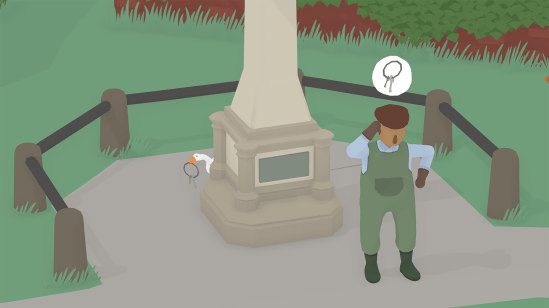
Don’t be fooled by its saccharine depiction of a quaint British village; Untitled Goose Game is a game about being a right fucking prick.
Technically, this is a puzzle game. Some objectives read like any other: “Get into the garden” or “Get someone to buy back their own stuff”. In practice however, you, as the goose, are less puzzle solving sleuth than you are neighborhood miscreant. Your puzzles are in fact things like untying a child’s shoes to make him trip, stealing his glasses thereafter. The puzzle for the man at the pub is to misplace so many of his tomatoes that you have time to drop a bucket on his head from above while he’s tidying up.
In Untitled Goose Game, you play an irritant for irritation’s sake. You play an avian anarchist with no regard for polite society or personal property. You are the villain in every sense. These people have done nothing wrong. And yet, you have no choice but to be a nuisance. You must sneak up behind people and honk to scare them. You must break valuable pottery because, if not you, then who? You must steal the town’s prized bell, because wow, you could be really noisy if you were running around with that bell.
In this sense, Untitled Goose Game is the quintessential goose role-playing experience. You might not have realized you wanted to inhabit the life of a goose, but you do. You want to be the goose, and the goose wants to do crimes.
A Plague Tale: Innocence – Asobo Studio

If you hate to see depictions of children in danger, then French developer Asobo Studio’s latest game will be an absolute endurance test for you.
Set in France in 1348, the game features two siblings – Amicia and Hugo de Rune – forced to flee their family estate after their parents are brutally killed by English soldiers. As the two flee into the countryside, they discover pestilence all around them – entire villages of sick and dead, rats gathering in swarms by the thousands. Nowhere is safe.
Something I love about the way this game handles historical fiction is in the subjective way it presents it. Amicia and Hugo have no larger context for what is happening around them, not the just-beginning Hundred Years’ War nor a name for the Black Death which is beginning to ravage European civilization. It is presented as the harrowing experience of a 15-year-old girl and her 5-year-old brother, fighting against the odds just to survive the chaos all around them.
On the gameplay side of things, what stands out the most about A Plague Tale is how each chapter of the game slowly spools out more and more mechanics. While the early game might seem like basic stealth – throw rocks to distract soldiers and avoid pits of rats like hot lava – by the mid and late-game, the designers begin adding in ways to manipulate and even invert their various systems they’ve spent time teaching you.
For example, one of the first lessons the game teaches you is that the rats hate light, so lighting torches is your best way to create safe havens for yourself in the environment. The enemy soldiers know this too, however, and often carry light sources of their own. You can simply slip by them unnoticed if you have good timing, but you learn later that you can extinguish their torches as they trudge across a river of rats, causing them to be devoured in moments. It’s horrifying, but such is the desperate state of this world. As you progress, you come across even more ways of manipulating the game’s systems to your advantage.
It’s all methodically paced out within the story. Just when you think you’ve seen all the game has to offer, it manages to surprise yet again. And the way these new gameplay mechanics are tied to revelations in the narrative are excellent – quintessential game design.
A Plague Tale: Innocence was one of the most surprising games of the year for me. Coming out of a studio I’d never heard of before, the game is considerably polished and gorgeous in its own right, complete with a haunting score by French composer Olivier Deriviere (who has become a new favorite of mine). There’s clearly a lot of talent at Asobo, and if A Plague Tale has proven anything it’s that this is a developer to watch very closely in the near future.
Top 10:
10. Luigi’s Mansion 3 – Next Level Games

If we’re being honest, I think we can all agree that Luigi is the worst. He sucks. If the Mario cast were The Beatles, he’d be Ringo. In fact, Waluigi is actually the good Luigi. And Smash players who main Luigi are bad people, whose opinions should never be taken seriously.
However, even I find it hard to argue against the absolute delight that is Luigi’s Mansion 3. The game won me over right from the jump in its opening cutscene; its playfully expressive animation work and expressionist, Tim-Burton-meets-art-deco visual style make a strong first impression. And then there’s that soundtrack, which has a ton of stylistic variety, but hooked me strongest with its jazz interpretation of the Luigi’s Mansion theme that it uses during scenes with Professor E. Gadd. It’s so up my alley.
Unlike prior games wherein Luigi did his paranormal house cleaning inside a spooky mansion, here a multi-level hotel takes center stage. This approach lends itself nicely to the game, as each floor of the hotel has a distinct theme all its own. With each ride of the elevator, the game might shift to a pirate aesthetic or a large, vertical greenhouse environment. Each presents its own subset of mechanics, with solid boss battles at the end of each.
But, of course, the thing each zone has in common is just how strangely satisfying it is to Poltergust vacuum every single square inch of it. Whether it’s the pneumatic tube sound of a fat bag of cash finally squeezing its way inside the Poltergust or the rapid-fire dinging sound of a hundred coins getting pulled down from a shelf, Luigi’s Mansion 3 has a keen sense of how to make exploring every nook and cranny of a small room incredibly fun.
It’s in this regard that the game’s exploration feels so refreshing. So many of the modern games touting “exploration” as a central gameplay feature end up gravitating automatically toward massive open worlds packed with places to go, and oftentimes forgetting to provide players reasons why they might want to go to said places. Even many of Nintendo’s own mainline franchises have fallen into this trend, for better and worse. Luigi’s Mansion 3 is a great reminder that there’s still plenty of appeal to exploring a tight play area, even down to room-scale.
None of this is to mention how funny this game can be. The game’s new doppelganger character Gooigi has some great moments of physical comedy, and E. Gadd’s hyperactive baby-speak never got old to me. And it practically blew my mind when I realized this game contained an extended reference to Park Chan-Wook’s Oldboy. In a Nintendo game of all things! But I just love that someone thought to put that in there, weird as it is.
It’s that embrace of weirdness, of getting a little low-key nutty with it, that makes this game so endearing to me. It reminds me of the days where Nintendo used to do off-the-wall stuff with their major franchises, and seemed like they had just as much fun designing it as it was to play.
And so that, combined with how the game managed to, miraculously, soften my hardline anti-Luigi stance, made it a big standout for me in 2019.
9. Metro Exodus – 4A Games
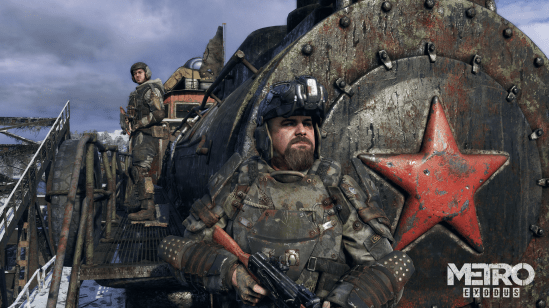
If you want to get a sneak peek at what “next-gen” graphics might look like, look no further than 4A Games’ finale to its Metro trilogy. The vanilla experience looks fantastic in its own right, but when you enable Nvidia’s ray-traced global illumination and then play the game on an HDR display, things start looking beyond what you thought video games were capable of. Combined with a developer as dedicated to first-person immersion as 4A, these technologies begin to transcend their marketing hype and simply integrate with the experience as a whole. It’s less “wow, look at what this tech is doing” and more “this world just feels real”. Exodus is quite simply the best I’ve seen a video game look, ever.
Drooling over its graphics aside, however, Exodus is an exciting experience for a number of reasons. Firstly, this is the first game in the Metro series to leave the Metro tunnels of Moscow behind for a series of wider open world areas spanning across Russia. While this could have easily resulted in a watered down Metro experience, replete with fetch quests and floating objective markers, Exodus has an interesting hybrid approach to open world design that I’m a big fan of.
Exodus’ approach to open world design is very naturalistic; it uses sandbox areas where they make sense for the locale and the story context, and where they don’t it uses its more traditional linear level design. This mixed approach works well in that it allows 4A to flesh out certain areas with backstory and a sense of place, but still reign things in to a more controlled pace when the story calls for it. How many open world games have you played where an urgent need to do something – defuse a bomb, save a main character’s life – is immediately made hollow as the game dumps you back into the sandbox to dick around some more? What I love so much about the design of Exodus is that it sees both open worlds and linear levels as choices rather than assuming one has inherent merit over the other.
The other element of Exodus that really struck me is how fond of the characters I became. Between each mission, the player is able to wander the Aurora, the game’s signature locomotive, and check in with each member of the crew. It’s very Bioware, but with a lot of characters monologuing about subject matter and in a style that can only be described as Russian-as-fuck. Does Artyom’s inability to speak get a little distracting? Sure, but watching and even non-verbally participating in the crew’s comradery really worked for me.
And maybe that’s the best thing about Metro as opposed to other apocalyptic media, which is that it leaves room for hope – hope for humanity and hope for the future. Contrast that with Western dystopic media’s obsession with every-man-for-himself, murder-each-other-for-rations brutality born out of survivalist delusion, and increasingly I come down on the side of the Russian approach.
And finally – lest you think this is some sort of post-apocalypse for softies – god damn is this game scary when it wants to be. I think the fact that you spend so much time above ground searching for crafting supplies and fighting raiders and whatnot, means that descending into a darkened bunker filled with giant spiders feels that much more terrifying. Put the Metro spiders up there with the Resident Evil dogs or Silent Hill nurses as some of the freakiest enemies in gaming. God damn, those fuckers make my skin crawl just thinking about them. The way they move, the noise they make…and the fact that they try to get around behind you to attack… Nightmare shit.
Metro Exodus is actually my favorite game of the Metro series. Maybe that’s sacrilege to say, I’m not sure, but I love how it widens the scope of the Metro universe, adding a significant variety of new environment types to explore, and allows you time to get to know the characters you’re meant to rebuild a future with.
Not only that, but the endings – whichever of the two you get – made me seriously emotional. Maybe I’m a sucker for that powerful music that plays over the game’s climax, but I found it to be an incredibly moving way to cap off the series. It felt like real closure for Artyom’s story, and I’m eagerly anticipating whatever 4A decides to work on next.
8. Devil May Cry 5 – Capcom

The character action genre has never really been my thing. I’ve always been turned off, justifiably or not, by the sense that most of them were repetitive, button-mashy affairs with little to offer my tastes. I’ve certainly dabbled with them over the years, but typically I’ve bounced off them rather quickly.
So, that said, I was skeptical when I heard all the praise Devil May Cry 5 was getting. Were people just excited – understandably so – to have Hideaki Itsuno back to direct an installment for the first time in 11 years, or was this really something special? Well, as an unbiased third party with no prior affinity for the DMC franchise at all, I can report that this game is, in fact, really fucking cool.
Honestly, I can point to the exact moment I knew the game had won me over. About 20 minutes in, Devil May Cry 5 drops a late title card over a cutscene which sets the tone for the entire rest of the game.
In it, Nero and his partner Nico drive through the city, casually bantering while she smokes a cigarette and he puts on a record. After a few moments of this, however, a group of demons appears up ahead, and Nico intentionally flips her van off some abandoned cars, sending it hurtling through the air in a 360 barrel roll. As this flip plays out – all in super slow-motion – Nero leaps from the passenger window, revolver in hand, executing demons with perfectly choreographed headshots. The record Nero put on before picks up volume, blasting the game’s infectious main theme song, and as this graceful dance of viscera and anime acrobatics continues, the main credits for the game fly by in huge font. Nero lands back in the van and the van lands back on its wheels, and they drive off, burning bodies of a half dozen demons hitting the ground behind them. The cutscene ends with the hilarious disclosure: “This game does not promote smoking or the use of cigarettes.”
It’s such a pointlessly overdone scene, of so little consequence to the story, and yet it looks so damn dope. And therein you have Devil May Cry 5 in a nutshell. This is a game about killing demons and looking good while doing it, not for any larger mission or ideal, but simply for the sake of looking like a cool-ass dude killing demons. It’s an attitude that could easily rub someone the wrong way – think 2011’s Bulletstorm – but it’s a testament to Itsuno’s sense of style and humor, as well as the incredibly likable cast of characters, that it never becomes grating.
I admit I had some reservations when I first started playing DMC 5. Holding the right bumper continuously to maintain lock-on instead of toggling it felt like a hassle, but it became second-nature after spending a few hours with it. Controls aside, the playstyles of the three main characters is where the game truly shines.
Nero is the most straightforward, with a bigass anime sword, revolver, and a metal rocket arm to fire off special moves. V, new to the DMC series, does not directly fight himself, but rather he employs a magical panther, crow, and golem as summons, with each mapped to a face button and capable attacking simultaneously or in combo with one another. It’s easily one of the most unique movesets I’ve seen attempted within the character action genre.
And finally, there’s series-staple Dante, the no-more-training-wheels daddy-demon with a staggering wealth of combat options, from sword to guns to fists to nunchucks to chainsaw motorcycle, all within four distinct combat styles, which can be hot-swapped at any time, be that mid-combo, mid-air, or mid-ass-tear. Throughout all my hours with the game, I never truly felt I had command of Dante’s true capability, and a cursory look online proved that no, in fact, I did not. Nero and V are fun and quirky for scrubs like me, Dante is the maroon trench coat wearing badass for the real sweats out there.
This is what I love about the game though. Sure, the levels and enemy encounters can be repetitive, mundane even, but it never feels like you have a total handle on what is possible with its combat flow. I felt like I was getting more proficient right up until the game’s excellent finale. An action game this scalable, and yet funny, so charming, so damn cool and fun? It’s one of the best experiences you could have had playing games in 2019.
7. Control – Remedy Entertainment

Control is a game about architecture. The winding corridors of The Oldest House intersect in ways that defy purpose and sometimes even gravity. Yawning atriums are filled with 1950s décor and dozens of rows of identical desks, the symmetry of the whole thing mystifying and unnaturally sinister. The blood red carpeting, the cherry wood paneling on the walls, and the concrete, what must be hundreds of thousands of tons of it, is everywhere; huge block pillars of the stuff constantly moving, shifting, realigning, as if reconstructing its own maze-like layout even as you attempt to navigate it.
The Oldest House is Brutalism reconstituted into something supernatural; architecture less as the result of human engineering and labor and more as a living entity with unknowable motivations. Its mise-en-scène is one of bureaucracy – its imagery evoking the cold administration of state power – and yet, as you explore the labyrinthine rooms of the FBC, it becomes apparent that it is not the pencil pushers working behind its desks who are manufacturing consent, but rather the other way around. The Oldest House is the thing in control.
You play as Jesse Faden, a woman in search of her missing brother, but you, like everyone else, are at the mercy of The Oldest House’s authority. How appropriate then, in a game such as this, that the most powerful weapon is not a shotgun or grenade launcher, but rather chunks of the concrete itself, torn up from the floor beneath the carpeting or sheered away from the steel rebar of a pillar, and flung with terrifying speed at the enemy. The Oldest House is an oppressive force to Jesse throughout the game, yet within any singular room of it, she is a god. With a litany of supernatural powers, from telekinesis to mind control and even levitation, every one of the game’s enemies can quickly become her plaything.
The combat in Control is empowering, even as its mysterious world feels disempowering. That’s a cool dichotomy to build a game upon, one made even better by the game’s structure as a Metroidvania. As you backtrack through the halls of the FBC, and new secrets open up to you – each more bizarre than the last – you are simultaneously becoming a one-woman wrecking crew, smashing your way through once-difficult encounters with little effort. The power fantasy combat is some of my favorite of the year. By the game’s end, I was taking every fight from the air, raining down death from above.
In a lot of ways Control seems like a creative justification for Remedy to let their freak flag fly. The concepts at work are one part David Lynch, one part The X-Files, and all parts the kind of shit that Remedy has been obsessed with for years. Whether it’s a red rotary phone with the ability to call other planes of existence or a refrigerator possessed by an interdimensional beast, a freaky Walkman-equipped janitor with a Finnish accent and mind-reading abilities or just a room that’s filled with clocks, there’s a whole hell of a lot to take in here. It’s usually this kind of crazy nonsense – of weirdness purely for the aesthetics of it – that turns me off of Remedy’s other games (see Alan Wake). But here, there’s such an extraordinary amount of it, of such heightened proportions, that it all began to work for me as a singular, otherworldly style.
Attempt to make sense of its story or themes, and Remedy’s Control will leave you cold. But appreciate its excellent combat, level design, and atmosphere for what they are, and you’ll have a great time.
6. Baba Is You – Hempuli

Video games are, at their core, collections of rules. That’s perhaps the least fun way to think of them, but it’s true. Take the original Super Mario Brothers for instance. When Mario lands on a Goomba’s head, the Goomba is destroyed. When he touches a Goomba anywhere but from above, he takes damage. The flagpole is the win condition. Touching a star makes him invincible. You get the idea.
The genius of Baba Is You is that it lets the player control not just their character in a virtual world, but also change those rules which the game logic is operating under. By default, in its most basic layout, rules read like “BABA IS YOU”, “WALL IS STOP”, and “FLAG IS WIN”. Put simply, you control the rabbit character “Baba”, your Baba can’t walk through walls, and touching the flag results in a win state. So, a simple A-to-B maze. Easy, right?
Well, each one of these pieces of logic is represented as 3 blocks in a sequence, and they can be pushed around to break and reconfigure the logic of the level. Break the sequence of text “WALL IS STOP” and suddenly, walls are nothing more than nice little floor textures that you can walk right through. Remove the WIN tile from the flag and pair it with WALL, and now touching any part of the wall will result in the win state – level over. Break the logic BABA IS YOU, however, and you get game over. If YOU are suddenly nothing, you have no control over anything, and the level becomes unplayable.
Neat stuff, but where the game gets truly fascinating is when you start doing things like creating pairs of IS statements. The valid text in Baba is You can be written left to right or top to bottom. So, that means you can do both at the same time. BABA IS YOU can be paired with BABA IS WALL, and suddenly the rabbit becomes a wall block, and every wall block on the map moves when you press a directional button. You’re playing as the wall, all of it at once.
But the possibilities deepen further. What if you make a 2-way split, this time with BABA IS YOU and BABA IS WIN? Well, you win. You are the win state, level over. Or how about a blocky C-shape made up of BABA IS YOU, BABA IS FLAG, and FLAG IS WIN. Well, now you are playing as a flag, and you win. Congrats.
The challenge of the game – and damn does it get challenging – comes from trapping certain blocks of logic in inaccessible areas of the map. Those become hard-coded in a sense, and not editable by the player. The text that is leftover for the player to edit becomes the essence of each level’s brain teaser. Each new level often requires the player to discover something they didn’t previously know about how the logic can be altered.
Things get even more trippy as the game adds extra logical operators. What happens when you throw in the operators AND or NOT? How about HAS, MAKE, or ON? Then add a bunch more properties – things like FLOAT, MELT, MOVE, or TELE. If lava in a level is killing you, because it has the rule LAVA IS MELT, you can create BABA IS FLOAT and hover over the molten river. Or make ROCK IS TELE and when you touch one rock, you appear at the other. It becomes apparent rather quickly the depth to which this game can go, with some puzzle solutions feeling absolutely like you are cheating the game.
In essence, Baba is You is a game about game design. The puzzles in their default state are broken, unwinnable levels. It is only by tampering with the game rules that the player can hope to cobble together a victory. Sometimes the end results are hilarious, with hundreds of infinitely spawning Baba all being controlled by the player at once. Sometimes they are absolutely bizarre, with boxes making keys as well as more boxes when destroyed, triggering a recursive key generator. But what all the Baba is You levels have in common is that feeling of elation – that eureka moment – as a solution finally clicks into place for you, the prior confusion and frustration all melting away in an instant of total clarity. It’s puzzle game magic, and this is one of the best puzzle games I’ve played in years.
5. Disco Elysium – ZA/UM

The biggest shock of 2019 certainly had to be the release of Disco Elysium, one of the most unique and densely written CRPGs I have ever played. It comes as Estonian developer ZA/UM’s debut title. It centers on Harry Du Bois, a middle-aged cop who awakes after an apocalyptic night of binge drinking, which has so thoroughly obliterated his memory that he has forgotten his entire life, name included. The game’s narrative centers on your investigation of a local murder, with you piecing the details of your memory back together as you go.
Disco Elysium is perhaps one of the most pure tabletop-style RPG experiences I’ve had in video game form. Gameplay here is completely dialogue driven, with critical moments being determined by dice rolls based on your skills. The skills themselves are each aspects of your mind and body – things like endurance and reaction speed, but also more abstract concepts like conceptualization, shivers, and Inland Empire, an homage to David Lynch and his penchant for the supernatural.
These skills not only determine your chances of passing the various skill checks throughout the game, but are each personified as a character inside Harry’s own head. Each one will chime in from time to time in the middle of dialogue to offer some input on what is happening. Encyclopedia, for instance, will pipe up occasionally to offer a relevant factoid from the game’s lore based on what you might be discussing with another character. Meanwhile, electrochemistry, the game’s name for Harry’s id, will chime in to convince you to snort drugs, get wasted, or try to have sex with women. It’s an excellent concept, one which captures the internal battle Harry is going through, while still allowing players the ultimate decision in what to have Harry do.
It’s refreshing to play an RPG with a setting and characters as grounded as Disco Elysium. This is not some high fantasy, dragons-and-magic nonsense with no human connection. If you have ever felt the bitter sting of regret, if you’ve felt a pang of guilt and that nagging question of “what if I had been a better person?”, then you’ll find some piece of your own humanity in Harry Du Bois’ quest to rebuild his tattered life.
And despite the grounded setting, the worldbuilding at work in the small port district of Martanaise is some of the best I’ve seen in an RPG since the heyday of Bioware. Nearly every character you interact with has a different perspective on the world around them – from the dense political history of the city of Revachol to their own lived experience with it. Some older characters still hold deep bitterness about how their world ended up, while the young exhibit a nihilism commensurate with the only life they’ve ever known.
Disco Elysium has a better understanding of politics than any game I’ve ever played, full stop. It’s because of this deep understanding that the game world feels so real, but also that its satire cuts so deep. This is a game that critiques the shortcomings of communist revolution, the extraction capitalism of neoliberalism, the death drive and absurd cruelty of fascism, and the oppressiveness of monarchy. And yet it manages to do so without falling into an idiotic “all sides are bad” trap, or some Zen-centrism for morons who believe themselves to be above ideology. Rather, the storytelling is deeply rooted in humanism, and it takes an unflinching look at the lives on the receiving end of these imperfect politics. Above all else, empathy is Disco Elysium’s greatest storytelling strength.
This is perhaps best encapsulated in the character of Cuno, a street urchin who continually throws out slurs while referring to himself In the third person. For me, his character went from an unbearable irritant in the early hours of the game to one of the most human, endearing, and likable characters come the finale. If that’s not the stuff of excellent writing, I don’t know what is.
I’ve never played a game quite like Disco Elysium. Obviously, it’s a CRPG by definition, but it’s also so much more than that. I can’t even imagine how much work went into the game’s script, a mammoth tome in its own right. And yet, contained therein are some of the most beautiful moments in any game in 2019. I teared up several times while playing it; the way in which it captures the sorrow of a place with a rich past but an increasingly dim future was exceedingly powerful at times. It’s a very slow, methodical experience, but still one that I think everyone should try. I’m not sure that its particular sense of humor and thematic content will work for everyone, but for me it was absolutely arresting.
I didn’t realize a role-playing experience could feel quite so emotionally resonant, but looking back after playing Disco Elysium, it’s more strange that I didn’t think it could be.
4. Sekiro: Shadows Die Twice – FromSoftware
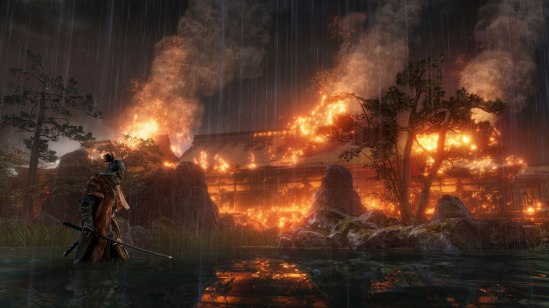
Sekiro features the best combat that FromSoftware has ever designed, no question. If you could master the ability to parry in Dark Souls or Bloodborne, it was one of the most satisfying ways to approach combat, and yet it was always relegated to a background role – if you wanted to use a buckler or a blunderbuss, you could, but it was your choice. In Sekiro, here is your choice: learn to parry or you will die. More than twice, trust me.
The key to this game is its posture mechanic. There is no stamina bar which the player must spend on attacking or dodging; Sekiro makes all these actions free and unlimited. Instead, the player has a meter that fills as they are injured by attacks or fail to parry with precise timing. Once this meter hits its limit, the player is stun-locked, and wide open to a huge attack.
However, every foe in the game also has a posture meter, bosses included. Landing hits to the opponent – blocked or otherwise – and deflecting attacks with perfect timing both deliver various degrees of posture damage to the enemy. Once that enemy’s posture fills, Sekiro can deliver a single deathblow attack, and its all over in a fountain of blood.
The beauty of this system is that there is no defense in Sekiro, not really. Your defense is a part of your offense. Perfect deflects damage the enemy’s posture just as attacks do. Because of this, aggression is your best friend here; where Dark Souls encouraged players to keep a safe distance from bosses, exercising restraint and attacking in small calculated moments, Sekiro instead rewards players for keeping their opponent constantly on their back heel. In fact, many bosses in Sekiro actually want to keep their distance from you, both so their posture can cool down and so they can engage with you at deadly range. Bosses have reduced movesets when cornered, and if you can keep the rhythm of a fight going without getting hit, you can deliver a deathblow in a matter of seconds. What’s liberating about this is that the pace of fights in Sekiro are based on the player’s actions, rather than boss’ actions determining the pace, a la Dark Souls. Once you internalize that lesson, Sekiro’s fights go from soul-crushingly difficult to an absolute blast.
One of the smartest changes that Sekiro makes to the FromSoftware formula is to tie its character progression to its various boss fights, rather than exclusively to combat grinding. There is a huge roster of boss and mini-boss fights in the game – many of which are optional – and each triumph over one of these foes will allow the player to increase their attack power or total health pool. This means that as white-knuckle difficult as Sekiro can get, you can very often stop and reroute to a different branch of its world, and any fights you win there will make returning to a previous nemesis a bit easier.
Sekiro is not only the best combat that FromSoft has ever designed, but also the best collection of boss fights. The infamous first encounter with Genichiro Ashina – which serves as a of rite of passage for Sekiro’s combat – is a ruthless mid-game difficulty spike, and yet, it’s the game’s way of molding you into a better player. It’s one of the best boss fights I’ve experienced in quite a while, even though I cursed my way through the entire thing. Sekiro is a cruel teacher, but the payoff is a sense of triumph that you feel like you really earned.
Sadly though, Sekiro makes quite a few strategic tradeoffs for its specific flavor of gameplay. It’s more distinct from Dark Souls than Bloodborne was, but that comes at the expense of quite a few things that are hard not to miss.
For starters, the level design is much more vertical and open in order to facilitate the game’s stealth mechanics. Sekiro’s prosthetic arm has a grappling rope in order to traverse this verticality quickly, but this directly results in levels which feel much less specific than previous FromSoft games. Limitations on traversal were a big part of what allowed the complex, interlocking levels that made Lordran and Yharnam such memorable settings. Imagine what Blighttown or the Cathedral Ward would be like if you could just leap off a cliff or grapple onto a rooftop immediately. It’s clearly a different approach, but I’m not sure it was worth it, given how half-baked the stealth mechanics actually are.
Then there’s the fact that you can’t really make different builds or play online co-op – choices which are perhaps necessary to facilitate the rhythmic flow of the combat, but also mean that Sekiro won’t have the staying power that Dark Souls 3 or Bloodborne have had for me and my friends over the years.
But, a few misgivings aside, Sekiro is a phenomenal game that further outlines Miyazaki and his team’s mastery over their unique subgenre. Their ability to reimagine and remix the Souls-like genre continues to far outclass everyone else, despite their many imitators. That, combined with the rate at which FromSoftware continues to deliver new games is something unseen in the modern games industry. They are one of the most exciting developers in the world right now, and Sekiro is further proof that there is no sign of them slowing down anytime soon.
3. Resident Evil 2 – Capcom R&D Division 1

Resident Evil might just be the greatest zombie franchise of all time. I’m not talking about the shambling, T-Virus reanimated corpses that roam the halls of the Raccoon City Police Department; I’m talking about the franchise itself. No matter how many bullets you put into it, no matter how many times you think “this series is done” – whether its Code Veronica or Resident Evil 6 – it somehow always manages to rise back from the dead.
I’ve watched this happen before as the series reinvented itself with 2005’s masterpiece Resident Evil 4, before proceeding to lose its way again for more than a decade, only then to reinvent itself yet again with 2017’s fantastically scary Resident Evil 7. The former navigated away from the classic RE formula, transforming into one of the best action games of all time. The latter went 180 on that, bringing back the early Resident Evil horror and level design, while ditching most of the action gameplay.
Now, in a remake of a 1998 classic, Capcom has somehow merged both disparate branches into a single game. Resident Evil 2 not only manages to be both scary as hell and fun to play, but also manages to solve issues that have plagued the franchise since its inception. And to top it all off, Resident Evil 2 provides a working formula to modernize classic survival horror. It’s damned impressive, and certainly my favorite Resident Evil game since RE4.
To start, Resident Evil 2 ditches the fixed camera angles of its predecessor for a tight, over-the-shoulder camera angle, similar to RE4, but here’s the difference: you can move while shooting in RE2! Thank the heavens! Praise be! Whether to allow the player to move and shoot has been a divisive issue in the series ever since it began, and admittedly, I have always been sympathetic to the notion that forcing the player to stop in order to aim does, in fact, make the game more tense. Understandably though, many players hate this idea. RE6 gave in first on this, and hey, guess what, it wasn’t scary. RE7 also allowed this, albeit at an absurdly slow speed. Resident Evil 2, on the other hand, finally gets it right.
RE2’s zombies are the slow and shambling variety, and wouldn’t normally pose much threat to a player who can simply shoot them while backpedaling away. To get around this, a lot of impressive animation work was done to ensure that there is just enough entropy to the zombies’ movements and their momentum. Even after dozens of hours with this game, I would still get surprised by a sudden lunge or sway of the head, causing me to miss shots and burning precious ammo. In addition to that, the game applies a fairly heavy crosshair spread while moving that takes time to retighten all the way. And while the game never directly tells you this, firing your weapon when the crosshair is completely tightened – meaning you haven’t moved for a few moments – actually does more damage. This, the scarcity of ammo in general, as well as the fact that getting grabbed by a zombie does a ton of damage, means that the player has to begin strategizing their engagements. Is it worth getting into combat with these zombies, who could expend anywhere between 5-12 handgun bullets each – yes, that many – or should I just try to run zig-zag between them like dodging landmines on my way to the next room?
This is where the game’s excellent level design comes in. As you weave your way through the RPD’s various winding hallways, locked doors, and puzzle rooms, you start developing a mental map of the place. The decision of whether or not to engage a given enemy or bypass it often comes down to whether they are isolated to a single, one-off room or blocking a major path through the station you will likely need to return to later. Eventually, and especially on successive playthroughs of the game, the gameplay centers around crafting the most efficient and/or least dangerous “runs” from one safe room to your destination and back. The game gently nudges players to plan out their path, as the map of the RPD records everywhere you’ve been, whether that’s a locked door or an item in a room you’ve previously passed through that you haven’t picked up yet. This is the first game in years that I’ve done multiple speedruns of – the game mechanics just facilitate it so well.
I’ve still yet to mention the crowning feature of this Resident Evil 2 reimagining – and the chief reason why it’s so damn scary – and that is the hulking Tyrant in a trench coat, Mr. X. In the original game, he was sort of an afterthought, only appearing on B Scenario playthroughs, and only in single rooms at a time, where he could dealt with by killing him or running through the next door. Here, he is a central piece of the story, unkillable, and relentless in his pursuit of you. Once he appears on the map, he functions as a persistent AI who patrols the station, room by room, searching only for you.
His presence on the map is keenly felt even when he isn’t actively chasing you, as his heavy stomping can be heard upstairs, downstairs, or right next door to you. Once he makes his absolutely killer entrance – accompanied by Leon’s reaction of “Jesus Christ!” – crafting those aforementioned safe runs through the station becomes far more uncertain. Nothing is worse than to engage with a Licker, only to have the noise you’re making shooting it call Mr. X to investigate. Situations can go from bad to very fucking bad really fast. It’s genius stuff, and has me absolutely ecstatic to see what can be done with Nemesis in the recently announced Resident Evil 3 remake.
I usually avoid placing remakes of any kind on my end of year lists. Should Link’s Awakening be declared one of the best games of 2019 just because it got a great visual overhaul? I think not. Resident Evil 2 is something different to me, however, as it represents a complete reimagining of the original game, similar in spirit and plot, but vastly different in its mechanics and how it plays. Also, I played the living hell out of it in 2019, so it goes on the list.
Much as a part of me bristles at the current cultural moment of nostalgia, remakes, and reboots, I hold the line for Resident Evil 2 – if remakes are going to be this good, then bring them on.
2. Outer Wilds – Mobius Digital

WARNING: I never do this for my best of the year lists, but with Outer Wilds, I feel that to spoil anything would detract significantly from the experience for others. However, without spoiling some things from the game, it’s impossible for me to talk about it. I highly recommend this game, and think it’s best experienced knowing as little about it as possible. If this doesn’t bother you, however, read on.***
The first time the sun goes supernova, I’m watching it from the outer rim of the solar system, having just fallen into the gravity well of a black hole and ended up here, cold and alone as the sun silently implodes. By the second time the sun dies, I’ve just discovered that what I thought was a gas giant is actually an ocean planet being ravaged by cyclones and thick storm clouds. By the third time, I’m floating through what remains of the space station orbiting the ocean planet, uncovering what I can about the research that was being done there.
Every 22 minutes in Outer Wilds, the sun will explode, destroying the entire solar system and you along with it. Whether you have just made a huge discovery or are in the middle of navigating to a new planet, it doesn’t matter, the solar extinction takes you all the same. Each time you die in Outer Wilds, your memories get recorded and you awake anew at the start of the 22 minute loop, back on your home world. All you get to carry with you into each new life is your memories, stored as a web of entries in your ship log. You are meant to explore the solar system and its various planets, moons, and astral bodies with the hope of finding a way to break the cycle.
The beauty of the time mechanic within Outer Wilds is how it liberates you. It allows you to explore its universe without consequences. Feel like seeing what happens if you dive headlong into that black hole? Leave your ship behind and give it a shot. All you’ve got to lose is a few minutes before you’re dead and reset anyway. Were it not for that, becoming stranded from your ship as it slips away from the low gravity of a comet and goes tumbling several kilometers off into the void would be near-catastrophic. Imagine how much effort would be required to go floating off in pursuit of it? I shudder to think.
What’s also brilliant about the time mechanic is how it binds the disparate elements of the solar system together. The game’s solar system is in constant process as things play out over the course of the time loop. A comet passing through the solar system has some of its ice melt away as it nears the sun. A space station orbiting the dying sun eventually collides with it as the giant burning mass swells. One planet is under constant volcanic bombardment from its own moon, and as chunks of its surface are blasted apart, they fall inward toward the black hole that makes up its core, winding up being transported to the farthest reaches of the system. The twin pair of planets closest to the sun exchange matter from their worlds back and forth over time in a giant spinning sand column, one losing mass as the other gains it, and then the process reverses.
You as the player learn all these things naturalistically – they happen whether you are present for them or not. There’s something magical about bearing witness to these cosmic phenomena, and it’s this sense that the universe never stays static that makes exploration in Outer Wilds feel so powerful.
Not only is Outer Wilds a captivating exploration game, but it’s also a spiritual fable of sorts. As you die over and over again, sometimes chipping away at the larger mystery, sometimes having made no progress at all, it’s hard not to feel the game is asking you to ponder your own existence in the universe. To me, what it seems to suggest is this: life is brief, so you should take chances, explore what you have the time to, and make memories. Whatever happens after our bodies are destroyed, it’s our memories that let us live on forever. The final moments of the game are a beautiful acceptance of death, of the finality of everything, and finding hope and meaning in spite of the quantum randomness of it all.
Outer Wilds is a game that had me feeling a lot of raw and very deep emotions, many of which are hard to put into words here. It’s the rare game world that’s worth exploring not because objective markers demand it, but because it contains mysteries that you actually want to find the answers to. Perhaps that makes it sound like a simple thing, but I have no doubt crafting a game like this was anything but simple. I’ve never enjoyed exploration in another game more than in Outer Wilds. It was an experience that was still surprising me, still scaring me, and still striking me with wonder hours into it.
A game is lucky to have one or two moments that spark the player’s imagination – Outer Wilds does it again and again and again, seemingly effortlessly. There’s nothing else quite like it.
1. Pathologic 2 – Ice-Pick Lodge
I’m about to attempt something very foolish. In the next few hundred words, I’m going to attempt to explain not only why Pathologic 2 is the best game of 2019, but also why it’s one of the most brilliant games I’ve ever played.
I have no doubt that I’ll fail in this endeavor. But if there’s one thing Pathologic has taught me after 30+ hours of grinding me under its bootheel, it’s that humanity’s capacity for failure is boundless. There’s an ideal version of what I want to say about this game in my head, but in execution, my writing is going to fall far short. I just know it. Honestly, this performance is already off to a pretty bad start… Let’s start over.
Pathologic 2 is a role-playing game in the truest sense – or, at least, a more literal one. You are cast in the role of Artemy Burakh, a haruspex, returning to your childhood home – an unnamed town in the Russian steppe – after receiving an urgent letter from your father, Isidor. The opening hour of the game plays out like a fever dream, a montage of death as the town is consumed by plague; you are accused of failing to find a cure as soldiers line up men and women into firing squad executions – the less merciful simply burning plague victims alive with flamethrowers – and all the while you are confronted by the mysterious director of the local theater, asking that you please not screw up the second performance like you did this one.
It’s a dizzying intro, a tutorial which teaches you the game mechanics at the same time that it establishes its bizarre, surreal, yet undeniably creepy atmosphere. During the montage, the game teaches you its bartering mechanic by having you trade your heart for the heart of an indigenous steppe-man, right after having had a fistfight with him. For every answer, the game provokes a dozen questions.
What is apparent very early is that Pathologic 2 is a survival game. Hunger and exhaustion meters hang at the bottom of the screen like oppressive reminders that everything in this game is in a constant state of decay – including you. The other thing that’s very apparent from the outset is that time is not your friend in Pathologic; during that hellish intro, one thing is made clear: you have 12 days to find a cure for a plague outbreak that is coming. The game clock is constantly ticking away like its own survival meter, only this is one that can’t be refilled or rolled back.
Miss an objective or leave a mystery unsolved on Day 1, the game moves forward without you. Forget to administer immunity-boosting tinctures to the dissidents of a plagued district, and they might become infected and later die. No character’s life is guaranteed in Pathologic, and no matter how catastrophically you fail in your daily tasks, no matter if one of the town’s children should die, the game presses on, unrelenting and uncaring.
Pathologic 2 is misery and death. It is a societal collapse simulator. It is the persistent dread of resources constantly ticking away. There is never enough food, never enough water, never enough medicine, never enough money, and certainly never enough time. Desperation is the primary driver of the gameplay; you might spend 3,000 coins early on for a handgun to defend yourself, and you might trade that same handgun away to a teenager for some food and antibiotics just a few days later. You might limp around at low health for hours at a time, with no means of recovering. You might resort to stealing, to murdering plague victims, to extracting organs to sell on the black market.
Pathologic is a cruel game – it wants its players to fail, and wants their failure to feel fucking bad. And then, like coarse salt in an infected wound, it punishes every player death by further and further decreasing your maximum health. Even reloading previous saves cannot undo this damage. Kojima-esque in the darkest sense, Pathologic 2 has read your memory card, and it isn’t going to let you get away with escaping your failure so easily. This is a game that is relentless about fucking with you.
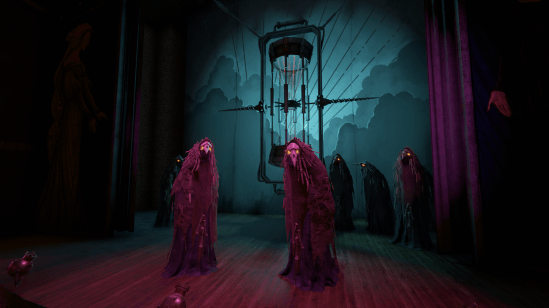
And yet, Pathologic is the only game I’ve ever played that fully understands its role as artifice. If you imagine the game as a series of concentric rings of philosophy and extended metaphors, the central circle is the game’s fundamental understanding and unwavering insistence that it is, in fact, not real. Sometimes, Pathologic’s town is simply a theatrical production, with characters addressing you not as the surgeon Burakh, but as the “actor” Burakh, running from scene to scene to say the requisite lines of dialogue that have been written for you. Sometimes, it’s taken even further, with characters talking past Burakh, directly to the player, and giving the player dialogue options where they can attempt to hold together the illusion that they are roleplaying Burakh, or instead offer input from the second person perspective. And sometimes these fourth wall-breaking moments are the developers themselves speaking to the player through an NPC character, about designing the town as a video game that players will inhabit. It’s mind-bending stuff.
And these moments are not cheap twists, meant only to shock the audience. Instead, they are central to the storytelling methodology that Pathologic is using. The game takes inspiration from the Brechtian method of theatrical storytelling, creating a distancing effect between the game world and its player. It asks that you embody the role of Artemy Burakh, only to have actors in tragedian masks constantly insist to you that you are part of a production. The consistent reminder is “This is not real, this death is not real, these people are not real”.
You are left only with question after question. What does it mean to save a fictional life in a stage play for an audience of no one? Or are you the audience? Are you the actor? No, I mean you, the player. The one reading this. What does it mean for you to fail? It feels bad to fail, but why does it if this is all theater and there is no audience to witness it? No one will know if you chose to let the kids die to save yourself. But you wouldn’t do that, would you? What is this world that has been created for you and what does your playing of it, in turn, create?
There’s never been a game like Pathologic 2, and I’d venture to bet there never will be another. In these rambling paragraphs of text, I’ve only scratched the surface of what is going on in this game. Its writing is the most ambitious I’ve seen in a video game, full stop. The soundtrack is bone-chilling – alien and otherworldly, sinister yet rife with emotion and cries of pain. It’s a deeply philosophical game, not just about what I’ve already outlined, but also in how it regards class, humanity, and governing systems. The leaders of the town all pull in different directions, each with their own ideas about how to achieve their personal vision for utopia, while the rest of the town’s populace, like extras in a stage play, must live with the consequences of their inevitable failure. That alienation effect, that constant reminder that “This is not real, this death is not real, these people are not real” starts having a lot more resonance when you consider the labor exploitation of capitalism or the dispassionate authoritative central planning of Stalinist Russia.
Pathologic 2 is a meditation on all of this and more. It is a game about failure from a country all too familiar with the bitter sting of failure. It is uniquely Russian, and has an identity all the more distinct for it. It’s one of my personal favorite games of the decade – not because I had “fun” playing it, but because it reminded me that games can be so much more than that.
 defectivepixeltest