2018 was a slower, more drip-feed type of year for games. There was plenty of great stuff, but it took a while to find it all. For the most part it felt like an inhale year – a soft reset for a lot of major studios as their production cycles were reset. To that end, it reminded me of 2014 – which is the last time we saw that, in my opinion.
All that said, this year had some real gems and a ton of surprises. I hope you’ll join me as I recount my favorites. My sincere thanks to anyone taking the time to read some of my thoughts about the year in gaming.
Quick obligatory notes:
– This is a ranked Top 10 list with 3 honorable mentions (unranked).
– Each game features a link to one of my favorite pieces of music from its soundtrack. Feel free to listen as you read.
– I’m never able to get to all the games I’d like to by the end of the year. There are always ones that slip through the cracks. I typically like to list up front the games that I had the most interest in that I admittedly didn’t have time to get to. This year, my pile of shame is as follows:
Ashen
Assassin’s Creed: Odyssey
Dragon Ball FighterZ
Far Cry 5
Overcooked 2
Now, on to the list…
Honorable Mentions:
Super Smash Brothers Ultimate – Sora Ltd.

As someone who’s bounced off of every Smash Brothers game post-Melee, I think it says a lot about Smash Ultimate that it was the first to win me back after so many years away from the series.
In a lot of ways, Ultimate is an embarrassment of riches. It brings back nearly every stage from the series’ history for a grand total of 103, compiles some of the greatest music from Nintendo’s archives for an absolutely mammoth soundtrack in excess of 850 songs, and not to mention a ridiculous roster of fighters, 74 in total. And while it’d be absurd to claim that the totality of fighters is balanced, (has Smash ever been?) the fact that so many of them feel viable here, across various weight classes, speeds, and widely diverse move sets, is one hell of an accomplishment — one which, sorry to say, but even granddaddy Melee can’t hold a candle to.
This is also the only time a Smash Brothers game has featured an adventure mode that I’ve found compelling. It encapsulates the core fight gameplay in a rudimentary RPG shell. It’s not especially deep stuff, but it provides just enough connective sinew to the fights, as well as some dynamic modifiers thrown in, such that things never got stale for me. In the fighting game genre, where good single player campaigns remain elusive, Ultimate’s offering was pleasantly surprising.
The thing that I appreciate the most about Ultimate, however, is its combat’s renewed emphasis on speed, as well as how huge the impact of even barely charged smash attacks can be. Hits feel more visceral than ever, and even as the action leans into its out-and-out chaos, that extra oomph makes the big moments both more readable and more satisfying when your blow connects just right.
Sakurai has dropped hints prior to release that this might mark the final entry in the series. Given the rather extraordinary sales figures, this seems unlikely to me. But that said, if it were to be the closing chapter, it’s hard to imagine a better sayonara swan song for this crazy, nostalgia-oozing mascot brawler series than Ultimate.
Vampyr – Dontnod Entertainment
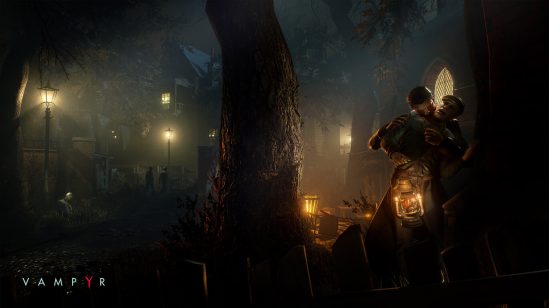
Typically, when it comes to these end of year lists, my bias almost always leans toward games that execute their ideas to a high degree of quality rather than games with ambitious ideas that don’t really pan out. Generally, I err on the side of games that nail what they are going for, so to speak.
Vampyr is going to be my exception for this year’s list. This is a game that I have a hard time calling great, but it is deeply interesting. So interesting, in fact, that I tolerated quite a few rage-inducing boss fights and awkward story twists just to see it all the way through.
In a lot of ways, Vampyr feels like a reaction to the modern RPG. What’s at stake in its narrative is not a whole kingdom’s future, not whether the Earth is overcome by darkness, not whether the galaxy itself is destroyed. It’s about what happens to a few districts of London and its citizens during the outbreak of the Spanish Flu in 1918. Increasingly, I find I am more compelled by games with this sort of localized, specific scope.
Similar to other modern western RPGs, Vampyr presents the player with numerous moral choices to make. However, here those choices are intimately tied to both the main character, Jonathan Reid, as well as to the central character progression and skill trees. Jonathan Reid is both a medical doctor and, as the title would suggest, a vampire. While his primary mission is as a healer for those afflicted with the Spanish Flu, the vast majority of the acquirable XP in the game is locked inside of – you guessed it – the blood of the very people you’re meant to help.
As such, every NPC in the game represents a moral dilemma in and of themselves. Do you fulfill your mission as a caretaker of the sick and destitute of London, thereby facing a game in which you will be under-leveled for almost every fight, or do you instead perform a sick sort of triage on the populace, determining who gets to live and who must die in order to fuel your character’s vampiric abilities? The way the game uses incentives to get the player to actually roleplay the conflicted soul of its main character is a genius way of contextualizing the game world and the protagonist’s role in it. Other RPGs should take note.
There’s a lot of other things at play in Vampyr that I really vibe with. For one, the streets of early 20thcentury London ooze with a sinister and dirty atmosphere that appeals to my Gothic nature. This is made more cohesive still by the game’s soundtrack, full of mournful strings and lo-fi synthesizers, and one of the year’s best. I even dig the combat, which is clearly inspired by Dark Souls – though with far looser controls. It’s a shame this game doesn’t come together quite as well as it could have, but for Dontnod’s first foray into the RPG genre, Vampyr is a unique take and one that I still think about fondly, flaws be damned.
Monster Hunter: World – Capcom
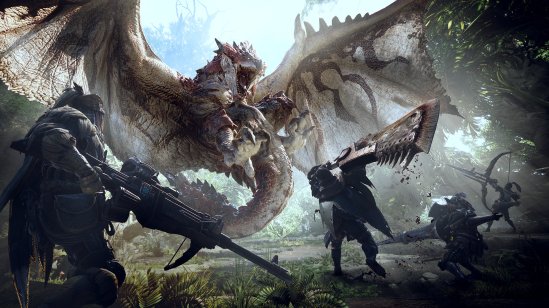
Call me late to the party, but 2018 was the first time I delved into the Monster Hunter series. World was my introduction to the world of Palicoes, Rathians, and sharpening mechanics, all at once. After dropping a cool 100 hours into it, consider me a newfound fan of the series.
Something I didn’t expect but seriously appreciated when playing Monster Hunter World was that it is an RPG where your build is entirely about the gear that you craft. There’s no real skill level tied to your character (save for Hunter Rank, which is simply a number to gate quests). Everything comes down to the gear you’re wearing and weapon you’re wielding, gear which you craft out of the carcasses, fangs, and claws of your previously slain beasts. What this means is that respecing your character can be done at any time, simply by swapping another specialized set of gear. So, depending on the target monster being hunted, you might want your particular set of gear that buffs your speed, stun recovery, and gives you ice damage.
It’s in this concept that the game grew on me considerably as I played. This will come as a shock to no one, but Monster Hunter is a game all about preparation – about strategizing for the hunt ahead of time, because once you’re face-to-face with a shrieking Rathalos, the time for changing game plans is long gone. This has the effect of making every encounter feel much more dramatic, especially when playing online with other hunters.
The stakes are big in some of these hunts – where fights can go on for upwards of 45 minutes, monsters can flee or maneuver into more treacherous terrain, and all the while the party must contend with an extremely scarce pool of respawns. The margin for error gets really minuscule as you get into the late-game encounters, where the game demands that players coordinate to provide each other with openings, healing, and brief moments of respite.
Monster Hunter: World, perhaps more than any game on my list this year, rewards its players for the amount of time they invest into it. The game doesn’t hold the player’s hand particularly well through any of this, but with every weapon combo learned or weak point successfully exploited, the game evolves beyond the sum of its parts. It can get extremely frustrating, even rage-inducing at times, but it always managed to pay dividends down the road.
The first time I got carpet bombed by a Bazelgeuse was absolutely terrifying, the first time a friend and I managed to take one down was euphoric, and to return hours later to absolutely dunk on one – that was a triumph that felt earned.
Top 10:
10. Tetris Effect – Monstars Inc. and Resonair

Few games are as positive, as life-affirming, as outright joyous as those of Tetsuya Mizuguchi. They are video games at their most synesthetic – synchronized sensory feedback loops of the tactile with the visual with the aural. To some degree, that is the appeal of control in all video games, but there’s something about the way Mizuguchi’s games over the years have managed to emphasize, and even elevate, that simple human-virtual response that make them truly emotional experiences. I still return to Rez every year or so just to let it cast its spell on me one more time.
With Tetris Effect, I think Mizuguchi has stumbled onto something even more spellbinding. Combining his signature tact for creating beautiful, evocative audio-visual experiences with the classic puzzler Tetris, and its penchant for near-primal geometry-based dopamine release, has resulted in a such a perfect left-brain/right-brain mind meld, that to play it, and play it well, is to enter a kind of lucid trance. It is perhaps the only game I played in 2018 that caused me to completely disconnect from the time of day, from my apartment, from my fucking phone, and just enter a state of pure immersion. I was never a good Tetris player, but something about the way Tetris Effect presented the game to made me want to get better. And I certainly did, even during my limited time with it.
Like other games from Mizuguchi’s catalog, this is game that I will no doubt return to for years to come. I just hope I don’t have too many dreams about T-Blocks…
9. Marvel’s Spider-Man – Insomniac Games

From the word go, Marvel’s Spider-Man hits the ground in full sprint. Where some open world games tepidly ease you into each and every concept with all the concern of a helicopter parent, Insomniac’s latest suits you up and throws you out a window, yelling down after you, “oh yeah, press R2 to swing!”
This is a developer operating with total confidence in their mechanics. One which knows that the best way to for a player to learn is by doing. It’s refreshing as hell, and a total rush the second you get a feel for the web swinging – a process which takes all of about 30 seconds; it’s that well-done.
Traversal is the star of the show here. Everyone that used to swear that “hey, the web swinging in that Spider-Man 2 game back in the day was actually dope” now gets unlimited passes to say, “I told you so”, because Insomniac clearly operated with that as their inspiration. And yet, the end result is so much more, with near-perfect controls, exceptionally expressive animation, and such an intense sense of speed that it quite literally never gets old. There’s a fast travel system in the game, but you won’t use it.
The combat is also a total blast, and with a surprising amount of depth to boot. There is a plethora of ways to keep Spider-Man’s combos going between enemy combatants, from web zipping toward a key target to aerial attacks to slippery dodges under an enemy’s legs. The enemies are no slouches either, with plenty of gear to make crowd control a challenge.
For those that know Insomniac’s track record, these things should come as no surprise. What did surprise me, however, is this is a game that understands Spider-Man as a character more than pretty much any of the films have (save perhaps for 2017’s Homecoming). It gets the key element that Spider-Man is an inherently working-class superhero. His ambitions begin and end where the five boroughs do, and his desire to do good for his community is clearly rooted in a value for public service.
What makes Spider-Man a powerful idea, and what makes him decidedly not-Batman, is in the way the citizens of New York City are depicted. In Marvel’s Spider-Man, the game makes a clear point of emphasizing those everyday laborers who keep NYC going, from sanitation workers to police officers to EPA regulators. They are not depicted as schmucks – not as comic relief or as rubes who never received a college degree or learned to code – but instead as people just trying, in their own small way, to do the right thing for their city. Contrast that with the way the game portrays private mercenaries Sable International, and critically frames the outsourcing and militarization of policing.
Sure, when you get right down to it, Marvel’s Spider-Man is the amalgamation of other games – a greatest hits of the open world genre from the last 5 years or so. The way the map is unveiled is lifted direct from Ubisoft and the combat is a faster version of Rocksteady’s Batman brawling. But the way the whole package comes together, complete with a narrative that’s way better than it has any right to be, makes for one of the easiest to recommend games of the entire year.
8. Hitman 2 – IO Interactive

It’s only about an hour into Hitman 2 that I’m dressed as a street food vendor in Miami – complete with a thick apron, hot pink leopard-spot leggings, hoop earrings, and a hat with what seems to be a squirrel tail hanging down from it – and adding a few dashes of emetic rat poison to the coconut ball I’m about to serve wealthy industrialist Robert Knox. Just prior to this, I shoved his daughter and my other target, Sierra Knox, down a trash chute while dressed as a giant pink flamingo mascot.
For a game ostensibly about murder, Hitman 2 is particularly hilarious. While developers IO Interactive have always had a weird sense of humor imbued in their macabre stealth series, this year’s entry has them hitting a real absurdist stride. From dressing as a pest control worker and fumigating an entire suburban house to get at a target to feeding a Colombian drug lord to a live hippo, this is a game that doesn’t leave any crazy idea on the table. The ridiculous nature of everything doesn’t undercut things either, as it’s not dumb jokes just for the sake of them. Rather, it’s creative liberation on the part of the developers, allowing them to craft dozens of surprising moments that inspire the player to think outside the box and experiment with their strangest ideas.
Then there’s the level design, which is my favorite in any game this year. Each new locale are distinct, intricate playgrounds that beg to be explored and tinkered with from the moment you set foot in them. They are places you’ll want to know front to back for practical reasons as well, as elusive targets and other games-as-a-service style events will test what you can do on these maps when the save scumming and retries are taken away. Knowing every entrance and exit to a particular building, of which there are often a ton, will be especially helpful.
As such, the appeal of this Hitman, similar to its 2016 counterpart, is about mastery of the levels. After the appeal of dressing in a suit of armor and surprise-impaling people with a sword wears off, what takes its place is a game that wants you to become even more intimately familiar with it. Maybe you didn’t even notice the sprinkler systems all over the map you’ve already played a handful of times. Well, here’s a challenge to not only clue you in, but also see if you can eliminate your targets exclusively by electrocution. Now those sprinklers are suddenly worth knowing about, as well as that car battery you glossed over during your last run.
It might seem that Hitman 2 is too much like its predecessor to warrant being on this list. I had a similar thought, but the fact of the matter is that no other games are fulfilling the same niche of open-ended, replayable stealth at the moment. Plotting out and perfecting runs is still a total blast. Not only that, but the levels here are significantly less hit-or-miss than 2016’s episodic game. And then there’s the new cooperative sniper level, which, though brief in nature, offers that same predator-toying-with-its-prey feeling of the main game. I must have replayed it with a friend at least a dozen times, poking and prodding at every aspect of the level like a kind of morbid diorama.
I’m very much looking forward to seeing what the team at IO does to mix things up with their next game, but for now, I’m still head over heels for their World of Assassination.
7. Frostpunk – 11 bit studios

According to the game’s clock, I’m about 6 hours into Frostpunk when I load a save from my previous session. As my frozen, desperate city loads in, I look it over with fresh eyes. It’s night, and searchlights scan the streets from atop imposing-looking guard towers. Loudspeakers are blaring propaganda from nearby, reminding people that they must continue work, despite the hour and blistering temperatures. Nearby is a packed prison, where dozens of protestors are locked up and serving time for daring to object to their leader’s commands. Children toil in the workshop while nearby medical tents begin amputating the limbs of those who have succumbed to particularly bad frostbite. Armed guards roam the streets in search of further dissenters.
After some time away since my last play session, I recoil a bit at the sight of this. I remember the bleak state of things, and the difficult choices I’ve had to make in order for my city to survive up until this point in brutal, sub-zero conditions. But I’d been focused on the moment-to-moment details at the time. Seeing the full picture now, I realize that what I’ve inadvertently built is what any political historian worth their salts would label as a totalitarian police state.
Where did I go wrong that this started to seem like a logical path forward? Does this say something about me that I would never admit to myself? Is all that stands between the values of democracy and total dictatorial control simply a Rubicon of fear?
This is what I love about 11 bit studios, the developers of both Frostpunk and 2014’s brilliant This War of Mine. In both games, they present human desperation and challenge the player to do triage on their morals and sociopolitical ethics. Think of yourself as against child labor? State violence? Euthanization? Well, what about when those values run up against raw survival instinct? While asking these questions directly can seem a bit like trite philosophical navel-gazing, illustrating them nonverbally through gameplay can result in some seriously powerful, and personal, experiences.
So just what the hell is Frostpunk? Well, put most simply, it’s a city-builder. But where most city-builders are about optimizing for the most efficient urban plans, Frostpunk is about doing the best you can at that under mounting pressure. Frostpunk takes place during a global volcanic winter, where massive coal-burning towers called “generators” provide some of the only significant sources of heat. The game starts as your convoy of Londoners happen upon one such generator after being stranded out in the icy wasteland.
The gameplay involves building housing and various facilities around the generator in a concentric circle format, so as to maximize exposure to the heat. Aside from that, you control scouting parties who explore the wilderness for supplies and other survivors. It’s an exciting framing to have a city-builder as a survival game, where there’s more drama and potential consequences for what you build and where.
It also means, as I hinted at before, that you’ll need to make some decisions about what kind of society you’re running. The tech tree offers plenty of optional “upgrades” that might strike you as efficient yet incredibly disturbing, such that you might never consider them. Or, as I did, you might allow panic to cause you to make exception after exception, until your city resembles something altogether horrifying.
This is what makes Frostpunk such a unique game, and what makes 11 bit studios a team to keep your eye on.
6. Return of the Obra Dinn – 3909 LLC

Lucas Pope seems to be making a career as a game designer out of turning mundane, bureaucratic tasks into vehicles for delivering narrative. Take his most notable game — 2013’s brilliant Papers, Please — wherein the player assumes the role of an immigration inspector at the border of Arstotzka, a fictional analog for a Soviet Eastern Bloc state. The primary gameplay consists of examining passports and searching for inconsistencies amongst documentation. On paper that sounds about as entertaining as watching paint dry, but in practice, it placed the player into deeply uncomfortable situations in which their empathy might compel them to one action, while the game systems incentivized them to be totally detached.
Now take Obra Dinn, in which the player assumes the role of an insurance adjuster dispatched to take stock of the damage and loss of life aboard a ghost ship of the same name. Not exactly thrilling at first glance, but the devil is in the details.
Your primary means of interacting with the world is through a log book, complete with a map, crew manifest, and sequence of known events. Via a sort of magic pocket watch, players are able to examine corpses to revisit the final moment of their respective lives. Each scene of death is presented as a tableau vivant that the player can walk around within, examine faces, actions, etc.
What Obra Dinn does so well is that it gets out of the players’ way. It establishes the basic tools and the goal – match the faces of the 60-person crew with their name in the manifest, and record each of their ultimate fates – and then goes almost completely hands-off. This is a game all about deductive reasoning, where any and every detail, from uniforms to accents to even more subtle context can become the key evidence to unlocking a series of identities.
Giving the player plenty of room to work through the evidence by their own logic is what allows for those elated eureka moments. And contrary to the design of other puzzle games, the framework here is open enough that solving a puzzle feels less like guessing the designer’s intent and more like naturally discovering something on your own – solutions that are so organic and common sense you have wonder if they were the ones intended for you to use.
Return of the Obra Dinn presents a narrative that requires active participation from the player in order to understand it. It’s a game where I returned to the same vignettes at least a half dozen times each, running between various characters’ frozen visages muttering relationships to myself. “Okay, so if this is the bosun’s mate, and he had the rifle in the previous scene, then that means…”. It’s that archaeological concept so many games use to weave together backstory and lore, but with the player in a much less passive role.
Simply, it’s one of the most unique games of the year, even on a visual level – with its awesome use of 1-bit rendering ala early Macintosh games. If I could wipe my memory of the answers in order to replay it again, I would at the drop of a hat.
5. Red Dead Redemption 2 – Rockstar Studios

I’ve never been so conflicted about a game as I am with Red Dead Redemption 2. Full stop.
Within this game are some of the most incredible feats of developer prowess I’ve ever seen, and yet some of the most absolutely mystifying design choices as well. It’s the first game in ages that had me constantly asking myself, even dozens of hours in, “how in the hell did they do this?”. And yet, for every hour of sheer disbelief, I must have spent another asking, “why in the hell did they do this?”.
Welcome to Rockstar’s colossal Red Dead Redemption 2, far and away the most expensive game ever made. I’m guessing there, but also, I’m pretty sure I’m right. This is a game so stuffed with graphical details, one-off animations, and voice lines for seemingly every conceivable context that the end result can feel at times unbelievable. To say that this game is an embarrassment of riches would be an understatement. The house that GTA built has truly put its full might behind this game, and the resulting world is something to behold.
However, all of RDR2’s extravagance comes with some big asks of its players. If most modern open world games are easy-drinking cheap cocktails – mostly sugar and no bite of alcohol – Red Dead Redemption 2 is Scotch served neat. It wants – well, demands – that you take your time with it. Like the frontier life it depicts, it will deny you convenience nearly every step of the way until you stop expecting it.
Red Dead Redemption 2 will feed back to you your own perception of its meticulous pseudo-realism. Get impatient with it, question its individual mechanics’ reasons for existing, and it will send you down an infinite rabbit hole of armchair game design. Why is my inventory done with traditional menus, but my horse’s inventory has hard limits and can interact with the world when I hit rocks or fall off cliffs? Why are some animals considered poor quality to begin with, if I also need to kill them correctly to not damage the pelt? Are most of these rabbits being born with garbage fur? Why is there a fast travel system that only works one-way? Why can’t I move just a bit faster??
But relent to its authoritative pacing, to its indulgent animations, to its bizarre control scheme, and you can in fact fall into that Zen-like state of immersion that so many games chase after but rarely have the patience to commit to in full the way Rockstar does here. When it works, RDR2 is one of very few video games where I could completely forget myself and just inhabit the daily life of the main character.
And speaking of character, the cast here is one of the best things going. These are far and away the most compelling, most human characters Rockstar has created to date. The writing, compared to GTA V, is a night and day step-up. It’s also refreshing to see Rockstar attempting to redeem themselves from the particularly awful way they treated women in GTA V. RDR2 is perhaps the first Rockstar game that isn’t completely male-centric, and its incorporation of several well written female characters into the Van der Linde gang makes the cast all the richer and more interesting for having done so.
Arthur Morgan’s development in particular really stands out. The game is structured as a prequel in which we know a disastrous ending looms in the distance, but do not know how we get there. As the story progresses and the Van der Linde gang begins to inevitably disintegrate piece by piece, Arthur has the bandages slowly unraveled from his eyes, seeing his mentor, friend, and spiritual leader Dutch in an entirely new light. There’s a real loss of religion aspect to it all that can feel pretty devastating at times. This is a case where the extreme slow burn of the game proves quite effective, as both Arthur’s and the gang’s progression happen so methodically that by the end it becomes difficult to pinpoint exactly where things started to go awry. This tonal shift is also presented in the game’s phenomenal musical score, where instrumentation slowly alters throughout the game, going from traditionally spaghetti western at the onset to something more electronic, more foreign, more sinister by the game’s final chapter.
Only Rockstar could have made Red Dead Redemption 2. It is the culmination of everything the studio has been working toward since pioneering the open world action game genre in the early 2000s. It is also the culmination of a studio that’s rarely been given “no” for an answer. Many of the basic systems that were reworked for 2008’s GTA IV are largely the same here, whether that’s running, shooting, or taking cover. Missions can still trigger fail states if you deviate even slightly from the developer’s intention. It is uncompromising in all ways, and that’s something that I respect the absolute hell out of, even if I don’t always agree with the choices. No one could dare accuse Rockstar of being sellouts for making a game like Red Dead Redemption 2. But madmen? Geniuses? Workaholics? World-builders at the top of their game? Arrogant auteurs on a power trip? The answer to all of these questions is an unmitigated “yes”.
4. Into the Breach – Subset Games
Before 2012’s XCOM: Enemy Unknown, the idea of playing a punishing turn-based strategy game sounded like getting a root canal to me. Ever since playing that game, however, I hold a special masochistic place in my heart for them. It’s somewhere nestled next to the Dark Souls ventricle. So, when Into the Breach dropped this year, it didn’t take much to convince me it was something I needed to try. It’s got that XCOM vibe? I’m down.
Well, it turns out that Into the Breach not only has that XCOM vibe, it refines and streamlines it to great effect.
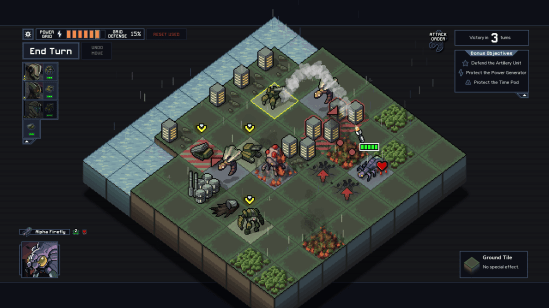
To start, it manages to address one of my biggest problems with the XCOM games’ design; Into the Breach removes random number generators from the combat equation altogether. Instead, enemy units telegraph exactly what they’re about to do on the next turn, including damage numbers, which tiles they’ll hit, attack order, all of it. Your job as the player is to react to them. Push the mortar unit one tile to the right, where his shot on the city will whiff. Plant a unit on top of the cracked ground tile to block a new Vek from emerging there. Even consider bashing one of your units into an enemy one, damaging both for 1 HP in the process. There are considerable options you can pursue every turn, and as the screws tighten, you’ll explore even more desperate plans.
See, Into the Breach is all about making tough calls. The game simply doesn’t give you enough resources to deal with every Vek encounter. Your goal is simply to minimize damage to civilian populations and run out the turn clock, after which the Vek will retreat. Bonus objectives, your mechs, and even their pilots are expendable. Sometimes, the only way to prevent a game over is to throw one of your units between a Vek’s giant hornet sting and your last city tile. Your pilot might die, but you will live to fight another day.
This is where the tension really kicks in. While revealing to the player exactly what will happen next turn might seem like a huge advantage, the fact of the matter is that it simply shifts the strategic emphasis to middle and long term. An example of this can be seen in the bonus objectives that every level has. When completed, they give out preciously scarce resources that can be a lifesaver in fights down the road. However, completing these bonuses can often put you in a situation where civilians get killed, making your overall survivability all the more precarious. You simply can’t do it all, and it’s the delicate balancing act of all these things that requires you to prioritize one option in a series of bad ones. And on top of that, the game autosaves constantly, so good luck trying to save scum. Brutal.
Into the Breach is like a distillation of everything I love about XCOM into its barest essentials. Your fights play out on just an 8×8 grid. You only have 3 units. Each fight only lasts about 5 turns. It turns out, that’s really all you need to experience the roller coaster of confidence, dread, despair, and elation that I love so much about the Firaxis games. It’s game design with zero fat. Everything is imbued with purpose. And, with eight selectable squads of units, there’s plenty of reason to replay the campaign with a completely different set of abilities. Quite frankly, it was one of the most challenging and immensely rewarding games I played all year.
3. Warhammer: Vermintide 2 – Fatshark
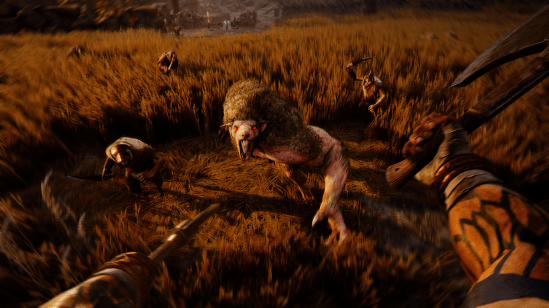
It took Vermintide 2, a game set in a fictional universe I previously had zero interest in, to remind me how much I’ve missed the Left 4 Dead series. There was just something about that co-op PvE experience that always felt refreshing to play with a group of friends – a reliable way to chat and casually game or an intense experience that required good communication and teamwork, depending on the difficulty level that was selected. And while Valve rests on its laurels as a game developer, Fatshark is here to fill the gap. Not only that, but Vermintide 2 makes several changes to the formula that make it much more interesting.
Even though I had no previous fondness for the Warhammer universe, the world as depicted in Vermintide 2 is something I instantly vibed with. Set during Warhammer’s End Times, the world is bleak and ridden with carnage, the cities and sewers and fields absolutely overrun with Skaven, a race of humanoid-rodents that appear in enormous and seemingly infinite hordes. For anyone that appreciates dark and apocalyptic fantasy, this game offers you a fantastic cocktail of beauty and ugly, of totally hopeless yet seriously cool. Dark Souls fans should feel right at home.
The RPG elements overlaid on the Left 4 Dead base gameplay are a huge addition. Where Left 4 Dead had each player on exactly even-footing, Vermintide 2 has 5 unique characters, each with 3 distinct archetypes, along with different melee and ranged weapon sets, skill trees, etc. It’s incredibly effective at making the game more satisfying to replay with friends, as each of you carve out a more and more distinct role for yourself as you level up. There’s nothing so strict as tank or medic classes, but individuals can spec into these directions as it makes sense for their character or the group as a whole. As the game ramps up in difficulty – and believe me it does – this only becomes more and more necessary.
In that regard, something that Vermintide 2 absolutely nails – and that dramatically makes both grinding levels and replaying levels much more interesting – is its tiered difficulty system. While there are 4 main difficulties, each with progressively higher XP rewards, there are also collectibles within each level that can moderately to severely ramp up the difficulty of successfully completing them. These collectibles, tomes and grimoires, are reminiscent to me of the Halo series’ hidden skulls. They’re much more straightforward however; there’s no Skaven Birthday Party tome to find. Tomes take up a player’s healing item slot and grimoires cut the entire party’s health by roughly 1/3 each. Tack on all of them, and a level can go from a casual hack-and-slash grind to a white-knuckle test where one mistake can decimate the entire group. And yet it’s all based on player choice along the way. So, if Champion difficulty is too much for your group at their current skill levels, but Veteran is now becoming a non-issue, the team can grind levels on Veteran while trying to collect as many of the tomes and grimoires as they can. This will effectively boost the challenge to somewhere that’s just right for them, as well as result in better loot and XP upon completion.
Vermintide 2 is not the most original concept for a game in 2018, but it fulfills and underserved subgenre and expands on it in some really smart ways. Not to mention, it was a game that myself and my friends kept coming back to again and again throughout the year. That might say more about the current landscape of great co-op games than it does about the addictiveness of Vermintide 2, but I’m not so sure about that. Either way, tearing through floods of Skaven infantry with 3 other mayflies was the most multiplayer fun I had in 2018.
2. Dead Cells – Motion Twin
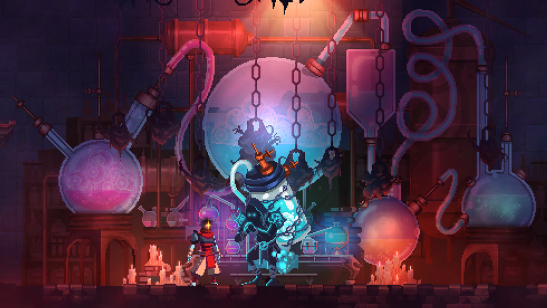
The idea that a Roguelike would be one of my favorite games of 2018 seemed inconceivable. This is not a genre I normally get much enjoyment out of, despite trying out several of them that have been recommended to me over the years. Dead Cells changed that in a big way.
The key distinction and what sets Dead Cells apart from every other Roguelike I’ve ever played is the action. From movement to jumping and attacking to parrying, everything in Dead Cells controls like an absolute dream. Everything feels precise and predictable, but by no means rigid or stifling. Rather, Dead Cells plays fast – seriously fast. This is like 2D Dark Souls, after pounding a couple Red Bulls with a Red Eye chaser.
The comparison to the Souls series isn’t just talk, either. Here, you’ve got a wide array of weapon types with randomized attributes to experiment with. Each weapon type has various animation wind up times that you’ll need to get a feel for to be effective. Some might hit quick and hit consistently, but at low damage. Some might have more elongated animations on the first hit, but then follow up with hits two and three very quickly for enormous combo damage. Top this off with those RNG attributes and you can discover some especially deadly combinations. How about a bow that fires 3 arrows at once, each with a freeze-on-impact status effect? Then pair that with a gigantic hammer as your melee weapon, and you can easily queue yourself up for massive combos against a target that can’t move out of your way. Each run of the game, these drops will differ, so character builds happen very on-the-fly as you figure out what works together and what doesn’t.
Not only is the moment-to-moment combat exceptional, but the approach to level design and progression is right up my alley. The levels themselves are not the full-on procedurally generated maps used in many modern Roguelikes, but rather a hybrid model in which levels have predictable characteristics – such as the number of exits, locked doors, enemy types, and treasure rooms – but with the modular spaces in-between shuffling with each run. It’s a variations-on-a-theme kind of model where the game can preserve a sense of the Metroidvania style exploration it’s going for without becoming stale and repetitive in the process.
If we’re splitting hairs, technically Dead Cells is what is known as a Rogue-lite, meaning that some of the progress players make carries over from one run to another. In my opinion, the distinction is only worth making to the extent that Dead Cells offers the most satisfying gameplay loop I’ve seen in this regard. One of the many reasons Dead Cells is so hard to put down is that there’s always some small sense that progress was made, even when you die 85% of the way through a complete run. Unlocks are quite substantial (upgrading from 1 heal potion per stage to 2 is huge) and there are also items which unlock alternate routes through the game, adding just enough extra choice to each subsequent run that the game always feels fresh.
Dead Cells was not only my invitation to a genre that had previously left me feeling cold, it was also the most immediately satisfying game I played this year. As soon as you get your hands on it, the whole thing clicks in a way that only the most polished of video games ever do. Motion Twin, a developer not previously on my radar, is going to be one I watch very closely going forward.
1. God of War – SIE Santa Monica Studio
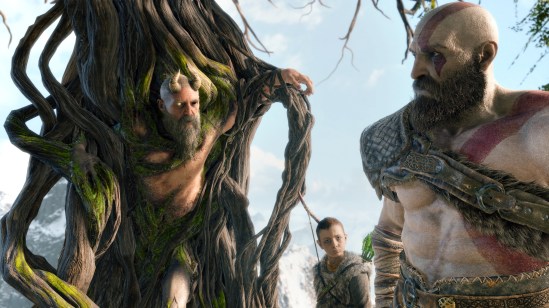
“And you must be better than me. Understand?”
In this one line of dialog, Kratos sums up 2018’s God of War, in terms of its themes, Kratos’ own character arc, as well as its meta-textual position as a franchise revival.
What I love about this new God of War is how it manages to take a series best known for its ever-raging, ever-god-killing protagonist, and reconstitute it into a thing imbued with subtlety, humanity, and fresh ideas. It’s not a reboot in terms of the plot, but it is one in terms of basically everything else.
At the game’s start, Kratos has aged – having left Greece behind for a quieter life in Scandinavia – and his white-hot fury has died down into a more subdued, albeit constant smolder. His young son, Atreus, does not know of his father’s godhood. Kratos keeps this from him and is constantly testing and scolding him at the start of the game. The point is never made explicit, but it is clear that he does this because of how he lost his former family to Ares in the original game. It’s a clever piece of characterization right out of the gate that also supplies the story with the drama of Atreus not knowing. Put simply, it’s good writing.
Where previous God of War games have framed vengeance as the main objective, this game inverts that, instead asking Kratos to go on a journey to spread his recently deceased wife’s ashes. There’s a beauty to this framing, both in its simplicity and in how it always keeps the focus on Kratos’ relationship to his family. Within this, God of War poses many of its thematic questions, such as whether the sins of the father are destined to repeat themselves, and whether being born into a family lineage presents a kind of curse for the child. These were not concepts I expected to be touched on by a God of War game, and yet, here we are. Such is the degree to which Santa Monica Studio beefed up its storytelling prowess.
Level design is another area where this game represents a significant step up from its predecessors. As the journey of God of War progresses, the structure of its world slowly reveals itself as a sort of inverse Russian nesting doll. What begins as a fairly straightforward level design reminiscent of the previous games expands, progressively widening in scope and nonlinearity. Eventually the player is met with a large hub area from which side quests, secret areas, and even alternate Norse realms fork off from. That same hub transforms multiple times throughout the course of the game, becoming far more than initially meets the eye. Not only that, but the puzzle design interwoven into the levels of this game is far better than it has any right to be. The puzzles – which feel very classic Zelda in their construction – frequently ask the player to experiment beyond the scope of a simple pass-fail requirement, often rewarding the player for alternative solutions or for digging deeper than is necessary to progress.
It should say something that I’ve managed to speak on a God of War game for this long without even touching on the combat. And yet, while the camera angle and general pace of combat is totally new, I find that it’s better here than it has ever been. It has adopted a slower, more deliberate attack style ala Dark Souls (of which I am admittedly a huge fan) and meshed that with an emphasis on crowd control enemy encounters ala Rocksteady’s Batman games (of which I am also a huge fan). The hits have even more of a visceral sense of impact than before, and player choice feels more tactical moment-to-moment and less like button mash-y combo memorization.
As part of this slower pace, as well as the change to Norse mythology, God of War swaps its signature whirling Chaos Blades for the Leviathan Axe, a runic battle axe that might be one of my favorite video game weapons of the last few years. The Leviathan Axe not only serves as a powerful close-range tool to chop down foes, it can also be thrown at any time as a ranged weapon. From there Kratos switches to his fists until the axe is recalled to him by hitting the triangle button, at which point it comes magically whooshing end-over-end back to his grip. If you’ve ever wanted to play with Thor’s hammer in a video game, God of War has your number. And yes, it’s every bit as satisfying and just plain fucking cool as you thought it would be. It’s a mechanic that never gets old.
God of War is an exceptionally deft interweaving of storytelling with combat, puzzles with set piece design, nuance with bombastic action. Hell, it even has the first score by Bear McCreary that I’ve thoroughly enjoyed. It really feels like this is the first Sony first party game to channel all their strengths at once, in the same game. It single-handedly updates Kratos from game console mascot to genuinely interesting character, establishes a relationship between its two leads that feels as compelling as The Last of Us did, refreshes and modernizes the entire combat and exploration mechanics of the series, and all the while showcases some of the best visuals possible on the PS4.
Simply put, God of War is the best damn game of 2018. And boy, should you play it.
 defectivepixeltest