2017 was a bad year. I’d dress it up as something else if I could, but it’s kind of an any-way-you-slice-it situation. I’m talking personal life here, not games. But considering what a challenging, absolute beatdown of year it was for me, writing this list and playing these games was a nice break from reality.
Games-wise, this year was pretty great. I’ll detail that below. To any that take the time to read some of it, you have my sincere thanks.
Quick obligatory notes:
– This is a ranked Top 10 list with 3 honorable mentions (unranked).
– Each game features a link to one of my favorite pieces of music from its soundtrack. Feel free to listen as you read.
– I’m never able to get to all the games I’d like to by the end of the year. There are always ones that slip through the cracks. I typically like to list up front the games that I had the most interest in that I admittedly didn’t have time to get to. This year, my pile of shame is as follows:
Persona 5
Middle-earth: Shadow of War
The Evil Within 2
Splatoon 2
Cuphead
Now that that’s taken care of, on to the list…
Honorable Mentions:
Uncharted: The Lost Legacy – Naughty Dog

Hey, sue me. It turns out, I really like Naughty Dog games. Yes, this is the fifth entry in the Uncharted series, but hear me out here.
I admire The Lost Legacy for concentrating Naughty Dog’s strengths into a tighter, more focused experience. The Lost Legacy is 8 hours in length compared to Uncharted 4’s whopping 20. It focuses on a singular area of the world – namely the Western Ghats of India – and keeps its cast small and personal in scope, focusing on the backstories of Chloe Frazer and Nadine Ross.
India is a gorgeous and, in retrospect, obvious locale to set an Uncharted game. The wide palette of vivid colors, lush geography, and Hindu architecture come together to make this game my favorite in the series from a visual perspective.
It’s within this gorgeous area of the world that Naughty Dog pushes forward with design ideas established in Uncharted 4. Chapter 4 of this game is an entire sandbox level, similar to Madagascar in the prior game but greatly expanded in size and density of content. There are puzzles to solve, enemy encounters to stumble upon, and multiple directions to approach a given situation from. Hell, there’s even a map that Chloe will mark up with notes as you explore.
To play an Uncharted game that allows that kind open level design without sacrificing the kind of hand-crafted, finely-tuned content Naughty Dog has always excelled at is thrilling, and has me giddy about what they might do with The Last of Us 2.
But what steals the show here above all are Lost Legacy’s leads. Chloe and Nadine are an unlikely pairing, but serve as excellent foils for one another. Chloe is mischievous, even manipulative, with plenty of dry humor to boot. Nadine meanwhile, is no-nonsense, direct, and prideful in a good soldier sort of way. The times when their rough edges come into contact with one another, often bringing out surprising similarities between them, make for some of the best moments in the game. Compare this to wisecracking Nathan Drake and and slightly different wisecracker Victor Sullivan, or alt-wisecracker Sam Drake, and the difference in dynamic is immediately refreshing.
Uncharted: The Lost Legacy is more than just a look back at the highs of the series. It certainly is that, and one need look no further than its spectacular finale, a thrilling cross-section of Uncharted 2 and 4’s grandest, most ambitious sequences. However, the game is also quite a successful exercise in restraint. The Lost Legacy is the best paced Uncharted game, it’s lean with very little filler, and it proves that you don’t need Nathan Drake to make the whole thing work. Top that off with a splash of exciting gameplay concepts for the future, and yeah, I’ll take that fifth cocktail. It’s still seriously great.
Nier: Automata – PlatinumGames
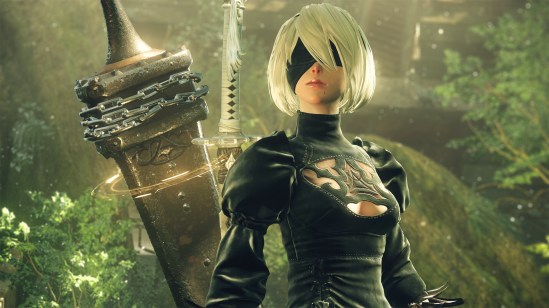
Nier: Automata is not the kind of game I’d normally be into. Character action games don’t usually do a lot for me, and neither do the typical designs and tropes of anime. And while I’ve got some serious reservations about parts of this game, there’s really nothing else I’ve ever played quite like it.
Nier: Automata is a game that takes particular joy in testing the constraints of the conventional video game. From its outset, combat is made up of character action swordplay as well as twin-stick shooter and a bit of bullet hell thrown in. At any point during the hack and slash fights, a button is bound to your floating robot pod’s gun. Hit the button and a continuous stream of gunfire is unleashed at wherever the camera is centered.
As you progress, Nier lets you start messing around with its mod-based upgrade system, which it designates as Plug-In Chips. Each Plug-In chip that provides a buff also comes with a size requirement to apply it. This leads to later game decisions like pulling out the Plug-In chip that allows you to see your own health bar, as well as other various pieces of your taken-for-granted HUD, in order to make room for more damage or healing buffs.
Finally, and where it gets most fascinating, is when Nier starts playing around with narrative and plot structure. The ending of Nier: Automata is merely the end of branch [A] of the story, after which the game switches protagonists and begins branch [B], which is an entirely separate campaign. I didn’t find this particularly exciting however, until I reached branch [C] of the story, at which point Nier: Automata really commits to a lot of the fourth-wall breaking, dark themes, and twisting plot points it had merely hinted at before. As the disparate elements of the game come together, the results are truly a thing to behold.
It’s final sequence, an artistic experiment equal in parts Hideo Kojima and We Are the World music video, is so abstract and out of left field that it shouldn’t quite work. However, it meshes excellently with the rest of the game’s themes about memory, sacrifice, and rebirth, and dammit if I just can’t stop thinking about it. It’s one of the most surreal and frankly bizarre endings to any video game of 2017, and for that, I kind of love it.
No one else is making games quite like Yoko Taro. At the start of the year, I wasn’t even aware of his work. Now, consider me a fan eagerly awaiting his next project.
Life is Strange: Before the Storm – Deck Nine

Life is Strange: Before the Storm probably shouldn’t have worked out. There was a lot working against this game from the start. Not only is it a prequel to the 2015 surprise hit Life is Strange, but it was being helmed by a completely new developer, one which I had personally never heard of before. Then, on top of that, this game was being made during the recent video game voice actor strike, so Ashly Burch was not reprising her role as Chloe Price, who was now being featured as the main protagonist.
Well, consider this déjà vu, because I didn’t expect much from the original Life is Strange back when it was released either, and yet it quickly became one of my absolute favorite games of that year.
Not only is Before the Storm successful in its role as a prequel, it may well be one of the best examples of one in gaming. It reminds me of all the reasons I fell in love with Arcadia Bay and its colorful cast of characters, while deepening my understanding of and attachment to several of them. Chloe Price was already an instantly loveable blue-haired punk rock chick before, but Before the Storm explores her painful history, re-contextualizing her as the series’ most complex and interesting character.
Before the Storm bears an interesting resemblance to David Lynch’s Fire Walk With Me, in that it examines the life of Rachel Amber, Life is Strange’s missing high school student and Laura Palmer analogue. It also largely eschews the supernatural elements of the storytelling in favor of raw empathy. As such, what we’re left with is a remarkably human story about the messiness of youth, about the budding relationship between Chloe and Rachel. This game excellently portrays the magical, not-quite-sober feeling of a teenage crush, and how the strength of that feeling can pull you towards a sort of righteous recklessness, as every other feeling seems unimportant by comparison. That feeling, as well as the melancholy of Chloe’s family situation, is underscored by an absolutely perfect original soundtrack by English indie folk band Daughter. Just like in 2015 with the original game, I’m still listening to Before the Storm’s soundtrack as I write this list. It’s great stuff.
The original Life Is Strange was about that sense of regret, of second-guessing, and about how even the smallest decisions, viewed across time, can become life-altering events. And if we could just go back and say something different, speak up when we were quiet, that maybe, just maybe, we could fix everything.
Before the Storm, by contrast as a prequel, is about the sense that, try as you might, the events of the world point toward a singular conclusion. We might change things along the way -maybe we don’t yell at our mom, maybe we do stick up for the kid being bullied, maybe we share that kiss- but the end result is always the same. Chloe’s dad isn’t coming back. Rachel will go missing and wind up murdered. Step-douche and mom are totally getting together, no question. Like any good tragedy though, Before the Storm is about finding beauty and meaning as it goes. It tells us that our choices in life don’t determine how we shape the ending, but how we tell the story along the way.
Top 10:
10. What Remains of Edith Finch – Giant Sparrow

It’s just a couple hours long, but few games this year are grander in thematic scope than What Remains of Edith Finch. This is just your average, unassuming adventure game about revisiting a big house from your character’s childhood. Where it goes from there, however, is a series of completely unpredictable vignettes of magical realism. It will fill you with wonder, break your heart, and put it back together again along with you.
You play as the titular Edith Finch, named after your grandmother. You begin the game returning home after your mother has passed away. Of your two brothers, one has been missing for years, the other died six years back. Your family are considered cursed by all who know of them. Tragedy always seems to strike each generation. The Finches always seem to die young.
You spend the game being whisked from room to room of the Wes Anderson-esque Finch house, in each learning the story of yet another long-lost family member who met an untimely end. With each diary or piece of memorabilia you encounter, you are transported into that family member’s perspective, playing some moment from their life.
In these vignettes, the game is rich with experimentation, both in gameplay as well as tone. There are kernels of ideas in these sequences that could almost be whole games of their own. There’s one sequence in particular that functions as a poem to escapism, beautiful and heart-wrenching, while simultaneously depicting the evolution of video games throughout the generations. What Remains of Edith Finch is brimming with wonderful moments like this, and it moves through them with a pace not often seen in narrative-focused games. It’s a powerful effect, giving the game a storybook quality that works well for its larger-than-life themes.
At its core, What Remains of Edith Finch is game about exploring grief and loss. It makes the assertion that living itself can, at times, seem like a curse. We often define our life stories by chapter upon chapter of our tragedies, and feebly try to make some sense out of them. It is the human condition that we always fall short of this.
We struggle to find what to do with the empty heartache of loss. Some might seal away the painful memories, like the doors of the Finch house, so as to not be confronted by reminders of the inevitable end. Others, like the Ediths, grandmother and granddaughter, look towards the stories in their totality, forever being written, interspersed with wonder and sadness and beauty and grief.
What Remains of Edith Finch posits that our lives are stories, each with their own individual ends, but each also a part of a grander tapestry of family and lineage. To define the stories only by their ends is our curse as humans, trapped in limited perspectives. But to create new stories, within ourselves and within others, has to be the true point.
For me, What Remains of Edith Finch makes the compelling case for a romantic atheism, of life’s meaning absent ideas of a divine creator or convenient afterlife. It’s subject matter we don’t often see represented in games, or, I might argue, artistic media in general.
It’s a tremendous piece of allegory, one which every player will likely come away feeling a deep personal connection to.
9. Resident Evil 7 – Capcom

The Resident Evil series has ventured so far down the rabbit hole of global conspiracies and biological warfare, of muscle-bound action stars and sunglasses-wearing anime villains, that it’s easy to forget how simple the original game actually was. It took place in a single mansion, and its horror was never about its shambling undead, not really.
Why is it that people still cite the original as the scariest game in the series? It’s because the 1996 classic was all about threats presented in confined spaces. The greatest terror of the original game was that of its doors. Those yawning, slow-opening portals into the next corridor of the unknown. Claustrophobia, resource scarcity, and a single, dimly lit hallway lined with windows were the tension. The zombified dogs that crashed through them were actually the release of that tension. This is the key lesson of horror that the original Resident Evil understood and which subsequent games progressively forgot.
Resident Evil 7 is a eureka moment for the series. It manages to deftly meld new-era survival horror with ideas it once pioneered. It’s the first main-line Resident Evil set in a first person perspective, and also the first to incorporate ideas of stealth gameplay into the mix. And yet, it brings back its core strengths of environment design, resource management, and excellent set-pieces.
That last point is a big one. Sure, I still maintain that Alien: Isolation is probably the scariest horror game I’ve ever played, but I’d be lying if I said that it had many individual moments I can describe back to you. Resident Evil 7, on the other hand, never forgets the value of a thrilling sequence or that visual you just can’t get out of your head. Remember the chainsaw guy in Resident Evil 4? That first big fight in the village square? Of course you do. Resident Evil 7, likewise, is no slouch in the “holy shit moment” department. There’s a half-dozen or so that I’m still thinking about, even now.
Resident Evil 7 also explores some gameplay concepts that I’m not sure I’ve seen elsewhere. These involve VHS tapes that can be found around the game world, which, upon viewing, allow the player to play from that character’s perspective. It’s very found footage movie (try to spot the clear Blair Witch nod early on), and these sequences are used by the game to cleverly foreshadow incoming locations or puzzles. In one particular moment of design brilliance, the player is forced into a deadly puzzle they’ve previously experienced via a VHS tape, and is meant to exploit the knowledge acquired there to break the logic of the puzzle. As the realization of what’s happening dawns on you, it’s immediately satisfying on a deep level.
Sadly, while Resident Evil 7 maps out a vision for future games in the series, it doesn’t take a lot of its concepts as far as I would like them to go. Maybe better to keep me wanting more than not, but the final third of this game wastes a lot of time reaching for the worst tendencies of the series. It’s unfortunate that a game as smartly designed as this still feels it necessary to weave itself back into the bloated lore of the series, offering heightened drama at the expensive of neutering its horror. That said, endings are a genre-wide problem, as a lot of horror games struggle with late-game pacing.
My saddest regret is that 2017 should have been the year when Resident Evil and Silent Hill clinked glasses, finally reunited like old friends after years of hard times. But alas, Silent Hill is still stuck in that bad relationship with its same old publisher. You know, the guy that would rather make money gambling than to give its star series the love she deserves. But I digress…
Resident Evil 7 was a horror experience that I won’t soon forget. It’s a comforting reminder that even a series as seemingly lost as Resident Evil can still find its way home again. It’s a reminder that all that was once the 90s is now gold again.
8. Night in the Woods – Infinite Fall
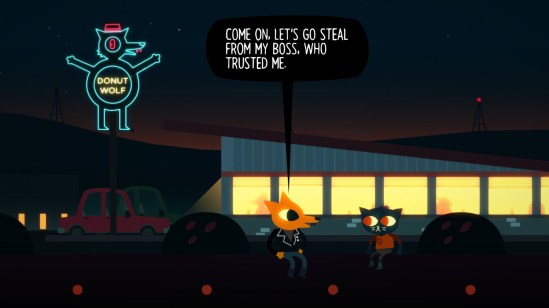
There’s something about being 20. I’m not sure I understand what. Maybe it’s some intersection of college stress and an uncertain, but increasingly looming future. Maybe it’s the last gasps of an adolescence that is now over. Or maybe it’s the sense that everything around you is suddenly different, and how did time get away from you like that? Regardless of why, it was a turbulent age for me, numerous friends, and my family. Likewise, it’s where we find ourselves at the opening of Night in the Woods. Mae Borowsky has dropped out of college at 20 years-old and has returned on a bus to her rural hometown of Possum Springs.
Night in the Woods is an indie adventure game featuring anthropomorphized animals in all the lead roles. For lack of a better way to put it, it’s a “hangout game”. Most in-game days are spent exploring the town of Possum Springs, chatting up residents, and hanging out with Mae’s colorful cast of friends. Sometimes there are crimes.
It’s irresistibly charming and ridiculously quotable, but much to my surprise, it’s also a game about a particular moment in time. Namely, the one we find ourselves in as a country right now, as examined through the prism of its 20 year-old protagonist and small-town setting. It’s an unassuming game that becomes increasingly political as you play, but without ever losing focus of its characters. It never strays into the realm of partisanship or ideological preaching. It’s not top-down political, but rather bottom-up. The people of Possum Springs don’t sit around talking about globalization, offshoring, or corporate consolidation, but they live with the reality of these things. It’s that sense of displacement and of an increasingly distant American Dream that the game captures so well.
On a character level, Night in the Woods is about nostalgia, in all its cozy warmth and bitter ephemerality. It’s old friends and dead malls. It’s TV with dad and a closing sign in the window of the local restaurant. It’s sleeping in your childhood room and the corporate supermarket opening up in town. This game not only arrives a poignant time politically, but also at a time which is incredibly relevant to me personally. I was unprepared at how deeply I would be affected by this game. As someone who was born in the Rust Belt, who still makes trips back home from time to time to visit family, I can say that this game takes that complex feeling I still get, one of being deeply sad and yet overwhelmingly homesick, and expresses it better than I could ever hope to. It’s a game whose art style and charm disarm you, so that when the witty quips fall away, all you’re left with is the raw moment. The gut-punch. And by the time the credits rolled for Night in the Woods, my gut was pretty sore, to say the least.
7. Prey – Arkane Studios
The history of legendary 90s development house Looking Glass Studios is a long and storied one. A litany of major game studios can trace their legacies back to it, including Irrational Games, Ion Storm, and Arkane Studios. System Shock and Thief: The Dark Project are the great granddaddies of a whole, nameless subgenre of modern games. Without their influence on the industry, we wouldn’t have any of the Deus Ex games, the Bioshocks, and certainly not Arkane’s own Dishonored series. Well, this year we got to add Prey to the list. Only question is whether it’s worthy to be mentioned among such titans? It absolutely is.
If Dishonored was a Thief-inspired reimagining of the first person stealth action genre, then Prey is its long-lost System Shock twin. Prey is first person shooter, survival horror, role playing, and stealth game all rolled into one. It has all the trappings, from lonely space station to deadly outbreak. In this case, that’s the alien species known as the Typhon. And that species happens to posses psionic abilities which, guess what, you eventually get access to as well. There’s unreliable narrators and even the quintessential wrench.
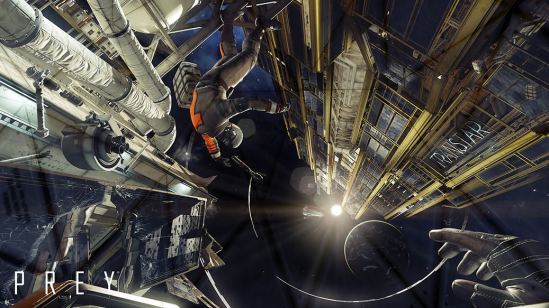
It’s in the specifics, however, that Prey sets itself apart. Items like the GLOO Cannon allow the player to build their own platforms from early in the game, encouraging exploration of vertical space and creating clever shortcuts. Later game Typhon abilities will let you change the way you move through the station, whether that involves creating gravity lifts at your feet or transforming yourself into a coffee cup (really). You can trust that if Prey introduces a gameplay concept, it will commit to it thereafter.
Commitment is the key word here. Prey doesn’t do anything in half-measures. It bothers to sweat the small details, and that’s what makes all the difference, turning Talos I from just your run-of-the-mill space station in a video game, to one of the most complete, believable, and immaculate settings in a game of 2017.
Every member of Talos I’s crew, and that’s dozens and dozens of people, are complete with names, job descriptions, and a tracking device attached to them. Find any of the various security terminals around the station, select a crew member, and bam, you’ll be guided to them, alive or dead. It’s a small thing, but it goes a long way toward turning faceless corpses lining the halls into real people with histories and lives prior to the Typhon outbreak.
Hell, even the set dressing of Talos I, from coffee mugs to sticky notes, have reason for being there. The base enemies of Prey, quasi-crablike alien life forms called Mimics, can disguise themselves as any – and I do mean any – inanimate objects within the game world, springing to life just as you get too close. It’s an awesome horror effect that forces the player into a constant state of paranoia about otherwise easily ignorable objects. Not to mention the way Prey handles its crafting and recycling mechanic, which allows every box, plant, and random bottle of whiskey aboard the station to be broken down into useful resources and repurposed as weapons, med-kits, or even ammunition.
Even though there’s plenty of optional side objectives throughout the game, there’s no fast-travel system in Prey. And it’s all the better for it. The level design wraps around the station in such a way that there’s never just one way to get from place to place, whether it’s through the duct-work cargo tunnels or even outside into the microgravity of space. My biggest issue with Prey is actually that there had to be loading screens at all. Not that they’re particularly egregious in any way. It’s just that, the station feels so intricate and complete, inside and out, that I would have loved to move uninterrupted throughout the whole thing. If that’s not a nitpick, I don’t know what is.
Prey is a game that’s based on a tested formula, but it adds enough great ideas of its own that it transcends being a System Shock clone and instead becomes something truly special. Arkane Studios’ passion for the games of Looking Glass couldn’t be more clear, and in 2017, as more games push further and further into the open world du jour, Prey stands as a confident reminder that player freedom can mean more than presenting a big field and saying “have at it”. We need more games like Prey, with clever level design and a sense of purposeful restraint.
At some point, somebody should really come up with a name for this subgenre. But until they do, we’ll just label Prey what it is: excellent.
6. The Legend of Zelda: Breath of the Wild – Nintendo EPD

Destroy Ganon. There’s beauty to the directness of this quest objective, which flashes in bright, bold text across the screen within the first two hours of Breath of the Wild’s hundred hour journey. It’s refreshing for an open world game to lay its cards on the table in such an up-front manner.
This is the theme of Breath of the Wild. It’s liberating, open world exploration, without all the extraneous filler. It’s The Legend of Zelda, without all the baggage. Ganon, kill him. Zelda, save her. World, explore it. Everything else you need to know, you’ll figure it out as you go.
This game is every bit a Zelda reinvention. All your puzzle solving items, you get them up-front. There are dungeons, but you can approach them in any order. There’s no cutting grass for hearts or reliance on a single sword for the whole game.
The brilliance of Breath of the Wild’s design is in how it rethinks some of the most fundamental design issues with open world games. One of the pitfalls this game so gracefully sidesteps is in how it deals with elevation. Mountains, hills, and rough terrain are great in open world games in that they provide geographic variety, as well as natural landmarks. However, it turns out, game engines don’t like them so much. Anyone familiar with jumping sideways inch by inch up a mountain in Skyrim knows this feeling well.
Breath of the Wild, on the other hand, allows Link to climb virtually any surface from its outset. This means that mountains and hills don’t represent barriers so much as opportunities. Climb to the peak of a mountain, and you can use it as a vantage point to mark new areas you’d like to investigate. Then, from that vantage, you can use Link’s glider to leap from the mountain, floating directly toward your goal. Since Breath of the Wild’s map doesn’t flag everything of note with icons, it’s imperative to seek out elevation to spot new places.
It’s an elegant re-evaluation of how open world traversal can, and perhaps should, work. It puts exploration at the forefront, and ensures that the player’s focus is on where they want to go, not what an icon on a map tells them.
On top of all that, this is the first time Zelda has embraced systems-based gameplay. A significant amount of the puzzles in the game involve manipulating physics to your benefit, using Stasis or Magnesis for example. Or, in areas that are freezing cold, you need to do what you can to keep Link warm. Whether that’s lighting a fire and staying close by, dressing in warmer clothes, eating cold-resisting food, or some combination of the three, that’s up to you. These sorts of dynamic systems make for a Zelda where experimentation and creativity are valued and rewarded far more than simply using the right item.
All that said, this stripping down and retooling of Zelda comes with a cost, one which I’m still a bit conflicted about paying. Oddly enough, I can make a pretty compelling case for why this is one of the best Zelda games ever made, and also why it could be seen as one of the worst. This was and continues to be a divisive game for me. Is it a wonderfully refreshing return to basics for a franchise that desperately needed a shakeup? Or is it a classic game series being submitted to the trends of the day; one more game series to add to the open-world traversing, tower-climbing, item-fetching homogeny that the modern AAA video game has become? What hath Ubisoft’s influence wrought? It’s a Zelda game where large swaths of the world are left purposefully empty. It’s Zelda puzzle-solving with very little ability to build off of itself, since it has to account for the fact that virtually anything can be encountered at any time.
That said, for every argument I have against this game, I have two more for it. For instance, I should hate the Korok seeds. Any game featuring 900 of any collectible should be jettisoned into the cold vacuum of space of space, never to be spoken of again. But not this one. You see, Nintendo uses these collectibles not to artificially lengthen their game and force players into a maddening pixel hunt, but rather for the sensation of discovery they create for the player. In a lot of ways, the Korok seeds are a deconstruction of the video game collectible. Their inclusion does not make the game world seem smaller; they don’t turn the world mundane with chores to deal with. Instead, the world becomes rich with possibilities.
Four statues are holding apples and the fifth has none. What happens if I give it one? There’s a ring of rocks in the water and a stack of rocks on the cliff above. What happens if I play basketball with rocks, flinging them down at the rock-net below? It turns out they produce Korok seeds. With these seeds, Breath of the Wild doesn’t tell the player “here’s a list of shit to do”. Instead, it encourages the player to poke and prod at the game world, to question their surroundings, and above all, not be afraid to experiment.
So, is Breath of the Wild even a Zelda game? Maybe the premise of that question is, itself, the problem. Maybe as much as I’d like to compare this game to an Ocarina, a Wind Waker, or even the great Majora, to do so would miss what it is trying to show me.
See, the beautiful irony of throwing out the traditions of the franchise is that doing so allows Breath of the Wild to be a Zelda game in the purest sense. Without the rote predictability of the boomerang-dungeon-with-boomerang-puzzles-and-a-boomerang-boss dynamic, Breath of the Wild makes room once again for a true sense of discovery, and for that intoxicating feeling that under every unturned stone, anything is possible.
5. Divinity: Original Sin II – Larian Studios

RPGs like to promise lots of things. We’ve all been read the list. “Your choices will matter.” “You can play however YOU want to play.” “Every player will get a unique experience.” We’ve all felt what it’s like to have been sold a promise and to have it fall short. We’ve all been Peter Molyneaux’d at one point or another. By contrast, however, Divinity: Original Sin 2 doesn’t promise you shit. It simply IS the things other RPGs claim to be.
Maybe that sounds a bit hyperbolic, but it’s appropriate here. There’s an effortlessness to the way Original Sin 2 handles all of its dramatic variability. Decisions the player makes in the first hour are still being accounted for by the hundredth. And when they are, it’s not treated like a hat trick by the developers. “Hey! Player! Did you see what we just did?” No, it just does the job it should in that moment. If you’re an undead dwarf, you’re always an undead dwarf. The game doesn’t take the time to show off.
Questlines in Original Sin 2 are more like suggestions, a log of stuff you’ve got going on. The entries, more often than not, are written as past-tense accounts. Not instructions for “go here, do that”. At times, this can be a bit maddening, if you’re a completionist like me. You can worry endlessly whether you’ve missed something. However, once you make peace with the fact that Original Sin 2 isn’t a content tour – you can’t see every iteration of this game, nor should you try – that’s when the beauty of the game really opens up.
This is an RPG that actually wants you to get your hands dirty. Try things. Mess up. Learn from those mistakes.
A fight is about to go down. You might talk yourself out of it if you pass a persuasion check. You might split your party of 4 characters in half, positioning each member of the team just-so so that when blades get drawn, you’re already mid-pounce. Hell, you might even lug a barrel of oil halfway across the map, sneak up behind the guy and drop it, then sling a fireball at it before he can say “I have no fire resistance”.
This sense of freedom even extends to the way the game handles character classes. The typical starter builds, battlemage, knight, cleric, and the like are, again, merely suggestions. Sure, the classic tank/mage/rogue/healer combination works here, and works well. But if there’s a niche in your party to be filled by an archer who summons demons, makes it rain blood, and uses hydrosophist healing spells, pulling from a mishmash of 4 different skill tress, far be it from the game to tell you otherwise.
And let’s be clear here, Original Sin 2 is the rare RPG in which the combat is actually the draw. Sure, I think this game’s overall pacing is uneven at best, molasses-slow at worst. I think the lore and world-building don’t hold a candle to the likes of The Witcher series or the works of Bioware. But when the shit hits the fan and the weapons get drawn, there’s not a single RPG I’d rather be playing.
Take the unflinching brutality of the turn-based XCOM combat and blend it with the ridiculous degree of class flexibility I highlighted above, and holy shit have you got my attention. The fact that the combat even remembers to take into account the world around it, means that each fight is memorable and, again, rewards you for thinking on your feet.
Verticality matters, as having the high ground gives a damage buff to any ranged attacks. Movement matters, so skills like teleportation, phoenix dive, and nether swap are invaluable in a pinch. Positioning matters, so getting your tankiest character in first is important, but so too is where everyone is standing. On top of everything else I’ve mentioned, everything in Original Sin 2 is a considered a surface. Whether that surface is water that can be electrified, blood that can be blessed to restore health, or a poison gas cloud just waiting for the first person to strike a match, any random plot of map can be turned into a noxious deathtrap at a moments notice with the right interaction of skills.
Coming off of playing Original Sin 2 is like waking to find that other RPGs have given you Stockholm Syndrome. It’s liberating in ways I didn’t even realize I was being restricted. It’s not doing anything that’s revolutionary. But if the devil is in the details, then maybe Original Sin 2 is the little pitchfork-carrying dude on your shoulder, whispering, “Who are these game designers to tell you how to play anyway?” It’s revelatory. It reminds you what the original promise of the computer role-playing game was, and still can be.
4. Wolfenstein: The New Colossus – MachineGames
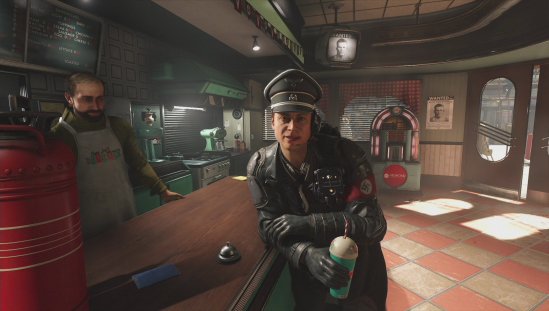
Sit down and strap the fuck in. Wolfenstein is a shot of adrenaline straight to your cold, dead heart. It’s a Ferrari engine redlining. It’s an air horn to the face, waking you from the by-the-numbers trance the average AAA game has you in. Think what you will, but I can promise you that this game won’t let you look away. This is hugely confident storytelling, backed by some of the most shocking moments in games this year, and some seriously satisfying, Nazi-killing combat.
The New Colossus lives and dies by its tone. It can make the jump from uproariously funny to ridiculously badass to existentially bleak and back again in an effortless flow. Sometimes it can be all three in the same scene, at the same time. Most games based on exploitation films simply reach for the low-hanging fruit, going for broke on over-the-top action coupled with absurdism. What sets these Wolfenstein games apart is in the way that they always remember the importance of character. There were numerous moments in The New Colossus that made my jaw drop, and more often than not, it was because of what was happening to the characters first, crazy ass shit second.
Of course, that’s not to suggest that The New Colossus isn’t packed with some seriously crazy ass shit. It most definitely is. I can’t say I’ve played many games where a Bolshevik New Orleanian moonshiner shouts the virtues of proletariat revolution over shots of spirit with the main character, while in the background a woman snipes Nazis out a bell tower window to a clarinetist playing Swing. I can’t say I’ve played a game this year quite as surprising, quite as joyously, confidently weird as The New Colossus.
I’d be remiss not to mention the current events surrounding this game’s release. 2017 was, unfortunately, a year in which the political landscape of the United States toyed with ideas of fascism, tacitly and sometimes explicitly endorsed racist views of nationalism, and blurred a previously much more clear line between American values and Nazism. All that to say that The New Colossus’ rousing speeches against its Nazi oppressors take on a significance that MachineGames couldn’t quite have seen coming. Its effect is transformative though, lending the game a timeliness and urgency almost never seen in video games. Seeing two Klansmen practicing German nervously in front of one of their Nazi occupiers is one of the more chilling moments in a game this year, a disturbing parallel rarely seen depicted so directly in other media.
In the game, this moment is played for laughs, but as I drew the comparison before, any exploitation movie worth its salts smuggles some social commentary along with its blood and gore. It’s no accident, for example, that the horror classic Night of the Living Dead ends the way it does, with a white militia casually gunning down the film’s main character, who happens to be a black man. It’s no coincidence either that The New Colossus casts a black woman, Grace Walker, as your ragtag resistance group’s leader, nor is it a random detail that a central theme of the game involves the pregnancy of Blazkowicz’s wife. If you’re a fan of the way a filmmaker like Quentin Tarantino handles the message in his movies, you’ll appreciate the writing in this game.
The New Colossus is a step up in every respect from 2014’s The New Order. With it, MachineGames solidifies itself as a developer to keep a close eye on. They’ve previously mentioned they’re aiming for a trilogy of these Wolfenstein games, with The New Colossus being its bleak middle chapter. After the whirlwind of insanity that this game was, I’m eager to see what they can pull off in the finale. In fact, I’ll drink to that. Here here.
3. Super Mario Odyssey – Nintendo EPD

I’ve got some seriously fond memories of playing Super Mario 64 as a kid. Hell, I’d imagine the world has some pretty fond memories of playing Mario 64. It’d probably be faster to count the people that don’t. It ushered in the Nintendo 64, and it established a lot of the key ground rules for how to make 3D gaming work, from how to handle the camera to player control to level design. What’s surprising then is that, in the 20+ years since its release, there’s really only been one other 3D Mario in the same open-ended, exploratory style, that being 2002’s Super Mario Sunshine. While I was a big fan of that game, in general, time and the public have not been kind to it.
Of course there were the Wii’s Super Mario Galaxy games, which I also loved, but those were much more linear, level-based Mario games, and not quite the same thing. In the lead-up to the launch of Mario Odyssey, Nintendo themselves acknowledged this, specifically stating that Odyssey would be a follow-up to the 64 and Sunshine approach to level design.
Hallelujah. It might not be everyone’s Mario, but this is MY Mario. The one I grew up with. The experience of playing Super Mario Odyssey was one of a constant giddiness, of a pure delight the likes of which I haven’t felt while playing a game in ages.
One of the most remarkable aspects of Odyssey is its use of space. The level design is effortless; it never feels overwhelming, yet almost no square foot is wasted. The game encourages experimentation and exploration so well in large part because everything is accounted for. Does it look like there might be something down below the edge of this cliff? Would I get something for stacking these Goombas? The answer to these sorts of player questions are met by a constant “yes” from the game designers.
Of course, the central gameplay concept behind Odyssey is the sidekick character that is Cappy, who takes the form of Mario’s signature hat. Cappy can be used as a projectile attack, as a means of assistance during platforming, and – most importantly – as a means of taking control of various enemies. Sling your hat on a bullet bill, and now you’re rocketing through the air as a Mushroom Kingdom warhead. Hit a Cheep Cheep, and bam, who needs that breath meter anyway?
It’s a simple idea, but one that turns every one of Odyssey’s immaculately designed kingdoms into playgrounds replete with opportunities. It might be my favorite gimmick of a 3D Mario game, because it allows Nintendo’s designers to riff, adding small pockets of gameplay here and there that take advantage of a totally different control scheme.
To be reductive, Super Mario Odyssey is a game about collecting things. In this case, that thing is Moons (Stars and Suns already got their due). And while you could dismiss a game like this as simply a “collect-a-thon”, to do so would miss all the rich detail, all the polished-to-a-sheen design, and all the craft behind Nintendo’s ability to elicit raw joy from the player. I’d say more, but if I have to defend the concept of joy to you, maybe I’m wasting my time.
This game is a smiles generator. It makes me happy to play it. I want you to be happy too, dear reader. You should play Super Mario Odyssey.
2. Hellblade: Senua’s Sacrifice – Ninja Theory
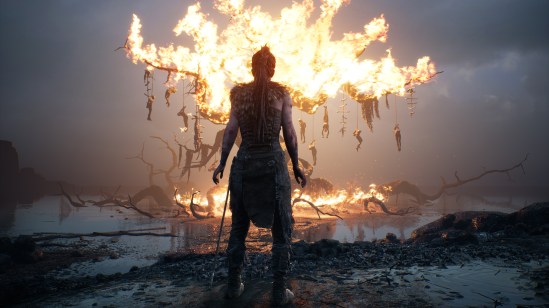
It’s not often I can say that the most visually arresting and technically accomplished game of the year is also one of the year’s most important. It’s not often that we get a game like Hellblade: Senua’s Sacrifice.
Hellblade is one of the most intimate experiences I’ve had playing a video game. Nearly every design decision here is meant to express the psychological state of its protagonist, Senua.
Visually, Ninja Theory brings all its performance capture expertise to bear with a haunting portrayal by Melina Juergens. Extreme close-ups of Senua’s face are commonplace, and they have a transcendent effect rarely, if ever, seen in games. Its more analogous with art house cinema; think the films of Darren Aronofsky. On top of this, the lighting, depth of field, and film grain effects altogether result in a world where every frame is a painting.
From the perspective of sound design, binaural microphones were used to create a 3D soundscape of the voices in Senua’s head. It’s unlike anything I’ve experienced in a game before, at once frightening and sinister on an instinctual, fight-or-flight level. To say that this game should be experienced with a good pair of headphones is an understatement.
Then, there’s the gameplay itself, which, though simple, is portrayed with an intensity that’s difficult not to get swept up in. Combat is made all the more nerve-wracking because of a promise the game makes early on, in which it informs the player that dying too many times will result in “corruption” spreading to Senua’s head and a total game over. Delete-your-save style game over. It’s a simple ultimatum that hangs like a shadow over the rest of the game. It puts the player right inside Senua’s headspace. The onslaughts of enemies become that much more oppressive, the sequences of horror become that much more desperate.
All these concepts result in a singular work that enraptured me throughout. The result is emotionally raw in a way that few pieces of commercial art ever are.
And though the terror represented here is disturbing – it can often chill you to your core – it’s fear represented empathetically rather than exploitatively, as we so often see with depictions of mental illness in other artistic media. We aren’t given a window into Senua’s experience as an excuse for the designers to create whatever inexplicable horror they feel like. Instead, we are given one of the most experiential games ever made. One in which Senua’s terror became my terror, her motivation for venturing deeper into Helheim became my own.
The yet untapped power of video games as a storytelling medium lies in their ability to convey empathy; to literally place the player inside the experience of someone else. I will likely never truly understand what it’s like to live with psychosis, to hear voices in my own head jeer and snarl at me, to hallucinate horrific images, to feel the effects of synesthesia, or to generally have the feeling that my life is not my own, but Hellblade brought me about as close to it as I can say I’d be willing to go. It brought me close enough for my humanity to bridge the remaining divide and make a connection.
Hellblade paves a way forward for video games both artistically and commercially. Going forward, video games need to find a compromise between AAA budgets subsidized by loot boxes and drip-feed dopamine releases, and that of tiny indie teams with full creative freedom but often lacking in technological ambitions. With Hellblade, Ninja Theory maps a course for a future that is vital if the medium is to continue to mature.
Hellblade was the type of harrowing experience that 2017 deserved. This was a year where we got an uncomfortable glimpse of what an empathy-deficient world is truly capable of. Video games certainly aren’t going to fix our problems, but having experienced Hellblade, I got to reclaim a bit of my faith in humanity. As bad as things can sometimes get, this game gave me hope.
1. PlayerUnknown’s Battlegrounds – PUBG Corporation

It’s just the three of us squatted behind one skinny tree, the opposing squad of two crouching behind another, maybe 20 meters away. In any other game, this final encounter would be a joke. But here, it’s pure, forget-to-breathe tense. It’s all come down to this. Us or them. Do or die time.
I ask one of my friends for some quick covering fire as I switch over to my one remaining hand grenade. He leans out from our pitiful cover, carefully as he can, and starts squeezing off rounds, peppering the enemy squad’s bark and wood defense. I bank out to other side and sling the grenade, hoping but not really taking the time to map its trajectory.
“Got one down” my friend states over his headset, followed quickly by “Shit, last guy got me” as he falls to his knees.
Just then, the last enemy standing makes a bolt from his cover, blindly sprinting into the open. There’s the dull thud of my grenade going off. My aim wasn’t perfect, but it was good enough that the guy panicked.
My other friend, the one still standing, steps out from cover, eyes already down his sights. Before I can even say anything, there’s a pop-pop-pop from him. And it’s over. The last enemy goes down in a heap and the game informs us, with an almost sarcastically low-rent victory screen, that we’d earned ourselves a chicken dinner.
The shouts of triumph are almost deafening. Congratulations abound. It’s an awesome moment. One of countless awesome moments that Battlegrounds gave me throughout 2017.
The genius and success of PlayerUnknown’s Battlegrounds is in how well it works, conceptually and in execution. The concept is simple enough that I can explain it to literally anyone. Good luck pointing out the intricacies of an Overwatch match to someone who barely plays games, but if I say “100 players enter, 1 leaves” or “battle royale”, people get the idea – and have a reaction to it – really quick. It’s instantly captivating, and can spark the imagination of just about anyone with a pulse.
Then there’s the execution half, and that’s where Battlegrounds is subtly brilliant. Its two maps of vast, varied terrain are as interesting to explore as they are glorious murder-sandboxes. The first time my squad stumbled upon Erangel’s hidden network of underground bunkers was as thrilling as any moment of discovery in a Bethesda RPG. Every drop into one of Battleground’s maps was an opportunity to see and experience some new piece of it, whether that was the all out clusterfuck that was the prison or the spooky game of cat-and-mouse in what we referred to as the sunken city.
Battlegrounds works so well in large part because of what it doesn’t do. It’s got vehicles, but they’re unarmed, and contrary to most games, actually a vulnerable place to be. It’s got guns on guns on guns, but you won’t find landmines, rocket launchers, or anything as impersonal as a mounted machine gun. Combat in Battlegrounds is, by design, more immediate and straightforward than that. Get a gun, spot the other guy before he spots you, line up and take the shot. It’s not flashy, and that’s precisely the point. Stripping things down to the basics and raising the stakes makes for an experience that’s just as much about mind games as it is about lining up headshots. Why are the doors on that house open? Did that vehicle spawn there or was someone driving it? Were those shots coming from the east or the north? These sorts of minutia are common things to discuss in a squad game of Battlegrounds.
The details, all of them, become matters of life or death, from whether you’re lying prone near that open window to whether you noticed that the game’s ever-shrinking playzone is already closing in while you were distracted gathering ammo. The game will beat these concepts into you, again and again, until you learn. If you don’t, then, well, I hope you enjoy that menu music.
How many games released in 2017 did you play that could make you leap out of your chair, whooping and shouting in triumph? For me, there was just one. Some people called it an early access piece of shit. Some people called it a broken, buggy, laggy mess. Some people called it some Day Z clone. To me and my friends, through a large part of 2017, none of that mattered, not really. To us, it was just PUBG. Why we kept coming back to it, again and again, in spite of the performance issues, network problems, script kiddie cheaters, and wonky physics was because it had gotten its hooks in us, somewhere deep. It captivated us, and much as we complained – and man, did we complain – there was just something about it.
The chicken dinner was my drug of choice in 2017. As rough of a year as it was for me in my personal life, a constant throughout was the compulsion to always return to chase that glorious poultry. There’s just no other experience quite like it.
 defectivepixeltest