2015 was an incredible year for games. One of the best in quite a long time, in my opinion. As such, I want to dive straight into the list. Only a couple things up front:
- I chose three honorable mentions and then the proper top ten list.
- Each game features a link to one of my favorite pieces of music from their respective soundtracks for your listening.
- There were a number of games that I didn’t have the time and/or ability to get to. These are games that very likely could have made this list, had I played them. This year, they are:
Super Mario Maker
Splatoon
Axiom Verge
- While I try to avoid outright spoilers when possible in this Top 10 list, I still need to actually talk about some of these games, what makes them unique, and even some of the themes that run through them. If you want to play any games on this list completely blind, I suggest not reading my reasoning for their spot on the list.
Now, that being said, let’s move on…
Honorable mentions:
Ori and the Blind Forest – Moon Studios
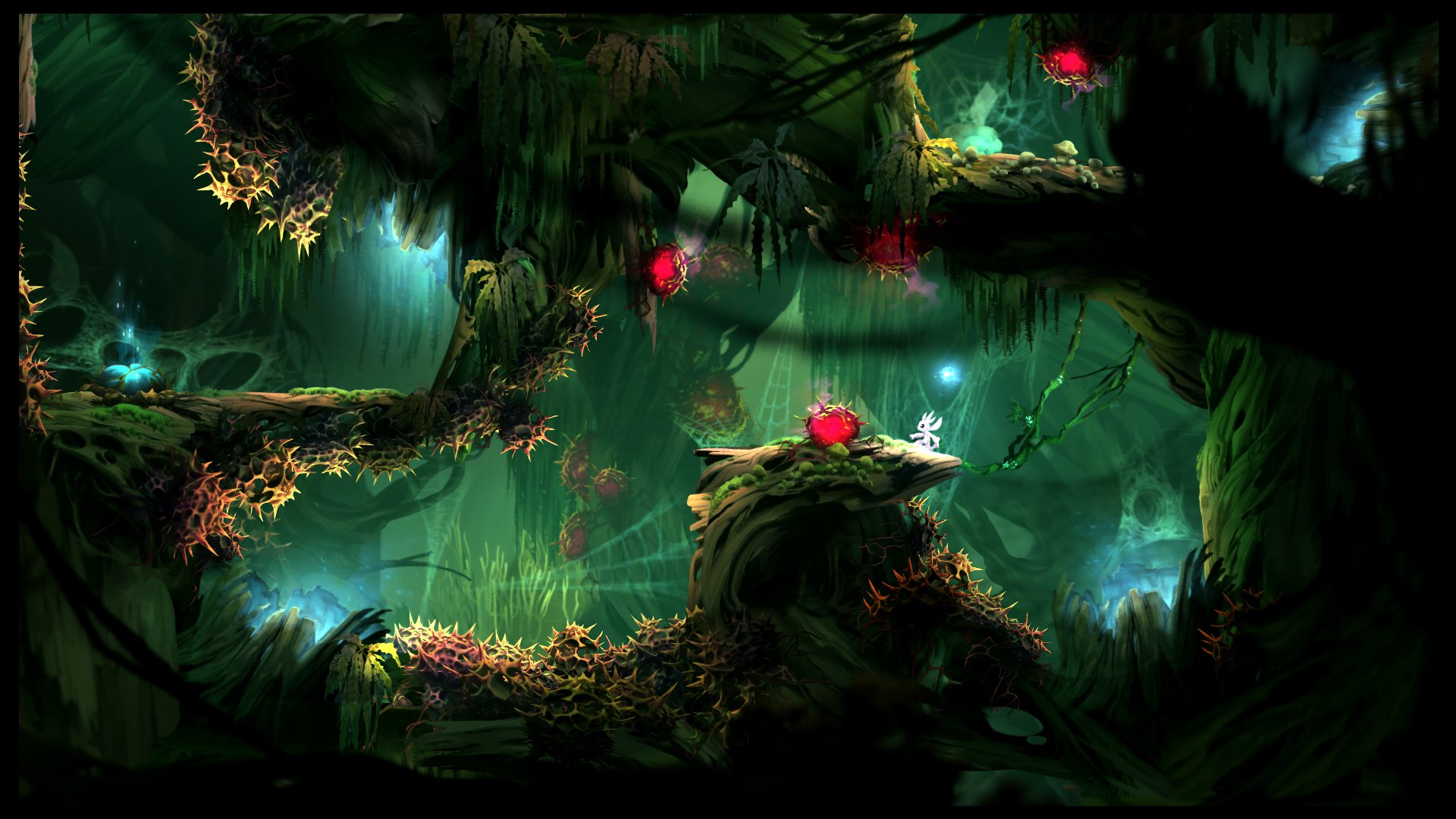
If there’s one thing to be said about Ori and the Blind Forest, it’s that it defies expectation. Don’t let its gorgeous art design and swooning score fool you, this is actually an immaculately designed Metroidvania that controls like a dream and will challenge the ever-loving hell out of you. I must have attempted that first escape sequence a hundred times, cursing my way through the entire thing. But when I finally made a successful run? Bliss.
Rise of the Tomb Raider – Crystal Dynamics

Of all the surprises in 2015, perhaps none was as personally shocking to me as how much I enjoyed Rise of the Tomb Raider. While 2013’s Tomb Raider reboot worked for some, I harbored a fairly significant resentment toward it. To me, it was horribly careless, a blunderbuss blast of a game which was trying really, really hard to be all things to all people, and not doing any one thing particularly well. That desperation frequently surfaced in the game’s awkward narrative, which presented a grand ambition for the Lara Croft character but only timidly inched toward it between woefully out-of-place third-rate Uncharted sequences.
But where that game struggled to find an identity, Rise of the Tomb Raider is shockingly confident. It relies much less on combat, instead turning its emphasis on exploring wider, open environments that make use of vertical space. Unlike its predecessor, it isn’t afraid of having longer stretches of quiet moments, with less overreliance on scripted moments. I also admire it for its commitment to a singular locale, as it significantly adds to that sense of excitement when you stumble across new places. And though we could make some qualms about “graphics don’t matter”, fuck that, because Rise of the Tomb Raider is drop-dead gorgeous, Xbox One hardware limitations be damned. And the experience of leaping, shooting, and raiding your way through its Siberian expanses is all the richer for it.
Now that it’s found its footing with the franchise, I’m excited to see what Crystal Dynamics does with Lara next.
Cibele – Star Maid Games

A lot of what’s been said about Cibele is how much of it is an autobiographical expression of its author, Nina Freeman, and how deeply personal it feels and how much it nails that culture of being deep into an MMORPG. And though all of that is certainly true, I find that those takeaways don’t quite give Cibele enough credit. For anyone who’s ever experienced the awkwardness of an online relationship, and all the timid flirting that eventually gives way to lusting, cringe-worthy conversation, this game is going to hit very close to home. There’s a lot to unpack in Cibele: about how first loves are often the most informative, about how the slow, almost tantric pace of online relationships can feel so exciting and then deflate so suddenly – as Cibele’s less-than-satisfying ending attempts to mirror, or even what it’s like to be a woman in a world of internet relationships. It’s the intense intimacy in Cibele, however, of everything right down to Nina actually playing herself in the game, that allows it to say so much in its brief 90-minute playtime. It’s in the game’s naked discomfort that we can find something of ourselves.
Top 10 List:
10. Her Story – Sam Barlow

You’ve never played a game like Her Story before. It is far and away the most unique game on this list. It’s a story-driven game in which all you do is watch police interrogations of a mysterious woman. The catch? The entire interview has been broken down into small clips, and all of the dialog in these scenes has been transcribed. To watch the story unfold, the player must type in search terms for the dialog in the clips.
This system, of querying a database as a means of unspooling a narrative yarn, might seem rigidly artificial, but the beauty of this game is how organically it allows the game to reveal itself. Watch a clip in which a mirror is mentioned? Your next search query should likely be “mirror”. Who the hell is Eve? Type “Eve”. But you don’t have to. You can go off on entire tangents unrelated to what you know, instead trying to “solve” the game by typing things like “murder” or “killed”. Or even entertain the part of your brain that runs to “sex”, or “affair”. This is a narrative that is wholly non-linear, told in such a manner that every discovery feels directly attributed to your actions as the player.
While Her Story doesn’t contain some incredible story that I simply had to know the answers to, the way it tells it was irresistible. It is unique to the medium of video games in a way that is powerful in its simplicity. It actually made me break out a pen and paper to start taking notes, as if I were role-playing a detective. If that doesn’t tell you what makes Her Story so special, I don’t know what will.
9. The Beginner’s Guide – Everything Unlimited Ltd.

I feel about the events catalogued in The Beginner’s Guide much the same way as I felt about the 2010 Banksy “documentary” Exit Through the Gift Shop. That is to say, I’m not too interested in debating whether it’s describing actual events or not. In fact, if the narrative of The Beginnger’s Guide is pure fabrication, constructed as a kind of fourth-wall breaking reality by way of authorial expression, then that makes it a hell of a lot more interesting creatively.
I didn’t expect to connect with The Beginner’s Guide on nearly as deep a level as I did going into it. It’s so absurdly unassuming in its first few minutes that I could have sworn it it was going nowhere. But it plants this troubling little seed of an idea in your head early on, and with each bite-sized level that passes, that seed grows into something a little more disturbing.
In part, what makes The Beginner’s Guide so disturbing is how uncomfortably personal it feels. The game worlds seem so intimately linked to their designer that to walk through them has this grotesquely voyeuristic vibe about it.
To that end, The Beginner’s Guide has the feeling of watching a slow-motion car crash. Once it has you, looking away is impossible, but it’s hard not to feel like you shouldn’t be witnessing any of it.
For anyone who’s ever felt compelled to create something, this game will force you to ask some uncomfortable questions of yourself. It’s existential in a very raw way, the game itself becoming increasingly panicked and desperate as it progresses. In a way, it is a deconstruction of the creative process, and the troubling ways in which anxiety and depression can both fuel it and be fueled by it. It also asks questions of why we create, whether compelled by self-expression or as a means of receiving affirmation, and what those creative works tell us about their creators.
Few games have left me in such an introspective state as The Beginner’s Guide. Your mileage will certainly vary here, but for me, this is a game I couldn’t stop thinking about.
8. Bloodborne – FromSoftware

The Souls games have been on my pile of shame for years now. They were these games that a great many people whose opinions I respect recommended wholeheartedly, but something about them just never quite reached out and grabbed me. With Bloodborne, FromSoftware left behind the low fantasy medieval setting, instead opting for a Gothic Victorian city with clear influence from authors such as H.P. Lovecraft. And it is this very design change that finally sucked me in.
Bloodborne is a character-action game with all the fat trimmed out. It’s not flashy, nor does it pack in mechanics simply for the sake of doing so. It is a game entirely about finesse, about the satisfaction of understanding some fairly basic rules and then executing them with near-machine levels of efficiency. Is there a lot of trial-and-error built into the design here? Of course. But as frustrating, as – excuse the pun – soul crushing as Bloodborne can be, I never felt slighted by it. That is not only because death is an integral part of the design – giving players a second chance to retrieve their Blood Echoes (EXP) at no penalty – but also because the game gives you all the tools for success up front. As angry as I sometimes got with Bloodborne, I realized that I was always angry at myself for failing to execute a plan that I had in my head. The difficulty of Bloodborne is less about guessing what solution the developers had in mind, and more about creating your own plan of attack, and actualizing that vision. There isn’t really a “wrong” way to play it.
And that’s a very important distinction that makes the Bloodborne gameplay loop, as it were, so deeply satisfying. There’s a continual sense of progression, but unlike many modern games, that progression isn’t guaranteed for simply putting in the time. Because of that, every victory feels earned, even when you figure out how to cheese the AI and bypass an entire section. Plus, the level design here is unlike just about any game out there right now, with crisscrossing corridors intersecting and trailing back off into their own unique areas before looping back around and reconnecting.
It’s these aspects of Bloodborne that made it so tough to put down, and that kept me coming back to a game that I should have found needlessly drawn-out and punishing, but instead found endlessly fascinating and effortlessly cool.
So, alright Hidetaka Miyazaki, you sinister bastard you, I’m on board with your crazy-ass games. Here’s to what’s next.
7. Rocket League – Psyonix
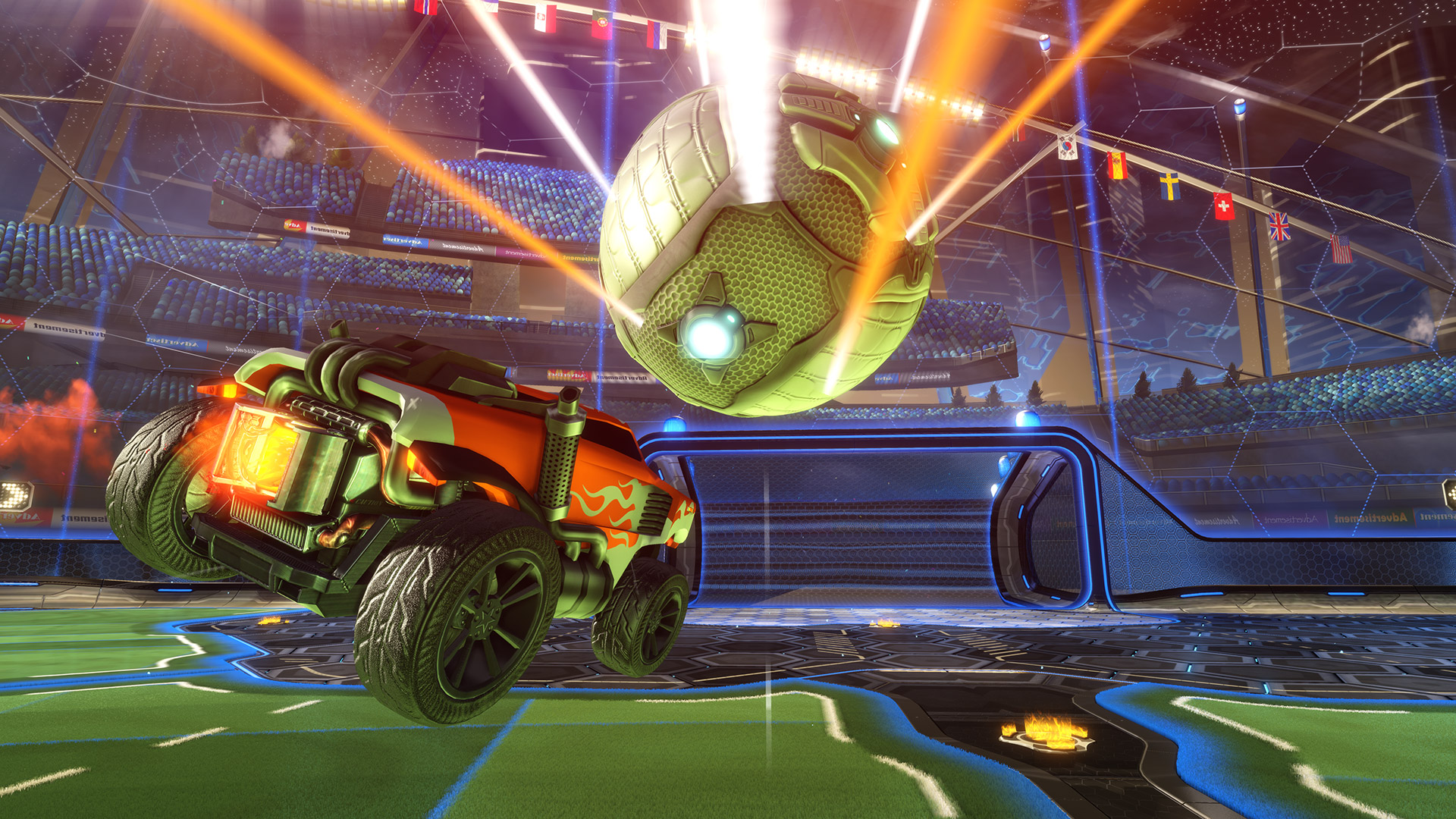
What does a minimalist multiplayer game with dead-simple controls but layers and layers of ingenious depth look like? Well, if you guessed a bunch of rocket-fueled RC cars hurdling headlong down a grass field and slamming into an enormous soccer ball, then congrats, my friend, you were likely a part of the indie game zeitgeist that was Rocket League.
Rocket League is the most immediately satisfying game on this entire list. It’s instantaneous to pick up but mastering it is no small order. In many ways, it is the perfect sports game. There are no mechanics beyond what you’ll encounter in your first match. Beyond that, it’s all technique, cooperation, and execution. And the simplest things, like the explosive blowback when a goal is scored, are so ridiculously satisfying – or totally crushing – that your hundredth goal will feel just as triumphant as your first.
This is one of the best Nintendo games that Nintendo didn’t develop. There’s such an obvious attention to detail and a faith that, if you get the basics right, the game won’t need extra modes or mechanics to make it feel complete. If sheer joy is the reason you come to video games, well then I’ve got your game of the fucking year right here.
6. Until Dawn – Supermassive Games

Holy shit.
When talking about Supermassive Games’ Until Dawn, that’s pretty much where you have to start. This is a game that came completely out of nowhere, from a studio whose most notable prior work was a critically-panned Doctor Who game released in 2012. Not only is this one of the best looking games of the entire year (how the hell is this running on a PS4???), it’s also one of the scariest games I’ve ever played.
Until Dawn draws its inspiration from an amalgam of teen slasher films, and wearing that influence on its sleeve benefits it in some seriously clever ways. For starters, unlike other narrative-focused decision-driven games that allow their main characters to be killed off in key moments, it doesn’t feel like punishment for the player in Until Dawn. A huge part of the slasher genre is that characters are meant to die in ways that the audience doesn’t see coming. Hell, sometimes the best characters are the ones to be met with an early grave. And because of that expectation, Until Dawn is able to make good on its threatening nature, and frequently. This stands in contrast to something like Heavy Rain, where you have to screw up pretty badly to actually get a character killed.
In addition to that, Until Dawn provides a system of prophetic totems that foretell future decision points. These serve an insidious dual-purpose for the game: they both prepare the player for critical decision moments while simultaneously keeping the information vague enough as to instill a sense of paranoia. In my own playthrough I actually had a character die because I was psyched-out by one of the totems I had acquired. I believe that was a very intentional part of the design. And because of those previously mentioned genre tropes, that didn’t feel cheap or frustrating so much as scary and fucking cool.
For fans of horror, be that in film or games, Until Dawn is an absolute must-play. It tinkers with genre conventions in such a way that it feels designed for maximum enjoyment by terror junkies. Not only that, but the game is absolutely worth replaying a second or even third time. Out of the cast of 8 playable characters, each one of them can survive to the end, meet a terrible end, or any combination in between.
Supermassive Games really blew my mind with Until Dawn. They built a game that I had always wanted but never quite realized, and they did it with such a clear sense of joy. This is horror as pure entertainment, the kind that feels you with eager excitement, even as it sends chills down your spine. I can’t wait to replay it.
5. Fallout 4 – Bethesda Game Studios
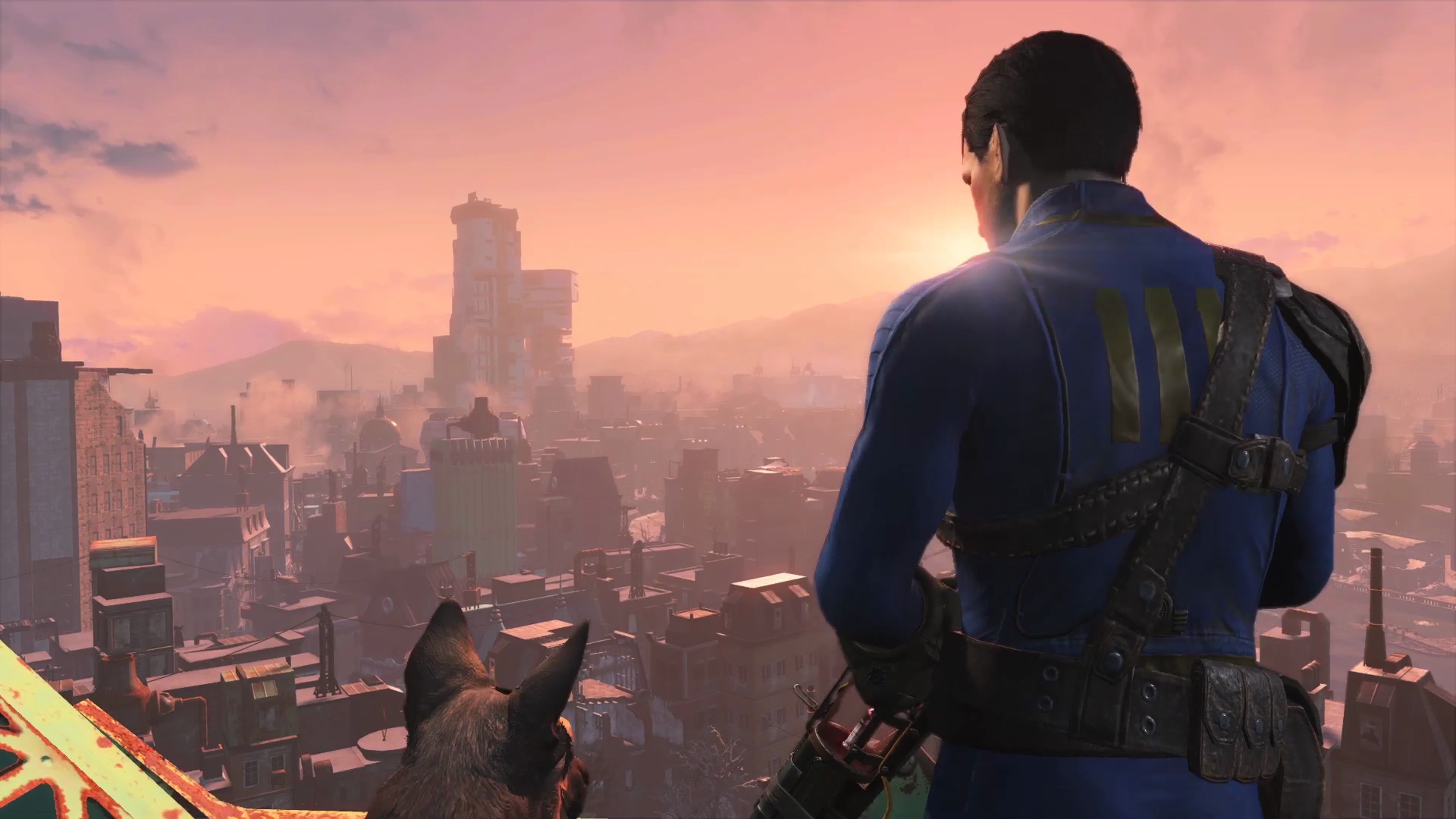
Fallout 4 was a weird game for me. It was likely the most anticipated game of 2015 for a lot of people, especially because of an E3 demo showing off lots of base-building and defense mechanics that felt very Minecraft-y. That demo left me feeling unsure as to how well any of it would integrate within the final game. Then the game launched, and my uncertainty was proven to be pretty well-founded. That entire system feels bolted on to the existing Fallout formula, in a way that almost works, but still doesn’t make a strong enough case for itself.
But fuck all that. Because behind these new, surface-level features is quite possibly the most well-realized game world Bethesda has ever created for one of their mammoth RPGs. The Commonwealth Wasteland, centered around the remnants of Boston, Massachusetts, is expansive, varied, complex, and positively loaded with character. To explore it is to absorb it. And the art design is so good and so extensive, I barely noticed when the game would recycle textures or geometry. All that technical thought just fades away into a sense of pure immersion and admiration for Bethesda’s world-building, which is more cohesive and imaginative here than it’s ever been.
At the end of the day, that’s the best way to describe Fallout 4. This is a sequel more about refinement than some ambitious new take. The shooting, previously lamented for its rigidity and awkwardness, now feels great, so much so that the V.A.T.S. mechanic feels entirely optional. Sifting through junk for supplies is also far more interesting this time around, since literally every object in the game can be used for something, be it crafting a weapon mod or an electrical generator for a settlement. The narrative is more dynamic, integrating well with its various faction questlines, as well as featuring better characters. The skill system has been gutted, albeit in a smart way that allows for greater experimentation. Even radiation has been radically changed, to the point where now it feels incredibly dangerous.
What this means is that on paper, Fallout 4 might sound a bit disappointing. It’s iterative rather than innovative, and that’s not something people have come to expect of Bethesda. But it’s the overall, cumulative effect of all of these changes that make all the difference. The moment-to-moment role-playing of Fallout 4 is unlike anything else out there right now. Once it had sunk its claws in me, the Commonwealth wasteland had me never wanting to leave it.
4. Soma – Frictional Games
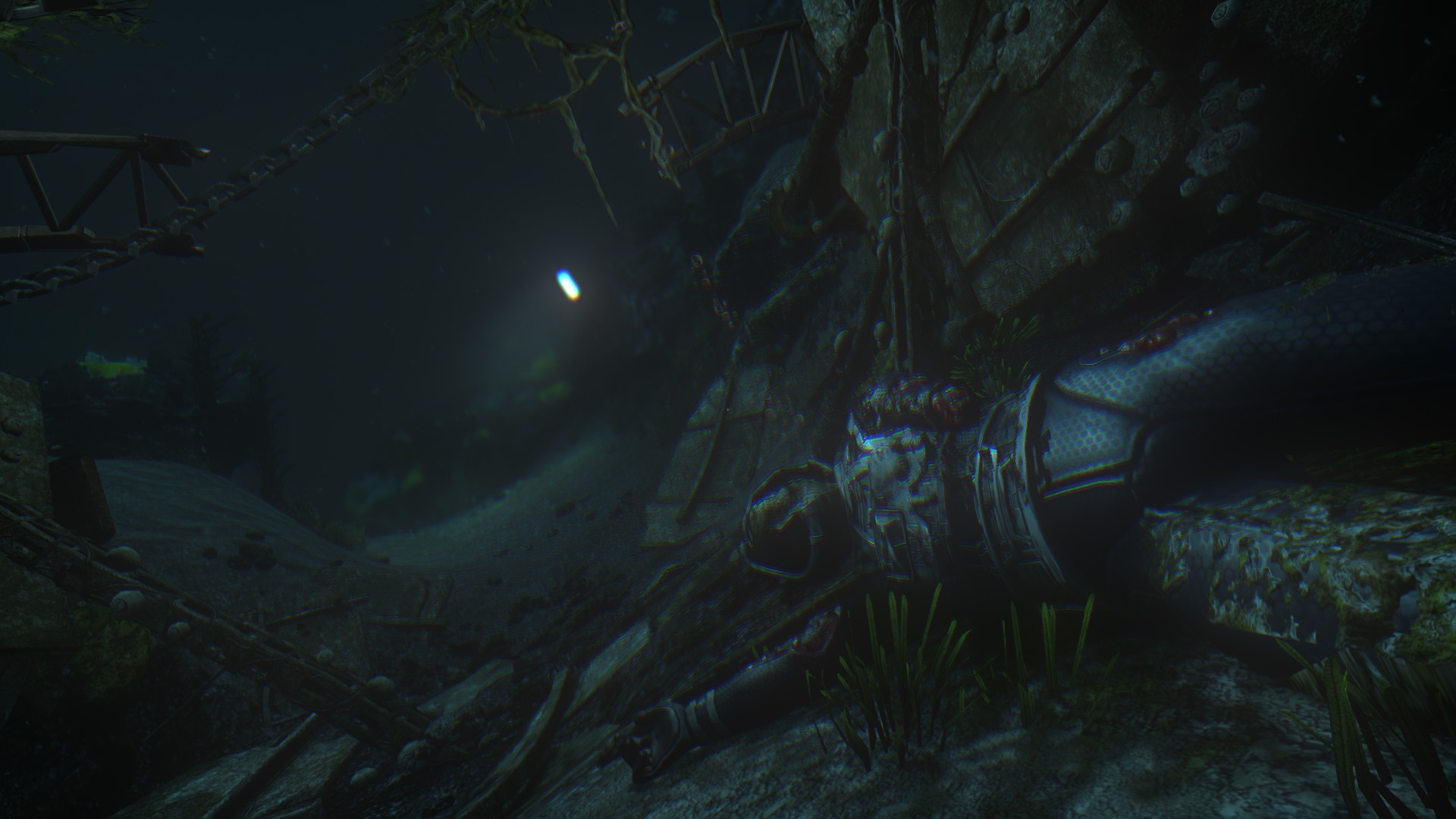
Soma is not the game that Twitch streamers are going to go nuts over, or that people are going to be creating over-the-top reaction videos of. There are scarier games out there, including developer Frictional Games previous title, Amnesia: The Dark Descent. Soma’s instead focused on the kind of horror that sticks around in your psyche, even after you turn it off.
As the title implies, Soma is a game about the self, and about deconstructing the troubling notion that the “self” might simply be an amalgamation of data. In this world, what value does a body hold other than as a mechanism to store brain data? Is the stream of consciousness a necessary part of human existence? What happens when that stream reaches a schism, in which two copies of the same brain are made? These are the sorts of existential quandaries that Soma wrestles with, all amidst the backdrop of an underwater research center where things have gone very, very wrong.
Soma is phenomenally paced for a horror title; it consistently one-ups itself as it progresses, all the while using its oceanic setting to create naturalistic break points for the player. And each one of the shambling, biosynthetic monsters throughout are a slightly different spin on the core enemy type, meaning each new zone of the research lab promises some new, unseen terror. Not to mention the puzzle designs, which reveal themselves naturalistically and strengthen the central ideas of the game, rather than seeming like extraneous playtime filler.
There are times when it stumbles, such as its awkward and occasionally immersion-breaking dialog, but when all of the disparate elements of Soma’s horror formula collide just-so, it results in some of the most deeply effective moments of any horror game I’ve ever played. By the time it had cut to black, Soma had rendered me speechless. It had taken my mind to some intensely dark places, and its final subversion of expectations had insured that I wouldn’t be forgetting it any time soon, much as I might want to.
The implications of that ending are super fucked, guys.
3. Metal Gear Solid V: The Phantom Pain – Kojima Productions
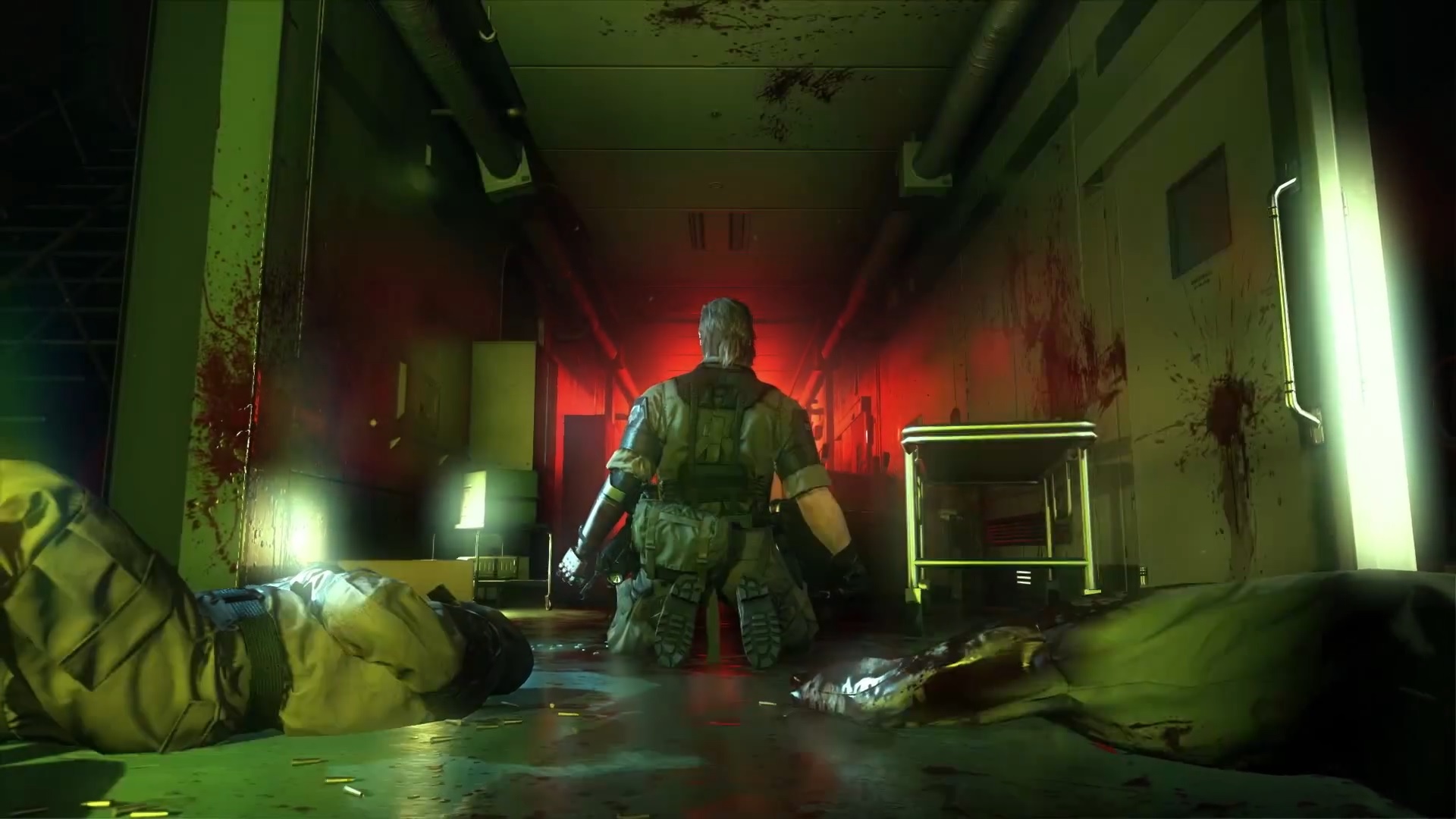
Hideo Kojima’s swan song with the Metal Gear Solid series is nothing like what I thought it would be. For a studio like Kojima Productions to go from developing highly linear, narrative-driven games to an open-world sandbox like The Phantom Pain was already impressive in and of itself. But the fact that The Phantom Pain is one of the most complex, rewarding, and flexible stealth sandboxes ever designed makes this game’s creation seem like an almost impossible feat.
The Phantom Pain is a game that functions on two main levels. The first is in the immediacy of its stealth gameplay, which has been streamlined into a thing of beauty. I’m still a little shocked that the team who once used the PS2’s analog face buttons managed to create a game that controls this well, but hey, they’re nothing if not full of surprises.
A lot of games like to tout how many options they give their players to approach a given scenario. Phantom Pain laughs those games out of the room. Just about anything the player can imagine doing, the game supports. From dog throat-slitting to APC-Fultoning, this is a game that really does encourage its players to try anything and everything. Just experimenting with what the game systems have allowed for provides for near-endless entertainment.
Not only this, but the gameplay feedback loop of Phantom Pain is phenomenal. While not unique in its density of systems (certain Assassin’s Creed games have certainly had comparable amounts), Phantom Pain remains unmatched in the masterful way it integrates them all together. The clockwork interaction of the base-building, soldier recruitment, and the core stealth-action mechanics each feeding into one another succeeds on a level that most games only like to think that they do. In a game as mechanically dense as this, none of these things should work half as well as they do, and yet, each one of these potentially disparate systems is a crucial part of the overall experience.
As awesome as The Phantom Pain is, I’d be remiss not to mention that it can be pretty hard to forgive at times. I can’t tell you how much I hated the boss battles in the last few missions of this game, or how tired I got of watching that damn helicopter take off, or how much the structure of the game falls to pieces in its back half. But for each one of its pain points, Metal Gear Solid V delivers a plethora of tremendous highs. Some of the best moments of the year are showcased here, like the sniper standoff with Quiet, scrambling for cover the first time Metal Gear Sahelanthropus appears, that wicked-dark mindfuck of an opening in the hospital, not to mention the dozens of amazing moments that’ll emerge from simply experimenting with the sandbox (and specifically boxes of the cardboard variety).
Believe me when I say that this game, like all Kojima games, is worth dealing with the bullshit. Because even when he throws out just about everything you thought you knew about Metal Gear games, he still manages to make something joyous and wholly unique. I’d like to say that Metal Gear Solid V is Kojima’s love letter – his signing off – to his fans, but the thing that makes this game so damn interesting is that that isn’t the case at all. Love him or hate him, he’s one of gaming’s true auteurs, and he leaves behind his signature series doing what he always has: the last thing you’d expect.
2. Life is Strange – Dontnod Entertainment

Life is Strange has more heart than anything else on this list. It is one of the most earnest, passionate games I’ve ever played. It handles its characters with total sincerity, and manages to be an emotional roller-coaster without ever feeling manipulative. It’s a choice-driven adventure game by way of the new-era Telltale formula, but applied to subject matter that we’ve almost never seen dealt with in games. Put simply, I adore this game.
Life is Strange takes the idea of reloading a save to experience every outcome and turns that into a gameplay mechanic. Rather than asking players to make split-second decisions about what to do, the game encourages its players to weigh each option carefully, before moving on and committing to a decision. This removes a lot of the frustration contained in choice-based games, when what the player means to say or have happen isn’t always born out. The drama here instead becomes centered around the long-term consequences of player actions. Oftentimes, players might have to endure a short term decision that is painful to make because the alternative could lead to an exponentially worse future.
What Life is Strange does so wonderfully across its five-episode structure is undergo a slow but deliberate transformation from hipster high school drama into something much more powerful. This is a game that tackles some heavy social issues, but you wouldn’t know it from its humble beginnings. And that’s why the darkest moments of Life is Strange land with such tremendous force. One moment, you’re having a simple conversation with the sad girl who gets bullied at school, the next, you’re witnessing a cry for help about a sexual assault and being asked for advice about what to do. It’s staggering in its gravitas, and it forces its players to do some serious introspection they might not be prepared for. And let’s be clear here, none of this is handled tastelessly or included simply for shock value. Instead, the ugliest moments of Life is Strange are crucial to the story, and are handled with a sense of care rarely, if ever, seen in video games.
Of course, none of this would work were it not for the astounding characters in the game. Life is Strange is about the central relationship between Max Caulfield and Chloe Price, childhood friends who reunite after almost a decade apart. Their moments together are irresistibly charming, and wonderfully awkward in all the ways that teenage friendships can be. Few characters in games get arcs so fully developed as Max and Chloe do. And there are moments between them in the final two episodes that are some of the most emotional I’ve ever experienced in gaming. **
And yet, in spite of all the time traveling and visions of apocalyptic cyclones, Life is Strange is a relatable story. As a very unexpected character points out, it’s a story set at the moment of a loss of innocence. At its core, it’s about the millions of what-ifs, the should-I-haves, the could-have-beens, all spiraling on and on into infinity. It’s a narrative filled with the very adult emotion of regret, and its ending is a beautiful and gut-wrenching choice about whether or not to allow a character to let go.
Or, at least, that’s what my ending was about. And it felt so totally perfect in the moment, I never bothered going back to see the alternative. In a game about continually reaching back into the past to see what might have been, finally making peace for once felt like the right thing to do.
1. The Witcher 3: Wild Hunt – CD Projekt RED
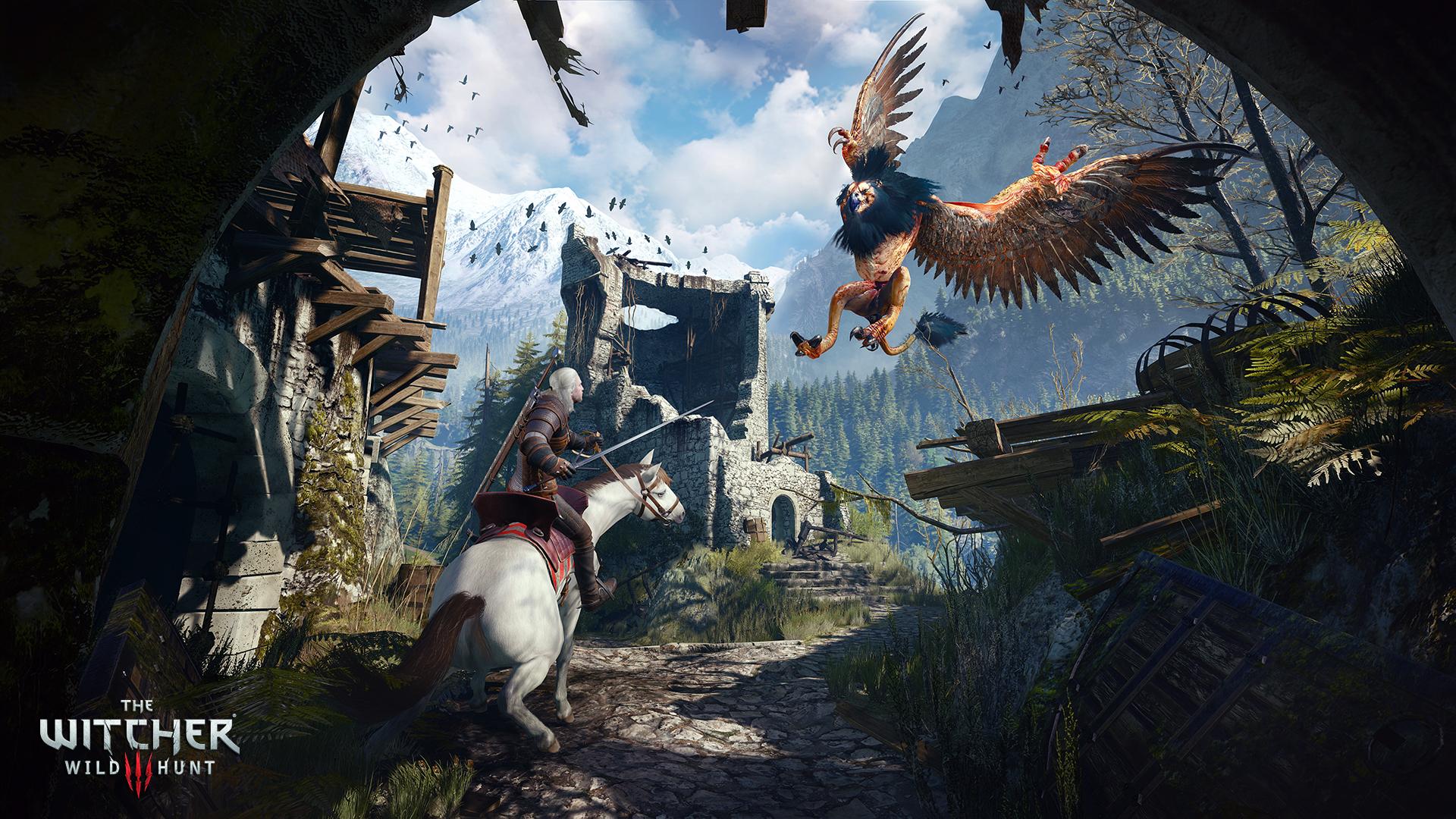
If you’re exceedingly lucky, every few years, a game will come around that can remind you, with childlike wonder, why you fell in love with video games to begin with. The last time I distinctly remember getting that feeling was playing through Mass Effect 2 for the first time. For me, that was a game that was just firing on all cylinders, rich with creative energy and a towering confidence. It felt revelatory and inspiring at the time. And though I don’t consciously think about it, a game hasn’t quite given me that same feeling since.
And then I played The Witcher 3: Wild Hunt. And holy shit. All those descriptors I used before? Apply them here. And then some. And then a few more still.
Right off the bat, Wild Hunt is fascinating in its structure. Quests naturalistically begin and end, sometimes branching off into entirely separate subplots. Quests that begin as unsuspecting postings on a settlement’s notice board can spiral off into a chance meeting with a major character, while others still scatter the breadcrumbs of a generic RPG scenario that then lead into a fascinating deconstruction of that very concept. There were many times during Wild Hunt that I couldn’t tell if the quest I was on was part of the main story without checking the quest log; the level of quality was so consistent across-the-board. The overall effect of this is that the world of Wild Hunt is one of the richest and most compelling I’ve ever experienced, fostering a thrilling sense that anything could happen at any time.
But in spite of its truly massive scale, it’s the smallest details of Wild Hunt that allow it to truly transcend being just another gigantic swords and spells RPG. And while, yes, Wild Hunt’s story builds to a climactic battle for the fate of the world, it doesn’t even reach that point until over halfway through. Here, the encroaching threat of apocalyptic doom that so commonly dominates the narrative arcs of modern video games is relegated to an ominous background, and the focus instead becomes the game’s diverse cast of characters.
When I think back to my favorite moments of Wild Hunt, rarely do I think about some big boss battle or awesome piece of armor I crafted (though that stuff is definitely solid), but rather, I think of getting piss drunk with Lambert and Eskel in Kaer Morhen, which had me laughing out loud the whole way through its escalation. Or the fairy tale dinner with Kira Metz, which was not only an interesting insight into her character, but also one of the few instances of a game scene being legitimately sexy that I can recall. And, of course, there are the final scenes of the Bloody Baron’s questline, which is bleak, uncomfortable, and complicated in all the ways that the world of The Witcher is. That stuff in particular is some of best storytelling of the entire year. No matter which decisions the player makes, the end results are all differing forms of heartbreaking tragedy.
It’s these sorts of moments that sum up what an enormous achievement this game is. As truly colossal of a world as CD Projekt RED built, they don’t do it at the sacrifice of specificity. There are dozens upon dozens of small character moments in The Witcher 3 handled with more care than some games can muster across their entire experience. Even within that massive world itself, the whole thing really does feel immaculately hand-crafted, from the architecture of Novigrad to the naturalistic progression of the landscape as you proceed south.
There’s a small moment in Wild Hunt that stood out to me as emblematic of why I love this game so much. Early on, when Geralt arrives in Novigrad, he runs into a pair of men badgering an elf woman. It’s a classic scene of overt racism, familiar to any who’ve played a Bioware RPG. The player is then given the option of whether to intervene or not. If the player chooses to help the elf though, and convince the humans to leave, they are met with hostility rather than gratitude. The elf woman is quick to point out to Geralt – and by extension, the player – that he only did what he did to make himself feel noble, and that a simple action like that will do nothing to end her persecution. And she’s right, obviously. She must continue living in this world, even after this brief interaction. Nothing has changed, and the game makes a point to remind the player of that.
In this way, and in numerous situations like it, The Witcher makes the distinction between player agency and players being able to bend the world or its characters to their will. The former it allows, the latter, it never does. That’s because the world of the Witcher is bigger than Geralt, bigger than the player, and while your influence over it matters, it is not so malleable as to be transformed into exactly what you want.
That’s a lesson that Wild Hunt had to hammer into my brain, so deeply ingrained was my RPG-player urge to find the “good” outcome of a quest. At the end of the day, CD Projekt RED makes games that respect their players as adults. Simultaneously, the worlds of their games demand that same amount of respect back from the player.
Each time I’ve done these lists, the game I pick as my favorite of the year has been one that forced me to re-evaluate something about video games as a whole, either what they are or what they’re still capable of. The Witcher 3 was that revelatory moment of 2015 for me. And craziest of all, it did so as a fantasy RPG, a genre that’s been a part of my life for years. That it managed to breathe so much life and energy back into that genre is exactly why it earns its spot at the top of this list.
 defectivepixeltest